
Interactive Circle of Fifths
Integrate the Circle of Fifths into your DAW for real-time harmonic analysis and chord progression generation.
Visit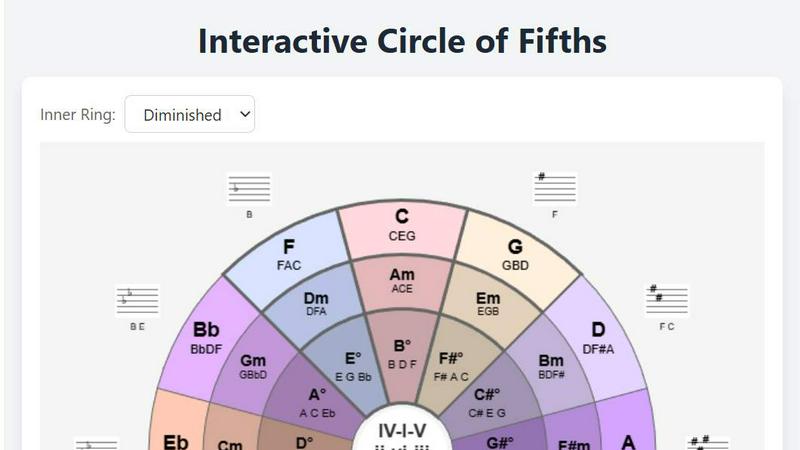
About Interactive Circle of Fifths
The Interactive Circle of Fifths is a sophisticated, web-based educational platform engineered for musicians, producers, and educators. It functions as a dynamic, real-time music theory visualization and auditory tool, designed to demystify the complex relationships between keys, chords, and scales. Built for seamless integration into modern digital music workflows, it caters to users across the proficiency spectrum—from beginners grasping foundational concepts to advanced composers exploring sophisticated harmonic progressions. Its core value proposition lies in translating abstract music theory into an interactive, multi-sensory experience. By providing immediate visual feedback and corresponding audio playback, the tool bridges the gap between theoretical knowledge and practical application. The platform's architecture supports dual-instrument visualization for piano and guitar, ensuring broad compatibility with common learning and performance setups. It serves as a centralized hub for exploring major, minor, and diminished chords, alongside a comprehensive library of scales including pentatonic, blues, diatonic, and harmonized scales, making it an indispensable, always-accessible resource for serious musical study and creativity.
Features of Interactive Circle of Fifths
Dynamic Multi-Scale Visualization Engine
This feature powers the central interactive diagram, allowing users to dynamically switch between viewing the Circle of Fifths for different musical scales. With a simple interface toggle, musicians can visualize the structure and relationships for Pentatonic, Blues, Diatonic, and Diminished scales. The engine updates chord positions and relationships in real-time, providing a clear, color-coded map of harmonic function and scale degrees, which is essential for understanding modal interchange and advanced composition techniques.
Integrated Chord Sequencer & Harmonized Scale Panel
The tool includes a built-in chord sequencer linked directly to the harmonized scale panel. Users can select a root key (e.g., C) and instantly see the corresponding diatonic chords (C, Dm, Em, F, G, Am, B°) alongside their Roman numeral functions (I, ii, iii, IV, V, vi, vii°). This integration allows for the direct auditioning of chord progressions and an understanding of their functional resolution, effectively acting as a sandbox for testing songwriting ideas and understanding cadences.
Dual-Instrument Fretboard & Keyboard Integration
For maximum utility and compatibility, the platform features synchronized visual layouts for both piano keyboard and guitar fretboard. When a user selects a chord or scale, the tool displays the precise notes and fingerings on both instruments simultaneously. This cross-compatibility feature is invaluable for multi-instrumentalists, educators teaching diverse students, and for translating musical ideas between different instrumental contexts seamlessly.
Analytical Function & Resolution Mapping
Beyond basic visualization, this feature provides deep analytical insights. For any selected chord, it displays its "Scale Degree" and suggests what it "Resolves To" within the key's harmonic framework. This transforms the tool from a passive reference into an active theory guide, helping users understand tension and release, dominant-to-tonic movements, and the logical flow of chord progressions in real-time, which is critical for improvisation and analysis.
Use Cases of Interactive Circle of Fifths
Music Theory Education & Classroom Integration
Educators can integrate this web-based tool directly into their curriculum, using it as a live demonstration platform during lessons. Its interactive nature allows for instant exploration of concepts like the relationship between relative majors and minors, chord construction, and scale modes, making abstract theory tangible and engaging for students in both in-person and remote learning environments.
Songwriting & Chord Progression Development
Songwriters and composers can use the Chord Sequencer and harmonized scale panel to break out of creative blocks. By experimenting with different diatonic and non-diatonic chords suggested by the Circle, users can quickly audition novel progressions, understand their functional harmony, and export these ideas to their preferred Digital Audio Workstation (DAW) for further development.
Instrument-Specific Practice & Transcription
Guitarists and pianists can utilize the dual-instrument display for targeted practice. A guitarist learning piano theory can see how the chords they know on the fretboard map onto the keyboard, and vice versa. This is also perfect for transcribing music, as identifying a song's key on the Circle immediately reveals the likely chords used, accelerating the learning process.
Improvisation & Solo Construction
Improvisers can select a backing track's key and then use the tool to visualize all available scales (e.g., major, pentatonic, blues) that fit over the harmony. The clear overlay of scale notes on the fretboard/keyboard, combined with the "Resolves To" function for chords, provides a roadmap for crafting melodically and harmonically coherent solos in real-time.
Frequently Asked Questions
What instruments is the Interactive Circle of Fifths compatible with?
The tool is primarily designed as a visual and theoretical aid compatible with all instruments. However, it provides specific, integrated fingering diagrams for two of the most common instruments: piano (keyboard) and guitar (fretboard). This allows users of these instruments to directly apply the theoretical concepts to their physical playing, making the learning process highly practical and immediately applicable.
Can I use this tool to help me write music in non-standard keys?
Absolutely. The core functionality of the Interactive Circle of Fifths is not limited to common keys. You can select any root note as your tonal center. The engine will dynamically recalculate and display all corresponding chords, scale degrees, and harmonized scales for that key, whether it's C major, F# minor, or any other, providing full flexibility for composition in any key signature.
How does the "Resolves To" function work?
The "Resolves To" function is an analytical feature based on Western music theory conventions. It indicates the typical harmonic tendency of a chord within a given key. For example, the dominant chord (V) strongly "resolves to" the tonic (I). This feature helps users understand cadences and the natural directional flow of harmony, which is fundamental for creating satisfying progressions and for analytical study.
Is there an audio output feature to hear the chords and scales?
Yes, a core component of the tool is its integrated audio engine. When you click on any chord or scale within the interface, it generates a clear, synthesized audio playback of that musical element. This auditory feedback is crucial for connecting visual theory with sound, reinforcing learning, and enabling users to train their ears alongside their theoretical understanding.
Explore more in this category:
Similar to Interactive Circle of Fifths

Learn languages with real movie and TV show clips.

Audio to Video AI generation for podcasts, narration, voice recordings, and music

Melodank turns your memories and special occasions into unique German or English songs you can preview and share as digital gifts.


Turn Long YouTube Videos into Quick AI Summaries in Seconds.

AI Image Remover is a free browser tool for erasing people and objects from photos. Upload an image, brush a mask over the distraction


VideoAny is an AI studio for generating uncensored videos, images, and audio from text or photos with models like Seedance and Wan.