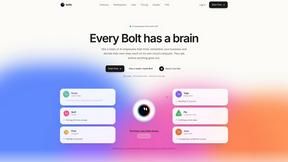
Bolts
AI employees with a brain and their own cloud computer. They think, remember your business and work 24/7.

AI employees with a brain and their own cloud computer. They think, remember your business and work 24/7.

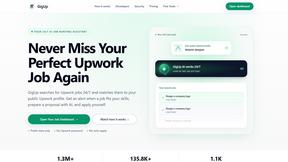
GigUp helps freelancers discover relevant Upwork jobs through AI matching, automated monitoring, and instant alerts.
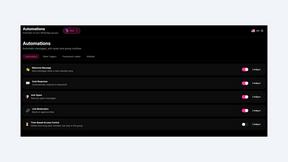
WhatsApp group bot for moderation, automation and reports: welcomes, anti-spam, link filtering, scheduling, RSS, live alerts, API and MCP.
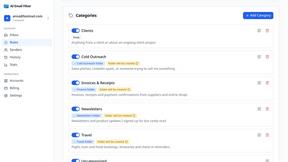
AI Email Filter sorts incoming mail into folders using plain-language prompts you write. Works with any IMAP mailbox; bring your own LLM if you want.
A curated directory of SaaS growth tools. Every listing is screened and scored before it goes live — no pay-to-rank, no filler.
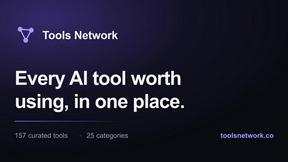
Tools Network is a curated directory that brings the internet's best AI tools together in one organized, easy-to-navigate place.

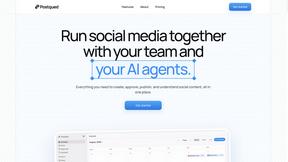
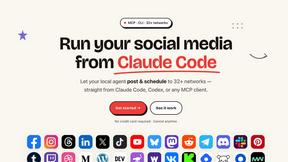
Schedule and publish social content across 10 platforms with one dashboard, API, and MCP built for teams and AI agents.
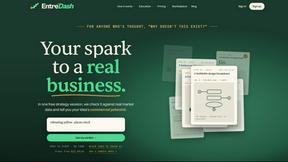
Turn daily annoyances and raw ideas into inventions, products, and businesses. EntreDash provides a virual personal advisory board using AI automation

AI Image Remover is a free browser tool for erasing people and objects from photos. Upload an image, brush a mask over the distraction
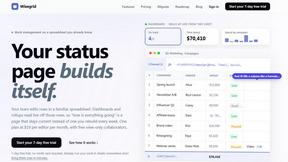
Spreadsheet-native work management with AI formulas, dashboards, automation, reporting, and project views for growing teams.

Turn table photos and screenshots into editable Excel files with Photo to Excel. Merge images, remove duplicates, preview, download free.
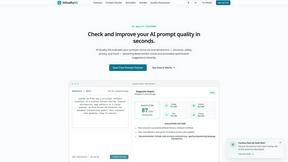
AIQualityHQ is a free browser-based tool that instantly checks your AI prompts for structure, safety, privacy, and accuracy with zero server tracking.
Tuning Engines is a unified AI control and governance layer, operating within the automation and orchestration category. It is designed for teams building production intelligence by providing a single platform to manage the entire AI lifecycle—from inference and model routing to fine-tuning, evaluations, and agent integration. Users commonly look for alternatives due to specific pricing models that may not align with their budget, a desire for more granular feature sets in niche areas like specialized agent frameworks, or platform needs that require lighter-weight deployment or different cloud-native integrations. When evaluating an alternative, it is critical to assess compatibility with existing AI workflows and APIs, such as OpenAI or Anthropic standards, as well as the depth of governance controls—including role-based access, audit trails, and policy-as-code capabilities. The ideal replacement should offer robust scalability, observable runtime traces, and seamless integration with coding agents and toolchains to ensure a smooth transition without sacrificing production oversight. Another key consideration when exploring alternatives is the breadth of the ecosystem they support. A strong substitute must provide extensible support for multiple model providers, MCP servers, and agent frameworks while maintaining a unified interface for team collaboration and cost tracking. Look for solutions that offer clear documentation for CLI workflows, resource catalogs, and tenant isolation to match the operational rigor of a governed AI operating layer. Ultimately, the right choice will balance feature parity with the specific technical requirements of your organization, ensuring that you retain the ability to train, evaluate, route, and govern models at scale without hidden complexity.
Tuning Engines is a unified AI control and governance layer that acts as an orchestrator for production intelligence. It brings together the full AI lifecycle—including inference, model routing, fine-tuning, evaluations, agents, and guardrails—into a single governed platform. The platform provides OpenAI-compatible APIs, Anthropic-compatible routes, and CLI workflows for developers, while offering admins role-based access, per-key budgets, and auditability.
Tuning Engines is built for development teams and organizations that need to move beyond isolated AI experiments into a secure, observable, and cost-aware production environment. It serves developers who want to connect coding agents like Claude Code, Cursor, and Continue.dev through a single governed platform. It also targets admins and platform engineers who require controls such as tenant isolation, usage analytics, and policy-as-code for managing AI workloads at scale.
Key features include a unified orchestrator for inference, model routing, fallback policies, and fine-tuning jobs, as well as comprehensive governance tools like role-based access, per-key budgets, rate limits, and guardrails. The platform supports MCP servers, reusable skills, AGT YAML policies, runtime traces, and integration with tools like OpenCode, Aider, and Windsurf. It also includes data capture, usage analytics, billing controls, and a resource catalog for models, agents, and tools.
Yes, Tuning Engines is designed with security and governance as core pillars for production deployments. It provides role-based access control, per-key budgets, rate limits, credential sources, and tenant isolation to ensure secure operations. The platform also offers auditability through usage traces, runtime traces, and policy-as-code enforcement, making it suitable for organizations that require strict compliance and oversight over their AI workloads.