
Agent to Agent Testing Platform vs QuickImg
Side-by-side comparison to help you choose the right product.

Agent to Agent Testing Platform
Validate AI agent behavior across chat, voice, and phone systems to detect risks and ensure compliance seamlessly.
Last updated: February 27, 2026
QuickImg
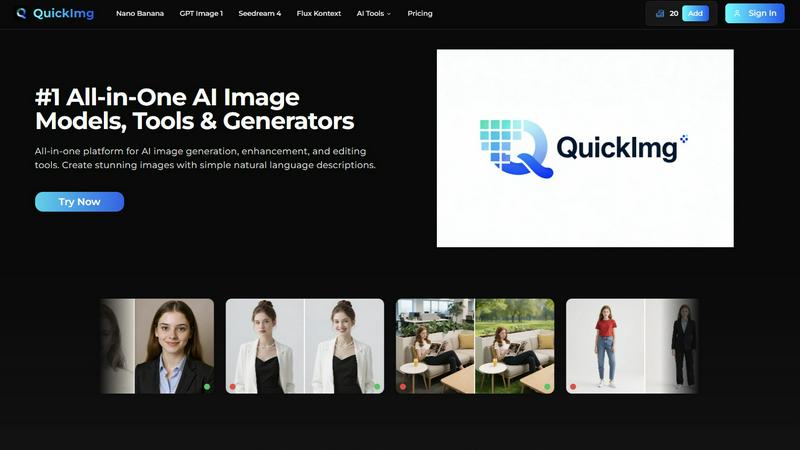
QuickImg integrates top AI image models and editing tools into one unified platform for seamless creative workflows.
Last updated: February 28, 2026
Visual Comparison
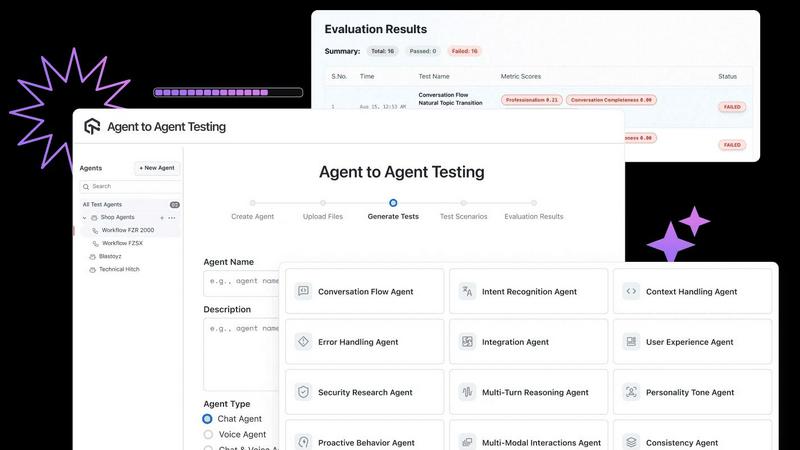
Agent to Agent Testing Platform
QuickImg
Feature Comparison
Agent to Agent Testing Platform
Automated Scenario Generation
The platform offers automated scenario generation capabilities that create diverse and realistic test cases for AI agents. This includes simulating various interaction formats such as chat, voice, and phone calls, allowing for an extensive evaluation of the agent's performance across different contexts and user scenarios.
True Multi-Modal Understanding
Agent to Agent Testing Platform supports true multi-modal understanding by allowing users to define detailed requirements or upload Product Requirement Documents (PRDs) that include varied inputs such as images, audio, and video. This feature enables a more thorough assessment of how AI agents respond in genuine real-world situations.
Autonomous Test Scenario Generation
With access to a library of hundreds of pre-built scenarios, users can also create custom test cases tailored to specific AI behaviors. This functionality includes testing agents' personality tones, data privacy compliance, and intent recognition, thus providing a comprehensive evaluation of the agents under various conditions.
Regression Testing with Risk Scoring
The platform facilitates robust regression testing by providing insights into risk scoring for the AI agents being evaluated. This feature highlights potential areas of concern, enabling teams to prioritize critical issues, thereby optimizing testing efforts and ensuring the stability and reliability of AI systems.
QuickImg
Unified Multi-Model AI Platform
QuickImg provides centralized access to a curated suite of leading AI image models, including Nano Banana Pro, GPT Image 1, and Seedream 4. This integration allows users to select the optimal model for specific tasks—such as text rendering, 4K output, or character consistency—without switching between different applications or APIs. The platform handles backend compatibility, offering a consistent interface that simplifies workflow and ensures you always use the most effective tool for your project's requirements.
Advanced Natural Language Image Generation
The platform's intuitive engine interprets simple natural language descriptions to generate detailed, high-quality images. This feature removes the barrier of crafting intricate, technical prompts, making professional-grade image creation accessible to users of all skill levels. You can describe a scene, concept, or style in plain English, and QuickImg's integrated AI models will render the visual, streamlining the ideation-to-creation process for rapid content development.
Comprehensive AI-Powered Editing Tools
Beyond generation, QuickImg includes a full suite of one-click editing tools designed for technical precision and compatibility with standard formats. Features like AI Background Changer, PNG Maker, AI Image Upscaler, and Watermark Remover allow for non-destructive, high-fidelity edits. These tools are built to integrate results seamlessly into existing design stacks, supporting workflows that require clean, transparent, or high-resolution assets for web, print, or social media.
Ready-to-Use Templates and Batch Processing
QuickImg offers a library of pre-designed templates for common scenarios like product photos, social media banners, and marketing materials, enabling rapid deployment and brand consistency. Furthermore, its architecture supports efficient batch processing capabilities, allowing users to apply enhancements, upscaling, or formatting changes across multiple images simultaneously. This is crucial for teams managing large content libraries who need to optimize visuals at scale while maintaining technical quality.
Use Cases
Agent to Agent Testing Platform
Quality Assurance for Chatbots
Enterprises can leverage the platform to ensure that their chatbots deliver accurate and effective responses in a variety of scenarios. This quality assurance process ensures that chatbots maintain high levels of user satisfaction and engagement.
Voice Assistant Evaluation
Organizations can utilize the Agent to Agent Testing Platform to rigorously test voice assistants across different accents and languages, ensuring that they understand and respond accurately to diverse user inquiries while maintaining a natural conversational flow.
Compliance and Ethical Testing
Businesses can perform compliance checks on their AI agents to identify and mitigate risks associated with bias and toxicity. This use case is crucial for maintaining ethical standards and ensuring that AI technologies serve diverse user groups without discrimination.
Performance Optimization for Phone Agents
The platform allows for the testing of phone agents in simulated environments that mimic real-world interactions. This use case is essential for optimizing the performance of voice calling agents, ensuring they exhibit professionalism and empathy during customer interactions.
QuickImg
Social Media Content Creation and Management
Marketing teams and social media managers can leverage QuickImg to rapidly produce a high volume of engaging, platform-specific visuals. Using natural language, they can generate unique images for posts, stories, and ads, then instantly edit them with tools for background removal, text overlay, and style conversion (e.g., Photo to Anime). This streamlines the content calendar pipeline and ensures brand visuals remain fresh and consistent across all channels.
E-commerce Product Image Optimization
E-commerce businesses can use QuickImg to enhance and standardize product photography at scale. The AI Image Upscaler improves thumbnail resolution, the Change Background Color tool creates uniform white or contextual backgrounds, and the PNG Maker generates transparent cutouts for catalogs. This creates a professional, cohesive storefront appearance and improves product presentation without extensive manual photo editing.
Concept Art and Character Design for Projects
Game developers, authors, and concept artists can utilize the AI Character Generator and models like Flux Kontext to visualize characters, avatars, and scenes with consistent styling. By describing character attributes, settings, or moods, they can quickly iterate on visual concepts, generate reference artwork, and maintain character consistency across multiple images, accelerating the pre-production and brainstorming phases of creative projects.
Professional Graphic Design and Asset Preparation
Graphic designers can integrate QuickImg into their workflow to expedite asset creation and modification. The platform assists in generating base artwork, removing unwanted elements or watermarks from stock imagery, upscaling low-res assets for print, and converting file formats. This compatibility-focused toolset acts as a powerful supplement to traditional design software, handling tedious tasks and freeing up time for high-level creative work.
Overview
About Agent to Agent Testing Platform
Agent to Agent Testing Platform is a revolutionary AI-native quality assurance framework specifically designed for validating the performance of AI agents in diverse real-world environments. As artificial intelligence systems evolve towards greater autonomy and complexity, traditional quality assurance (QA) methodologies, which were primarily developed for static software, become inadequate. This platform transcends basic prompt-level evaluations by offering comprehensive insights into multi-turn conversations, encompassing chat, voice, phone, and multimodal interactions. It empowers enterprises to effectively assess and validate the behavior of AI agents before deploying them in production. By introducing a dedicated assurance layer that utilizes advanced multi-agent test generation, the platform can identify long-tail failures, edge cases, and nuanced interaction patterns that are often overlooked by manual testing methods. With the capability to simulate thousands of realistic interactions, organizations can ensure their AI agents meet high standards of accuracy, reliability, and performance, addressing critical metrics such as bias, toxicity, and hallucinations.
About QuickImg
QuickImg is a comprehensive, multi-model AI image generation and editing platform engineered for seamless integration into modern digital workflows. It consolidates access to cutting-edge AI models like Nano Banana, GPT Image 1, Seedream 4, and Flux Kontext within a single, unified interface, eliminating the need to manage multiple disparate services. The platform's core value proposition lies in its tech-stack oriented design, which prioritizes compatibility and ease of use for both developers and creative professionals. By leveraging natural language processing, QuickImg democratizes advanced image creation, allowing users to generate, upscale, edit, and enhance visuals through simple descriptive prompts rather than complex technical commands. This makes it an indispensable tool for graphic designers, content creators, social media managers, and marketing teams who require high-volume, high-quality visual content that integrates smoothly with existing design software and publishing pipelines. QuickImg functions as an all-in-one solution, streamlining the entire image production lifecycle from initial concept to final, polished asset, thereby significantly boosting productivity and creative output.
Frequently Asked Questions
Agent to Agent Testing Platform FAQ
What is Agent to Agent Testing Platform designed for?
The Agent to Agent Testing Platform is designed to validate AI agents in real-world environments, ensuring their performance across various interaction scenarios, including chat, voice, and phone calls.
How does the platform help in identifying long-tail failures?
The platform employs a dedicated assurance layer that uses multi-agent test generation to uncover long-tail failures and edge cases that traditional testing methods may miss, ensuring a comprehensive evaluation of AI behavior.
Can I create custom test scenarios?
Yes, users have the ability to create custom test scenarios tailored to their specific AI requirements, in addition to accessing a library of pre-built scenarios for comprehensive testing.
How does the platform ensure compliance with ethical standards?
The platform helps identify potential biases and toxicity in AI agents through automated scenario generation and detailed analytics, allowing organizations to address compliance and ethical considerations effectively.
QuickImg FAQ
What AI models are integrated into QuickImg?
QuickImg integrates several state-of-the-art AI models to cater to different needs. This includes Google's Nano Banana Pro for advanced text rendering and high-resolution output, OpenAI's GPT Image 1 for superior multimodal understanding, ByteDance's Seedream 4 for ultra-fast 4K image generation, and Flux Kontext for precise editing with character consistency. This multi-model approach ensures you have the right tool for any specific image task.
Do I need technical expertise to write effective prompts?
No, technical expertise is not required. QuickImg is specifically designed with an intuitive natural language processing interface. You can generate and edit images using simple, descriptive sentences about what you want to create or change. The platform interprets everyday language, eliminating the complexity of traditional, parameter-heavy AI prompting systems.
How does QuickImg ensure the quality and resolution of output images?
QuickImg leverages advanced AI models like Seedream 4 and Nano Banana Pro that are engineered for high-fidelity output, supporting up to 4K resolution. Additionally, the dedicated AI Image Upscaler tool can enhance the resolution of existing images while preserving detail and quality. The platform is built to deliver production-ready visuals suitable for both digital displays and professional print media.
Can I use QuickImg for commercial purposes?
Yes, images generated and edited using QuickImg are typically intended for commercial use, including in marketing materials, digital content, and products. However, users should review the specific licensing terms and conditions provided by QuickImg to ensure compliance, particularly regarding the use of AI-generated content for their specific commercial applications and distribution channels.
Alternatives
Agent to Agent Testing Platform Alternatives
The Agent to Agent Testing Platform is a pioneering AI-native quality assurance framework designed to validate the behavior of AI agents across various modalities, including chat, voice, and phone interactions. As organizations increasingly adopt AI systems, they often seek alternatives due to concerns over pricing, feature sets, or specific platform compatibility requirements. Choosing an alternative involves evaluating the ability to conduct comprehensive testing, ensuring robust integration with existing systems, and verifying that the solution can scale to match the demands of real-world scenarios.
QuickImg Alternatives
QuickImg is a comprehensive AI image generation and editing platform within the AI Assistants category. It leverages models like Nano Banana and GPT Image 1 to transform text descriptions into visuals, offering an all-in-one suite for creation, enhancement, and editing. Users often explore alternatives for various technical and operational reasons. This can include seeking different pricing structures, specific feature sets like API availability or unique AI models, or better compatibility with their existing tech stack and workflow tools such as CMS platforms or design software. When evaluating an alternative, key considerations should be its core AI model capabilities and output quality, the depth of its editing toolkit, and its integration potential. Assess how well it connects with your current applications, its scalability for team or project use, and the overall developer or user experience it provides within your operational environment.