
Agent to Agent Testing Platform vs AI Agents Marketplace
Side-by-side comparison to help you choose the right product.

Agent to Agent Testing Platform
Validate AI agent behavior across chat, voice, and phone systems to detect risks and ensure compliance seamlessly.
Last updated: February 27, 2026

AI Agents Marketplace
Deploy pre-built AI agents that integrate seamlessly with your existing tech stack.
Last updated: March 1, 2026
Visual Comparison
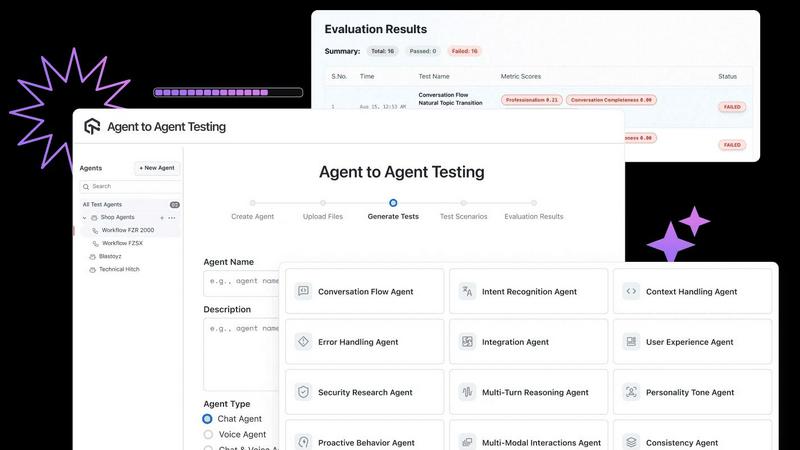
Agent to Agent Testing Platform
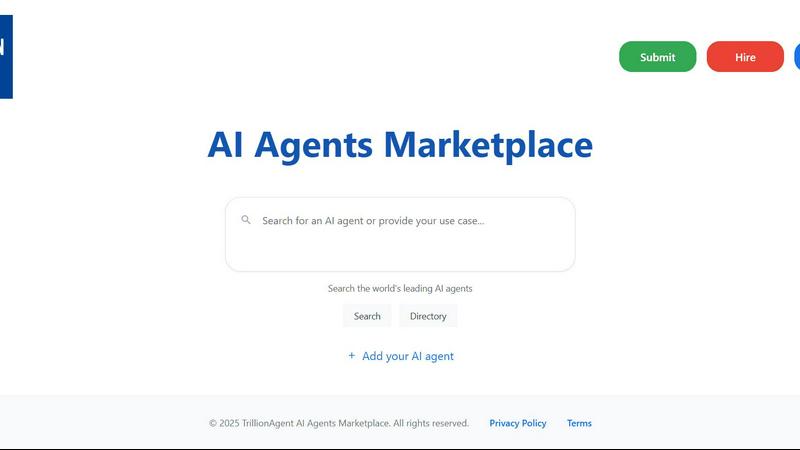
AI Agents Marketplace
Feature Comparison
Agent to Agent Testing Platform
Automated Scenario Generation
The platform offers automated scenario generation capabilities that create diverse and realistic test cases for AI agents. This includes simulating various interaction formats such as chat, voice, and phone calls, allowing for an extensive evaluation of the agent's performance across different contexts and user scenarios.
True Multi-Modal Understanding
Agent to Agent Testing Platform supports true multi-modal understanding by allowing users to define detailed requirements or upload Product Requirement Documents (PRDs) that include varied inputs such as images, audio, and video. This feature enables a more thorough assessment of how AI agents respond in genuine real-world situations.
Autonomous Test Scenario Generation
With access to a library of hundreds of pre-built scenarios, users can also create custom test cases tailored to specific AI behaviors. This functionality includes testing agents' personality tones, data privacy compliance, and intent recognition, thus providing a comprehensive evaluation of the agents under various conditions.
Regression Testing with Risk Scoring
The platform facilitates robust regression testing by providing insights into risk scoring for the AI agents being evaluated. This feature highlights potential areas of concern, enabling teams to prioritize critical issues, thereby optimizing testing efforts and ensuring the stability and reliability of AI systems.
AI Agents Marketplace
Structured Role-Based Taxonomy
The marketplace is built on a meticulously engineered taxonomy of over 300 human-role-equivalent categories, such as "Data Analyst," "SEO Specialist," or "Full-Stack Developer." This structure moves beyond simple keyword tagging, enabling precise, intent-based discovery. It ensures that businesses can find agents designed for specific operational functions, guaranteeing a higher degree of compatibility and integration readiness with their existing tech stack and business processes from the outset.
AI-Powered Natural Language Search
Beyond traditional filters, the platform integrates a sophisticated natural language search engine. Users can describe their operational need or technical requirement in plain English (e.g., "an agent to clean and normalize daily Salesforce CRM data exports"). The AI parses this intent to surface the most relevant, compatible agents, dramatically reducing discovery time and improving match accuracy by understanding context, required inputs, and expected outputs.
Seamless Integration & Deployment Framework
The marketplace is designed as a transactional hub, not just a directory. It provides standardized technical schemas, API documentation, and compatibility metrics for listed agents. This allows development and operations teams to evaluate integration requirements, authentication protocols, and data handoff mechanisms directly within the platform, streamlining the procurement-to-deployment pipeline and reducing friction in embedding new AI capabilities into live environments.
Monetization & Distribution Platform for Developers
For AI developers and solution providers, the marketplace offers a robust channel to distribute and monetize agent-based products. It handles discovery, vetting, and commercial transactions, providing developers with access to a targeted audience actively seeking to integrate AI talent. This ecosystem accelerates go-to-market strategies and provides a scalable revenue model, backed by the platform's trust and structured categorization.
Use Cases
Agent to Agent Testing Platform
Quality Assurance for Chatbots
Enterprises can leverage the platform to ensure that their chatbots deliver accurate and effective responses in a variety of scenarios. This quality assurance process ensures that chatbots maintain high levels of user satisfaction and engagement.
Voice Assistant Evaluation
Organizations can utilize the Agent to Agent Testing Platform to rigorously test voice assistants across different accents and languages, ensuring that they understand and respond accurately to diverse user inquiries while maintaining a natural conversational flow.
Compliance and Ethical Testing
Businesses can perform compliance checks on their AI agents to identify and mitigate risks associated with bias and toxicity. This use case is crucial for maintaining ethical standards and ensuring that AI technologies serve diverse user groups without discrimination.
Performance Optimization for Phone Agents
The platform allows for the testing of phone agents in simulated environments that mimic real-world interactions. This use case is essential for optimizing the performance of voice calling agents, ensuring they exhibit professionalism and empathy during customer interactions.
AI Agents Marketplace
Augmenting DevOps & Engineering Teams
Engineering organizations can integrate specialized AI agents directly into their CI/CD pipelines and development environments. Use cases include deploying agents for automated code review, infrastructure provisioning scripts, real-time security vulnerability scanning, or production log analysis. This creates a scalable, autonomous layer within the tech stack that augments human engineers, accelerates release cycles, and maintains code quality and system reliability.
Scaling Data Operations & Business Intelligence
Data teams can discover and deploy agents for specific ETL tasks, real-time data quality monitoring, dashboard generation, or predictive analytics modeling. Instead of building one-off scripts or manual processes, teams can integrate pre-built, specialized AI agents that plug directly into their data warehouses (like Snowflake or BigQuery) and visualization tools, creating a more agile and automated data ops framework.
Automating Customer Experience & Support
Businesses can architect a hybrid customer support stack by integrating AI agents for tier-1 query resolution, sentiment analysis on support tickets, automated follow-up communications, and knowledge base article generation. These agents can be seamlessly integrated with existing CRM platforms (like HubSpot or Zendesk) and communication channels, providing 24/7 coverage and escalating only complex cases to human agents.
Enhancing Creative & Marketing Production
Marketing and creative departments can operationalize AI for content generation, graphic design asset creation, A/B test analysis, and SEO optimization. By finding and integrating role-specific agents (e.g., a "Social Media Copywriter" agent or a "Brand Design Assistant"), teams can maintain brand consistency while automating high-volume, repetitive creative tasks, freeing human talent for strategic initiatives.
Overview
About Agent to Agent Testing Platform
Agent to Agent Testing Platform is a revolutionary AI-native quality assurance framework specifically designed for validating the performance of AI agents in diverse real-world environments. As artificial intelligence systems evolve towards greater autonomy and complexity, traditional quality assurance (QA) methodologies, which were primarily developed for static software, become inadequate. This platform transcends basic prompt-level evaluations by offering comprehensive insights into multi-turn conversations, encompassing chat, voice, phone, and multimodal interactions. It empowers enterprises to effectively assess and validate the behavior of AI agents before deploying them in production. By introducing a dedicated assurance layer that utilizes advanced multi-agent test generation, the platform can identify long-tail failures, edge cases, and nuanced interaction patterns that are often overlooked by manual testing methods. With the capability to simulate thousands of realistic interactions, organizations can ensure their AI agents meet high standards of accuracy, reliability, and performance, addressing critical metrics such as bias, toxicity, and hallucinations.
About AI Agents Marketplace
The AI Agents Marketplace is the definitive integration layer for the modern enterprise tech stack, engineered to operationalize autonomous AI talent at scale. It functions as a centralized, transactional hub that bridges the gap between sophisticated AI automation and tangible business outcomes by providing a structured directory for discovering, evaluating, and deploying specialized AI agents. The platform is architected for two core user groups: businesses seeking to augment their operational capabilities with pre-vetted, role-specific AI agents, and developers or AI companies aiming to distribute and monetize their agent-based solutions within a high-intent ecosystem. Its primary value proposition is a deeply structured, searchable taxonomy of over 300 human-role-equivalent categories, enabling precise, intent-based matching that ensures compatibility with existing workflows. By leveraging an AI-powered natural language search engine, the marketplace cuts through the fragmentation of standalone AI tools, allowing technical teams to seamlessly integrate agents for specific tasks—from data engineering and DevOps to customer experience orchestration and creative production. This focus on discoverability, role-based categorization, and seamless deployment makes it an essential component for organizations building a scalable, hybrid human-AI workforce, directly addressing integration complexity and accelerating time-to-value for AI-driven automation.
Frequently Asked Questions
Agent to Agent Testing Platform FAQ
What is Agent to Agent Testing Platform designed for?
The Agent to Agent Testing Platform is designed to validate AI agents in real-world environments, ensuring their performance across various interaction scenarios, including chat, voice, and phone calls.
How does the platform help in identifying long-tail failures?
The platform employs a dedicated assurance layer that uses multi-agent test generation to uncover long-tail failures and edge cases that traditional testing methods may miss, ensuring a comprehensive evaluation of AI behavior.
Can I create custom test scenarios?
Yes, users have the ability to create custom test scenarios tailored to their specific AI requirements, in addition to accessing a library of pre-built scenarios for comprehensive testing.
How does the platform ensure compliance with ethical standards?
The platform helps identify potential biases and toxicity in AI agents through automated scenario generation and detailed analytics, allowing organizations to address compliance and ethical considerations effectively.
AI Agents Marketplace FAQ
How does the marketplace ensure the quality and reliability of listed AI agents?
The platform employs a multi-layered vetting process that includes technical validation of the agent's API and integration specs, performance benchmarking against stated capabilities, and security review of data handling practices. Additionally, a transparent review and rating system from enterprise users provides social proof and real-world performance data, allowing buyers to make informed decisions based on compatibility and proven results in similar tech stacks.
What is required to integrate an AI agent from the marketplace into my existing systems?
Integration typically requires API access, which is standardized through the marketplace's framework. Key requirements include validating authentication methods (API keys, OAuth), ensuring data schema compatibility between the agent's expected input/output and your internal systems, and configuring the agent within your workflow orchestration tool (like Zapier, n8n, or a custom middleware). Detailed technical documentation for each agent is provided to streamline this process.
Can we customize or fine-tune an AI agent after deployment?
Customization capabilities depend on the specific agent and its provider. The marketplace categorizes agents based on their flexibility: some are closed, off-the-shelf solutions, while others offer configuration panels, allow for fine-tuning on proprietary data, or provide white-label options. Filtering and search features allow you to specifically seek out agents with the customization and integration depth your use case requires.
How does the pricing and licensing model work for AI agents?
Pricing models are set by the individual agent developers and are clearly listed on each agent's profile. Common models include subscription-based SaaS pricing (monthly/annual), usage-based pricing (per API call, per task), or enterprise licensing. The marketplace facilitates the transaction and billing, providing a unified procurement experience. You can filter agents by their pricing model to align with your operational budget and cost structure.
Alternatives
Agent to Agent Testing Platform Alternatives
The Agent to Agent Testing Platform is a pioneering AI-native quality assurance framework designed to validate the behavior of AI agents across various modalities, including chat, voice, and phone interactions. As organizations increasingly adopt AI systems, they often seek alternatives due to concerns over pricing, feature sets, or specific platform compatibility requirements. Choosing an alternative involves evaluating the ability to conduct comprehensive testing, ensuring robust integration with existing systems, and verifying that the solution can scale to match the demands of real-world scenarios.
AI Agents Marketplace Alternatives
The AI Agents Marketplace is a centralized platform in the AI Assistants category, designed for discovering and deploying specialized, role-based AI agents that integrate directly into your existing tech stack. It focuses on precise, taxonomy-driven matching to ensure compatibility and operational scalability for businesses building a hybrid workforce. Users often explore alternatives due to specific integration requirements, budget constraints, or a need for different feature sets like custom agent development tools or alternative deployment models. Platform lock-in, security protocols, and the depth of API documentation are also common decision drivers. When evaluating an alternative, prioritize its compatibility with your core systems, the granularity of its agent taxonomy for precise role matching, and the robustness of its integration framework. Assess the total cost of ownership, including deployment and maintenance overhead, and ensure the platform's security model aligns with your data governance policies.