
APIMCP.dev vs BarBrain
Side-by-side comparison to help you choose the right product.

APIMCP.dev
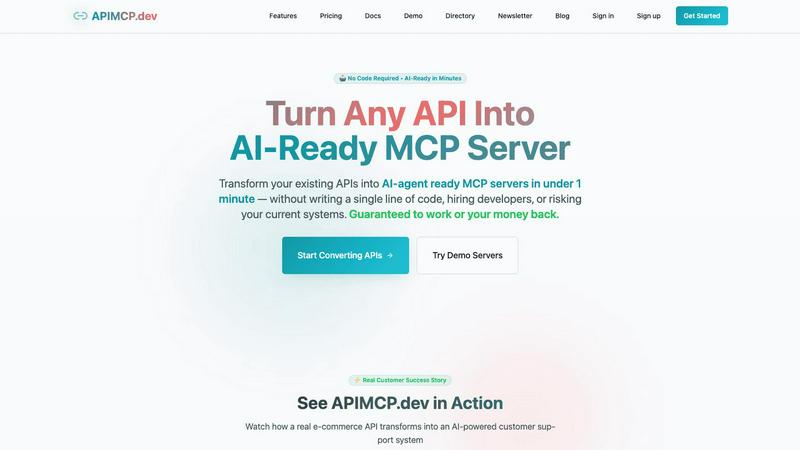
APIMCP.dev instantly converts any REST API into an AI-ready MCP server without coding.
Last updated: March 1, 2026

BarBrain
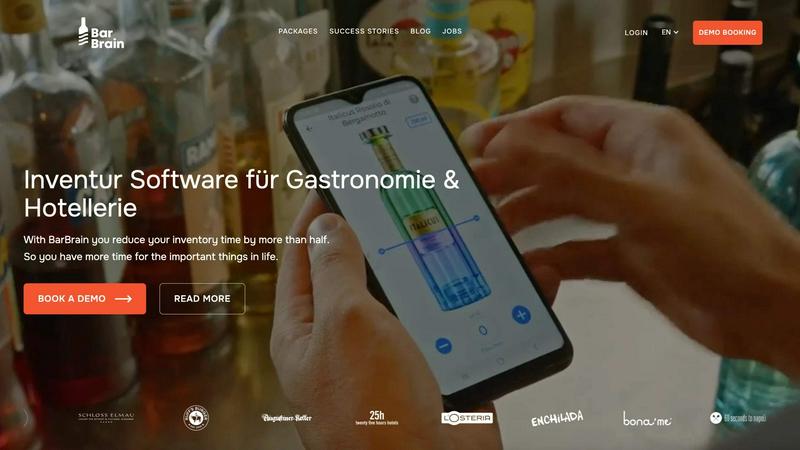
BarBrain is an API-first inventory platform that integrates with your POS to automate beverage and food counting for hospitality.
Last updated: April 4, 2026
Visual Comparison
APIMCP.dev
BarBrain
Feature Comparison
APIMCP.dev
Instant No-Code MCP Server Generation
The platform's intelligent engine automatically parses your provided OpenAPI specification and authentication details to generate a production-ready MCP server. This feature completely bypasses the need for manual coding, understanding MCP specifications, or managing server infrastructure. It dynamically creates the necessary tools, descriptions, and parameter mappings, making your API's capabilities immediately understandable and callable by AI agents without any developer intervention.
Built-in Enterprise Security & Authentication
APIMCP.dev ensures your existing backend systems remain secure and untouched. The platform handles authentication translation, meaning your API keys, OAuth flows, or other credentials are managed securely through the MCP layer. It provides enterprise-grade security for the MCP endpoint itself, acting as a secure proxy so AI agents never directly access your core systems, maintaining your existing security posture while enabling new AI integration channels.
Broad AI Agent & Tool Compatibility
The generated MCP servers are built to the open Model Context Protocol standard, guaranteeing immediate compatibility with a wide range of popular AI tools and platforms. This includes seamless integration with Claude Desktop, ChatGPT via relevant MCP clients, Cursor IDE, and any other agent framework that supports MCP. This universal compatibility ensures your API becomes a versatile tool across the entire AI development stack.
Real-Time Analytics and Performance Monitoring
Gain operational visibility into how AI agents are interacting with your APIs. The platform provides real-time analytics dashboards that track usage metrics, monitor API call performance, log AI agent interactions, and report on system health. This feature is crucial for understanding utilization, debugging interactions, and ensuring the reliability and performance of your AI-integrated services.
BarBrain
Parallel Multi-Device Counting
BarBrain's architecture is built for collaborative efficiency, allowing teams to conduct inventory counts simultaneously on multiple iOS and Android smartphones or tablets. This distributed counting model, powered by real-time cloud sync, drastically reduces the time required for physical stocktaking. The system ensures data consistency across all devices, eliminating the traditional bottleneck of a single person or device and enabling complete inventory audits to be finished in a fraction of the traditional time.
Extensive Pre-Loaded Product Catalog
The platform integrates a massive, industry-specific database containing over 30,000 pre-defined products, including spirits, wines, AFGs, food items, and housekeeping supplies. This extensive catalog accelerates initial setup and ongoing counting by providing standardized product information. For custom or unique items, the system offers full customization capabilities, allowing operators to build a perfectly tailored digital inventory that matches their specific stock, ensuring comprehensive coverage.
Automated Inventory & Variance Reporting
Upon completion of a count, BarBrain's backend processing engine automatically generates a detailed, finalized inventory report. This eliminates hours of manual data entry, cross-referencing, and spreadsheet calculation. The report provides clear insights into stock levels, usage, and, crucially, identifies variance and potential shrinkage in real-time, offering operators immediate, actionable financial data to control costs and reduce waste.
Intuitive Fill-Level Slider for Open Items
Understanding the nuance of partial consumption, BarBrain features a unique UI component: a fill-level slider. This allows staff to accurately record the remaining quantity of open food and beverage products—like a half-used bottle of olive oil or a partial bottle of whiskey—with a single tap. This granular tracking is essential for precise cost-per-dish/drink calculations and provides a true picture of on-hand inventory that simple unit counting cannot achieve.
Use Cases
APIMCP.dev
E-Commerce Customer Support Automation
Transform a Shopify or WooCommerce REST API into an AI customer support agent. Instead of building custom integrations, connect the generated MCP server to an AI like Claude. The agent can then directly query order statuses, search customer records, and check inventory levels using natural language, providing instant, accurate support without human intervention and freeing up team resources for complex issues.
Internal Business Intelligence Querying
Enable non-technical team members to query complex internal data systems. By converting HR, CRM, or ERP APIs into MCP servers, employees can use AI assistants in their daily tools (like Slack with Claude) to ask questions such as "What were Q3 sales in the EMEA region?" or "List all open positions in the engineering department," receiving instant, data-driven answers pulled directly from live systems.
Accelerated Developer Tooling Integration
Software development teams can instantly expose their internal microservices or third-party SaaS APIs (like GitHub, Jira, or Sentry) as tools within their AI-powered IDE, such as Cursor. Developers can then ask the AI to "create a Jira ticket for this bug" or "fetch the recent deployment logs from service X," streamlining workflows without context-switching or writing boilerplate integration code.
Dynamic Content Management System (CMS) Operations
Content teams can manage digital assets and publications through conversational AI. By converting a headless CMS API (like Contentful or Strapi) into an MCP server, marketers and editors can instruct an AI agent to "publish the drafted blog post about Q2 results" or "find and update the banner image on the homepage," making content operations faster and more intuitive.
BarBrain
Independent Bars & Restaurants
For single-location owner-operators, BarBrain replaces error-prone spreadsheets and clipboards. It provides an affordable, professional-grade system to gain control over liquor costs and food margins without requiring dedicated staff or IT expertise. The quick setup and intuitive mobile interface allow the owner or manager to conduct fast, accurate counts themselves, leading to direct, measurable savings and preventing revenue leakage from unaccounted-for waste or shrinkage.
Multi-Location Restaurant & Bar Groups
BarBrain's centralized cloud dashboard offers corporate or regional managers a unified, real-time view of inventory performance across all venues. This enables standardized counting procedures, consolidated reporting, and easy benchmarking between locations. The platform's scalability ensures consistent data collection, allowing leadership to identify best practices, spot outliers with high variance, and make bulk purchasing decisions based on accurate, aggregated data from all sites.
Hotels & Resorts (F&B Operations)
Hotels with complex F&B offerings, including multiple restaurants, bars, banqueting, and minibars, require a robust inventory solution. BarBrain is compatible with tracking a full range of products, from fine dining ingredients to housekeeping amenities. Its ability to handle high product volume and provide detailed consumption reports helps large hospitality operations manage costs across diverse revenue centers and maintain strict budgetary control.
Nightclubs & High-Volume Venues
In fast-paced environments with high product turnover and often less formalized controls, BarBrain provides essential oversight. The speed of parallel counting minimizes operational disruption during off-hours. Real-time variance flags help management quickly identify discrepancies that could indicate spillage, over-pouring, or other issues, allowing for immediate corrective action to protect profitability in a margin-sensitive business.
Overview
About APIMCP.dev
APIMCP.dev is a transformative platform engineered to bridge the gap between existing REST APIs and modern AI agent ecosystems. It functions as a high-speed conversion layer, instantly transforming any OpenAPI-compliant REST API into a fully operational Model Context Protocol (MCP) server. This process, which traditionally demands 40-80 hours of specialized development work, is accomplished in under 60 seconds without requiring any manual coding. The product is specifically designed for developers, product teams, and businesses that possess valuable API-driven data and services but lack the time or resources to build custom integrations for AI assistants like Anthropic's Claude, OpenAI's ChatGPT, and code editors like Cursor. Its core value proposition is radical time-to-market acceleration and seamless compatibility, allowing organizations to unlock their data for AI agents instantly. By providing a secure, managed MCP endpoint, APIMCP.dev eliminates the complexities of authentication schema translation, tool description generation, and server deployment, enabling users to focus on innovation rather than integration plumbing.
About BarBrain
BarBrain is a purpose-built, cloud-native inventory management platform engineered exclusively for the hospitality sector. It directly addresses the critical inefficiencies of manual stocktaking and generic warehouse software by providing a specialized tool that understands the unique operational flows of bars, restaurants, hotels, and multi-location groups. The platform's core value proposition is delivering verifiable, real-time financial control by digitizing and automating the entire inventory lifecycle. Built with a modern tech stack for seamless integration and accessibility, BarBrain enables operators to conduct inventory counts in minutes instead of hours, leveraging parallel counting on multiple iOS and Android devices. It goes beyond simple stock tracking by automatically calculating exact pour costs, identifying variance and waste, and generating comprehensive audit reports. This provides management with the precise data needed to protect margins, optimize supplier orders, and make informed purchasing decisions. Designed for scalability, its architecture supports everything from single independent venues to large enterprise operations, ensuring reliable, accurate numbers are always at the operator's fingertips without the need for complex training or bloated feature sets.
Frequently Asked Questions
APIMCP.dev FAQ
What is an MCP server and why do I need it?
MCP (Model Context Protocol) is an open protocol that allows AI applications like Claude and ChatGPT to securely connect to external tools, data sources, and APIs. An MCP server acts as a bridge, translating between the AI's requests and your specific API. APIMCP.dev automatically builds this server for you, so you don't need to learn the protocol or write any code to make your API accessible to leading AI agents.
What do I need to provide to generate an MCP server?
You primarily need your API's OpenAPI specification (formerly Swagger), which is a standard, machine-readable description of your REST API's endpoints, parameters, and authentication methods. You will also provide the necessary authentication details (e.g., API key, OAuth credentials). APIMCP.dev uses this information to automatically configure and generate a fully functional MCP server that mirrors your API's capabilities.
Is my API data and authentication secure?
Yes. APIMCP.dev is designed with enterprise security in mind. Your original API remains untouched in its secure environment. The platform acts as a secure proxy, managing authentication and request routing. Your credentials are stored encrypted, and the MCP server endpoint includes built-in security measures. The system does not store your actual API response data.
Can I use the generated MCP server with any AI tool?
The generated servers are compliant with the open Model Context Protocol standard, which is natively supported by a growing ecosystem of tools. This includes Anthropic's Claude Desktop, Cursor IDE, and compatible frameworks for ChatGPT. As long as your chosen AI tool or platform has MCP client support, you will be able to connect your API seamlessly. The platform ensures broad compatibility across the AI stack.
BarBrain FAQ
What devices and operating systems are compatible with BarBrain?
BarBrain is built as a cross-platform mobile application, ensuring broad compatibility. It is fully functional on both iOS (iPhone, iPad) and Android smartphones and tablets. The system operates on a cloud-based architecture, meaning all data is synchronized in real-time across devices and accessible from any web browser for management reporting, requiring no complex on-premise software installation.
How does BarBrain handle our existing product list and supplier information?
The platform offers multiple pathways for integration. You can leverage the extensive pre-loaded catalog of over 30,000 items for quick addition. For custom products, you can manually enter them or utilize bulk import tools via CSV files to migrate existing lists. The system also allows you to input and manage supplier details, streamlining the ordering process by keeping all vendor information centralized within the inventory ecosystem.
Can BarBrain integrate with our existing Point of Sale (POS) or accounting systems?
BarBrain is designed with API-led connectivity in mind, focusing on seamless data exchange. While direct, pre-built integrations depend on specific partners, the platform can facilitate data export in standardized formats (like CSV) that can be imported into most accounting software (e.g., QuickBooks, Xero) for financial reconciliation. For POS integration, it enables variance analysis by comparing theoretical usage (from sales data) against actual physical inventory counts.
Is training required for our staff to use BarBrain effectively?
BarBrain is engineered for intuitive use, requiring minimal formal training. The mobile counting interface is designed for simplicity, often requiring just a single tap or slider adjustment per item. Most teams become proficient after one guided inventory cycle. Furthermore, BarBrain provides onboarding support and resources to ensure your staff can leverage the platform's full capabilities efficiently from the start.
Alternatives
APIMCP.dev Alternatives
APIMCP.dev is a productivity and management platform that instantly transforms REST APIs into AI-ready MCP servers without coding. It serves developers and businesses aiming to integrate their data and services with AI agents like Claude in under a minute. Users often explore alternatives for various reasons. These can include specific budget constraints, the need for different feature sets like custom authentication flows or SDK support, or platform compatibility requirements with other AI ecosystems beyond the major players. When evaluating other solutions, key considerations should include the speed and ease of the API-to-MCP conversion process, the depth of security and compliance features, the availability of analytics for monitoring, and the overall compatibility with your existing tech stack and target AI agent environments.
BarBrain Alternatives
BarBrain is a specialized inventory management platform built for the hospitality industry, specifically bars and restaurants. It falls into the productivity and management software category, designed to replace manual counting and generic warehouse tools with a system that understands pours, recipes, and perishables. Users often explore alternatives to BarBrain to find a solution that better aligns with their specific tech stack, budget, or operational scale. Common drivers include the need for different pricing models, deeper integrations with existing POS or accounting systems, or a feature set tailored to a different segment of the food service industry. When evaluating an alternative, prioritize solutions with robust API access and native integrations for seamless data flow. Look for platforms that offer real-time analytics, granular cost tracking, and a user experience designed for the high-speed, detail-oriented environment of hospitality. The right tool should fit your existing operational workflow without requiring extensive customization or training.