
APIMCP.dev vs Changeflow
Side-by-side comparison to help you choose the right product.

APIMCP.dev
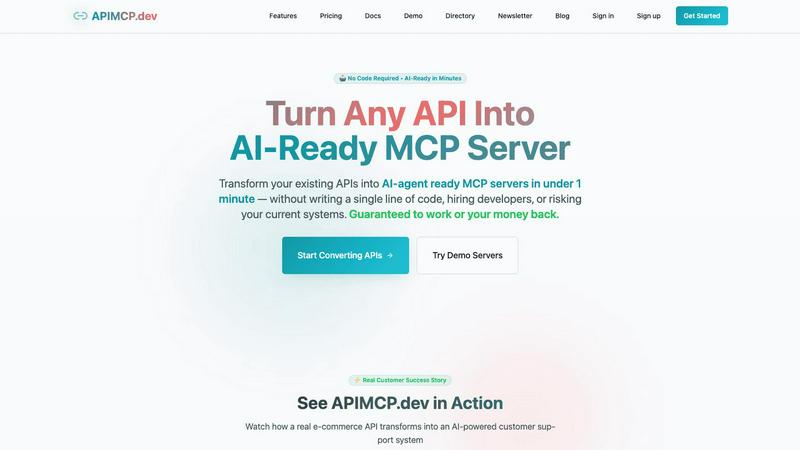
APIMCP.dev instantly converts any REST API into an AI-ready MCP server without coding.
Last updated: March 1, 2026

Changeflow
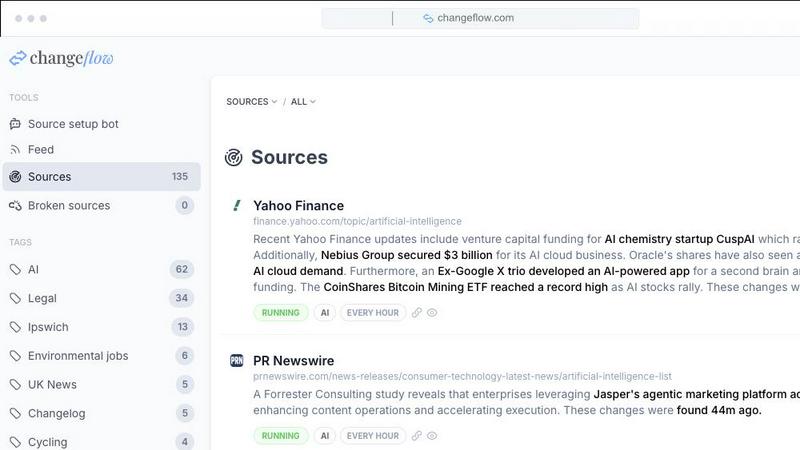
Changeflow delivers AI-driven insights on market and competitor changes, ensuring you stay informed without the noise.
Last updated: March 4, 2026
Visual Comparison
APIMCP.dev
Changeflow
Feature Comparison
APIMCP.dev
Instant No-Code MCP Server Generation
The platform's intelligent engine automatically parses your provided OpenAPI specification and authentication details to generate a production-ready MCP server. This feature completely bypasses the need for manual coding, understanding MCP specifications, or managing server infrastructure. It dynamically creates the necessary tools, descriptions, and parameter mappings, making your API's capabilities immediately understandable and callable by AI agents without any developer intervention.
Built-in Enterprise Security & Authentication
APIMCP.dev ensures your existing backend systems remain secure and untouched. The platform handles authentication translation, meaning your API keys, OAuth flows, or other credentials are managed securely through the MCP layer. It provides enterprise-grade security for the MCP endpoint itself, acting as a secure proxy so AI agents never directly access your core systems, maintaining your existing security posture while enabling new AI integration channels.
Broad AI Agent & Tool Compatibility
The generated MCP servers are built to the open Model Context Protocol standard, guaranteeing immediate compatibility with a wide range of popular AI tools and platforms. This includes seamless integration with Claude Desktop, ChatGPT via relevant MCP clients, Cursor IDE, and any other agent framework that supports MCP. This universal compatibility ensures your API becomes a versatile tool across the entire AI development stack.
Real-Time Analytics and Performance Monitoring
Gain operational visibility into how AI agents are interacting with your APIs. The platform provides real-time analytics dashboards that track usage metrics, monitor API call performance, log AI agent interactions, and report on system health. This feature is crucial for understanding utilization, debugging interactions, and ensuring the reliability and performance of your AI-integrated services.
Changeflow
AI-Powered Intelligence
Changeflow utilizes cutting-edge AI technology to understand the context of web pages and filter out irrelevant changes. This ensures users receive only the most pertinent information, reducing noise and saving time.
Natural Language Setup
Setting up Changeflow is a breeze; users can describe in plain English what they want to track. This straightforward approach eliminates the need for technical configurations, allowing anyone to start monitoring changes quickly.
Customized Summaries
Forget about sifting through long web pages for updates. Changeflow generates concise, AI-driven summaries that highlight what has changed and why it matters, enabling users to grasp essential information at a glance.
Advanced Anti-Blocking Technology
Changeflow's sophisticated anti-blocking mechanisms ensure that the tool can monitor challenging sites with a 99.9% success rate. This reliability is crucial for businesses that depend on uninterrupted access to updates on their target pages.
Use Cases
APIMCP.dev
E-Commerce Customer Support Automation
Transform a Shopify or WooCommerce REST API into an AI customer support agent. Instead of building custom integrations, connect the generated MCP server to an AI like Claude. The agent can then directly query order statuses, search customer records, and check inventory levels using natural language, providing instant, accurate support without human intervention and freeing up team resources for complex issues.
Internal Business Intelligence Querying
Enable non-technical team members to query complex internal data systems. By converting HR, CRM, or ERP APIs into MCP servers, employees can use AI assistants in their daily tools (like Slack with Claude) to ask questions such as "What were Q3 sales in the EMEA region?" or "List all open positions in the engineering department," receiving instant, data-driven answers pulled directly from live systems.
Accelerated Developer Tooling Integration
Software development teams can instantly expose their internal microservices or third-party SaaS APIs (like GitHub, Jira, or Sentry) as tools within their AI-powered IDE, such as Cursor. Developers can then ask the AI to "create a Jira ticket for this bug" or "fetch the recent deployment logs from service X," streamlining workflows without context-switching or writing boilerplate integration code.
Dynamic Content Management System (CMS) Operations
Content teams can manage digital assets and publications through conversational AI. By converting a headless CMS API (like Contentful or Strapi) into an MCP server, marketers and editors can instruct an AI agent to "publish the drafted blog post about Q2 results" or "find and update the banner image on the homepage," making content operations faster and more intuitive.
Changeflow
Competitor Pricing Monitoring
Businesses can use Changeflow to keep a close eye on competitor pricing strategies. By monitoring competitors' websites, teams can quickly respond to pricing changes, helping them stay competitive in the market.
Regulatory Compliance Tracking
Compliance teams in large organizations can track changes in regulatory guidance, such as FDA updates or SEC filings. Changeflow ensures that they are always aware of important legal updates that could impact their operations.
News Monitoring for Brand Mentions
Changeflow allows businesses to monitor news articles and online mentions of their brand. This capability helps teams respond to public sentiment and manage their reputation proactively.
Legal Research and Docket Monitoring
Legal librarians and professionals can leverage Changeflow to monitor court dockets and legal citations effectively. This ensures they remain informed about relevant legal proceedings and can prepare accordingly.
Overview
About APIMCP.dev
APIMCP.dev is a transformative platform engineered to bridge the gap between existing REST APIs and modern AI agent ecosystems. It functions as a high-speed conversion layer, instantly transforming any OpenAPI-compliant REST API into a fully operational Model Context Protocol (MCP) server. This process, which traditionally demands 40-80 hours of specialized development work, is accomplished in under 60 seconds without requiring any manual coding. The product is specifically designed for developers, product teams, and businesses that possess valuable API-driven data and services but lack the time or resources to build custom integrations for AI assistants like Anthropic's Claude, OpenAI's ChatGPT, and code editors like Cursor. Its core value proposition is radical time-to-market acceleration and seamless compatibility, allowing organizations to unlock their data for AI agents instantly. By providing a secure, managed MCP endpoint, APIMCP.dev eliminates the complexities of authentication schema translation, tool description generation, and server deployment, enabling users to focus on innovation rather than integration plumbing.
About Changeflow
Changeflow is an advanced web page monitoring tool designed to track updates and changes across the internet, providing businesses with critical information tailored to their needs. Unlike traditional monitoring solutions that simply alert users to changes, Changeflow employs sophisticated AI technology to analyze web pages, filter out irrelevant updates, and deliver meaningful summaries. This capability is ideal for business teams looking to stay informed about competitor pricing, regulatory changes, market movements, and news mentions. Legal professionals and compliance teams also benefit from its precise monitoring of court dockets and important filings. With a user-friendly setup that requires no technical expertise, Changeflow ensures that users receive timely intelligence directly to their inbox or dashboard, transforming how organizations keep tabs on online information.
Frequently Asked Questions
APIMCP.dev FAQ
What is an MCP server and why do I need it?
MCP (Model Context Protocol) is an open protocol that allows AI applications like Claude and ChatGPT to securely connect to external tools, data sources, and APIs. An MCP server acts as a bridge, translating between the AI's requests and your specific API. APIMCP.dev automatically builds this server for you, so you don't need to learn the protocol or write any code to make your API accessible to leading AI agents.
What do I need to provide to generate an MCP server?
You primarily need your API's OpenAPI specification (formerly Swagger), which is a standard, machine-readable description of your REST API's endpoints, parameters, and authentication methods. You will also provide the necessary authentication details (e.g., API key, OAuth credentials). APIMCP.dev uses this information to automatically configure and generate a fully functional MCP server that mirrors your API's capabilities.
Is my API data and authentication secure?
Yes. APIMCP.dev is designed with enterprise security in mind. Your original API remains untouched in its secure environment. The platform acts as a secure proxy, managing authentication and request routing. Your credentials are stored encrypted, and the MCP server endpoint includes built-in security measures. The system does not store your actual API response data.
Can I use the generated MCP server with any AI tool?
The generated servers are compliant with the open Model Context Protocol standard, which is natively supported by a growing ecosystem of tools. This includes Anthropic's Claude Desktop, Cursor IDE, and compatible frameworks for ChatGPT. As long as your chosen AI tool or platform has MCP client support, you will be able to connect your API seamlessly. The platform ensures broad compatibility across the AI stack.
Changeflow FAQ
How does Changeflow determine what changes matter?
Changeflow's AI analyzes the content of monitored web pages, assessing the context and relevance of changes. This allows it to filter out noise and deliver only the most significant updates to users.
Is there a limit to the number of pages I can monitor?
Changeflow offers various pricing tiers, allowing users to monitor anywhere from 20 to 500 pages, depending on their subscription plan. This flexibility caters to businesses of all sizes.
Can I integrate Changeflow with my existing workflows?
Yes, Changeflow provides API access, allowing users to integrate its monitoring capabilities into their existing systems and workflows, enhancing overall productivity.
What types of notifications does Changeflow provide?
Users can receive notifications via email, dashboard alerts, or other channels through integrations like Zapier. Notifications are concise and descriptive, ensuring users have access to critical updates promptly.
Alternatives
APIMCP.dev Alternatives
APIMCP.dev is a productivity and management platform that instantly transforms REST APIs into AI-ready MCP servers without coding. It serves developers and businesses aiming to integrate their data and services with AI agents like Claude in under a minute. Users often explore alternatives for various reasons. These can include specific budget constraints, the need for different feature sets like custom authentication flows or SDK support, or platform compatibility requirements with other AI ecosystems beyond the major players. When evaluating other solutions, key considerations should include the speed and ease of the API-to-MCP conversion process, the depth of security and compliance features, the availability of analytics for monitoring, and the overall compatibility with your existing tech stack and target AI agent environments.
Changeflow Alternatives
Changeflow is an AI-driven tool designed to provide market and competitor insights by tracking changes on web pages. It belongs to the productivity and management category, enabling businesses to monitor critical information efficiently. Users often seek alternatives for various reasons, including pricing considerations, specific feature requirements, or the need for compatibility with existing platforms and workflows. When evaluating alternatives, it’s essential to assess their capabilities in handling complex web pages, the ease of integration into current systems, and the overall user experience to ensure they meet your specific tracking needs.