
APIMCP.dev vs Decode This Text
Side-by-side comparison to help you choose the right product.

APIMCP.dev
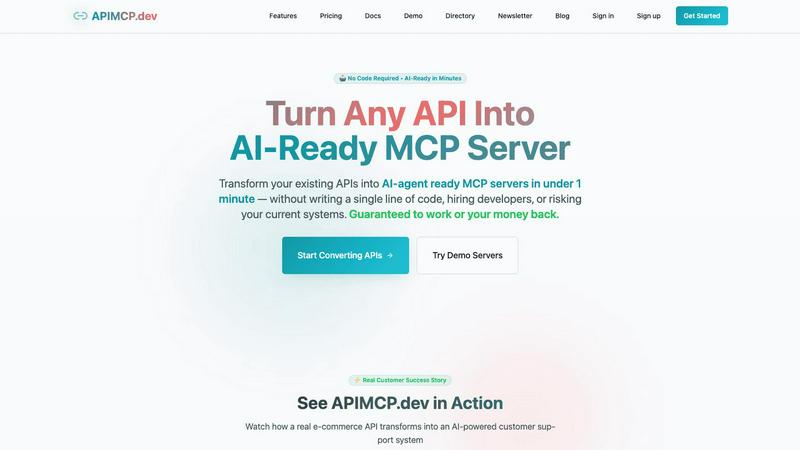
APIMCP.dev instantly converts any REST API into an AI-ready MCP server without coding.
Last updated: March 1, 2026

Decode This Text
Decode This Text provides instant, human-like analysis of confusing conversations in just 30 seconds.
Last updated: February 28, 2026
Visual Comparison
APIMCP.dev
Decode This Text

Feature Comparison
APIMCP.dev
Instant No-Code MCP Server Generation
The platform's intelligent engine automatically parses your provided OpenAPI specification and authentication details to generate a production-ready MCP server. This feature completely bypasses the need for manual coding, understanding MCP specifications, or managing server infrastructure. It dynamically creates the necessary tools, descriptions, and parameter mappings, making your API's capabilities immediately understandable and callable by AI agents without any developer intervention.
Built-in Enterprise Security & Authentication
APIMCP.dev ensures your existing backend systems remain secure and untouched. The platform handles authentication translation, meaning your API keys, OAuth flows, or other credentials are managed securely through the MCP layer. It provides enterprise-grade security for the MCP endpoint itself, acting as a secure proxy so AI agents never directly access your core systems, maintaining your existing security posture while enabling new AI integration channels.
Broad AI Agent & Tool Compatibility
The generated MCP servers are built to the open Model Context Protocol standard, guaranteeing immediate compatibility with a wide range of popular AI tools and platforms. This includes seamless integration with Claude Desktop, ChatGPT via relevant MCP clients, Cursor IDE, and any other agent framework that supports MCP. This universal compatibility ensures your API becomes a versatile tool across the entire AI development stack.
Real-Time Analytics and Performance Monitoring
Gain operational visibility into how AI agents are interacting with your APIs. The platform provides real-time analytics dashboards that track usage metrics, monitor API call performance, log AI agent interactions, and report on system health. This feature is crucial for understanding utilization, debugging interactions, and ensuring the reliability and performance of your AI-integrated services.
Decode This Text
Screenshot & Text Input Parsing
The platform supports multiple, flexible input methods for seamless integration into any user's tech stack. Users can directly paste message text or, more innovatively, upload a screenshot of their chat interface. The system's OCR (Optical Character Recognition) and parsing engine automatically extract and structure the conversation, eliminating manual transcription. This feature ensures compatibility with any messaging app (WhatsApp, iMessage, Slack, etc.), making the decoding process universally accessible and frictionless, regardless of the source platform.
Tone and Sentiment Analysis Engine
At its core, Decode This Text employs a robust sentiment analysis API that quantifies the emotional temperature of a message. It doesn't just label text as positive or negative; it provides a nuanced percentage-based score (e.g., 75% friendly, 40% effort) for tone, intent, and investment. This technical analysis identifies sarcasm, passive-aggression, or genuine warmth that might be missed by the human eye, offering an objective, data-backed read on the subtextual emotional state of the sender.
Behavioral Pattern Detection
This feature utilizes temporal and linguistic pattern recognition algorithms. It analyzes metadata and content patterns that users often overlook, such as consistent late-night messaging, avoidance of specific questions, gradual shortening of replies, or delayed response times. By flagging these behavioral cues, the tool provides insights into long-term communication trends, helping users understand if a change in interaction style is a one-off event or part of a significant pattern.
AI-Generated Response Suggestions
Integrated directly into the analysis workflow, this feature provides actionable output. After decoding a message, the system generates three tailored response options—calm, direct, or firm—formulated to align with the user's desired outcome and the analyzed context of the conversation. This turns analysis into immediate utility, offering compatible next steps that users can deploy with confidence, effectively closing the loop between interpretation and action.
Use Cases
APIMCP.dev
E-Commerce Customer Support Automation
Transform a Shopify or WooCommerce REST API into an AI customer support agent. Instead of building custom integrations, connect the generated MCP server to an AI like Claude. The agent can then directly query order statuses, search customer records, and check inventory levels using natural language, providing instant, accurate support without human intervention and freeing up team resources for complex issues.
Internal Business Intelligence Querying
Enable non-technical team members to query complex internal data systems. By converting HR, CRM, or ERP APIs into MCP servers, employees can use AI assistants in their daily tools (like Slack with Claude) to ask questions such as "What were Q3 sales in the EMEA region?" or "List all open positions in the engineering department," receiving instant, data-driven answers pulled directly from live systems.
Accelerated Developer Tooling Integration
Software development teams can instantly expose their internal microservices or third-party SaaS APIs (like GitHub, Jira, or Sentry) as tools within their AI-powered IDE, such as Cursor. Developers can then ask the AI to "create a Jira ticket for this bug" or "fetch the recent deployment logs from service X," streamlining workflows without context-switching or writing boilerplate integration code.
Dynamic Content Management System (CMS) Operations
Content teams can manage digital assets and publications through conversational AI. By converting a headless CMS API (like Contentful or Strapi) into an MCP server, marketers and editors can instruct an AI agent to "publish the drafted blog post about Q2 results" or "find and update the banner image on the homepage," making content operations faster and more intuitive.
Decode This Text
Decoding Romantic and Dating Ambiguity
Users can paste confusing texts from dating apps or partners (e.g., "I'll let you know," or post-date radio silence). The tool analyzes tone and intent to clarify if the sender is genuinely busy, losing interest, or being avoidant. It helps answer pressing questions like "Why did they ghost after three months?" by providing a reality-check based on linguistic and behavioral evidence, preventing over-analysis and regretful replies.
Interpreting Professional and Workplace Communication
This use case focuses on integrating clarity into professional environments. Users can decode cryptic one-word emails from a boss, vague feedback like "we'll keep your resume on file," or nuanced Slack messages. The analysis clarifies underlying tones of anger, dissatisfaction, or genuine neutrality, and provides professionally compatible response strategies to navigate office politics and communication with appropriate tact.
Navigating Friends and Family Dynamics
The tool helps analyze group chat silences, passive-aggressive comments from relatives, or changing communication patterns from friends. By inputting these social exchanges, users receive an objective breakdown of the group or individual's dynamic, identifying potential conflicts, disengagement, or simple misunderstandings, enabling more empathetic and effective personal communication.
Pre-Send Message Validation and Review
Before sending an emotionally charged or important reply, users can input their drafted response into the system to analyze its likely perceived tone and impact. This proactive use case acts as a communication firewall, allowing individuals to stress-test their messages, adjust tone, and ensure their intent is clearly and effectively communicated, thereby preventing escalation or misunderstanding.
Overview
About APIMCP.dev
APIMCP.dev is a transformative platform engineered to bridge the gap between existing REST APIs and modern AI agent ecosystems. It functions as a high-speed conversion layer, instantly transforming any OpenAPI-compliant REST API into a fully operational Model Context Protocol (MCP) server. This process, which traditionally demands 40-80 hours of specialized development work, is accomplished in under 60 seconds without requiring any manual coding. The product is specifically designed for developers, product teams, and businesses that possess valuable API-driven data and services but lack the time or resources to build custom integrations for AI assistants like Anthropic's Claude, OpenAI's ChatGPT, and code editors like Cursor. Its core value proposition is radical time-to-market acceleration and seamless compatibility, allowing organizations to unlock their data for AI agents instantly. By providing a secure, managed MCP endpoint, APIMCP.dev eliminates the complexities of authentication schema translation, tool description generation, and server deployment, enabling users to focus on innovation rather than integration plumbing.
About Decode This Text
Decode This Text is a sophisticated AI-powered communication analysis engine designed to parse and interpret the subtext of digital conversations. It functions as a critical layer of intelligence for personal and professional communication, transforming ambiguous text messages, emails, and chat logs into actionable insights. The platform is engineered for individuals seeking to eliminate guesswork from their interactions, providing a clear breakdown of emotional tone, sender intent, and engagement patterns. Its core value proposition lies in its seamless integration into a user's daily workflow—acting as a real-time communication co-pilot. By leveraging advanced natural language processing (NLP) models, it deciphers context, detects non-obvious patterns like response timing and evasiveness, and generates contextually appropriate response options. This tool is built for anyone navigating complex digital dialogues, from analyzing a vague message from a date to interpreting a terse email from a manager, ensuring users respond with confidence and clarity, backed by data-driven analysis.
Frequently Asked Questions
APIMCP.dev FAQ
What is an MCP server and why do I need it?
MCP (Model Context Protocol) is an open protocol that allows AI applications like Claude and ChatGPT to securely connect to external tools, data sources, and APIs. An MCP server acts as a bridge, translating between the AI's requests and your specific API. APIMCP.dev automatically builds this server for you, so you don't need to learn the protocol or write any code to make your API accessible to leading AI agents.
What do I need to provide to generate an MCP server?
You primarily need your API's OpenAPI specification (formerly Swagger), which is a standard, machine-readable description of your REST API's endpoints, parameters, and authentication methods. You will also provide the necessary authentication details (e.g., API key, OAuth credentials). APIMCP.dev uses this information to automatically configure and generate a fully functional MCP server that mirrors your API's capabilities.
Is my API data and authentication secure?
Yes. APIMCP.dev is designed with enterprise security in mind. Your original API remains untouched in its secure environment. The platform acts as a secure proxy, managing authentication and request routing. Your credentials are stored encrypted, and the MCP server endpoint includes built-in security measures. The system does not store your actual API response data.
Can I use the generated MCP server with any AI tool?
The generated servers are compliant with the open Model Context Protocol standard, which is natively supported by a growing ecosystem of tools. This includes Anthropic's Claude Desktop, Cursor IDE, and compatible frameworks for ChatGPT. As long as your chosen AI tool or platform has MCP client support, you will be able to connect your API seamlessly. The platform ensures broad compatibility across the AI stack.
Decode This Text FAQ
How does Decode This Text ensure my privacy and data security?
The platform is built with a privacy-first architecture. As stated, no human ever reads your texts. All analysis is performed by automated AI systems. Conversations are processed anonymously and are not stored for long-term profiling or used to train public models, ensuring complete confidentiality and integration into your personal communication security protocol.
What messaging platforms and formats are compatible?
The system is platform-agnostic due to its dual input method. It is compatible with any digital text source. You can directly copy-paste text from SMS, WhatsApp, Signal, Email, Slack, Discord, and social media DMs. Alternatively, the screenshot upload feature with OCR integration means you can use it with any app or platform that displays text on your screen, ensuring universal compatibility.
Can it analyze long conversation threads or only single messages?
Yes, the engine is designed to parse and analyze full conversation threads. When you paste a multi-message exchange or upload a screenshot of a long chat, the NLP model evaluates the context, flow, and patterns across the entire dialogue. This provides a more accurate and comprehensive analysis than a single message in isolation, as it understands relational dynamics and historical context.
How accurate is the AI's analysis compared to a human perspective?
The AI is trained on vast datasets of human communication and is designed to identify consistent linguistic and psychological cues. While not infallible, it provides an objective, data-driven perspective free from personal bias. Many users report it feeling like a "wise older sibling" because it highlights patterns and tones they were too emotionally involved to see, offering a highly effective and consistently available second opinion.
Alternatives
APIMCP.dev Alternatives
APIMCP.dev is a productivity and management platform that instantly transforms REST APIs into AI-ready MCP servers without coding. It serves developers and businesses aiming to integrate their data and services with AI agents like Claude in under a minute. Users often explore alternatives for various reasons. These can include specific budget constraints, the need for different feature sets like custom authentication flows or SDK support, or platform compatibility requirements with other AI ecosystems beyond the major players. When evaluating other solutions, key considerations should include the speed and ease of the API-to-MCP conversion process, the depth of security and compliance features, the availability of analytics for monitoring, and the overall compatibility with your existing tech stack and target AI agent environments.
Decode This Text Alternatives
Decode This Text is a productivity tool focused on communication analysis. It operates within the text interpretation and interpersonal intelligence software category, helping users parse ambiguous messages by providing insights into tone, intent, and suggested responses. Users often seek alternatives for various technical and operational reasons. Common drivers include budget constraints, the need for specific API integrations, or compatibility requirements with existing CRM or communication platforms like Slack or Microsoft Teams. Others may require more advanced features, such as batch processing or deeper sentiment analysis engines. When evaluating an alternative, prioritize its technical stack and integration capabilities. Assess whether it offers a RESTful API for custom workflows, supports real-time analysis within your primary communication apps, and provides data export options. Security protocols and data handling policies are also critical, especially for business use.