
Avif2Png vs SparkPix
Side-by-side comparison to help you choose the right product.

Avif2Png
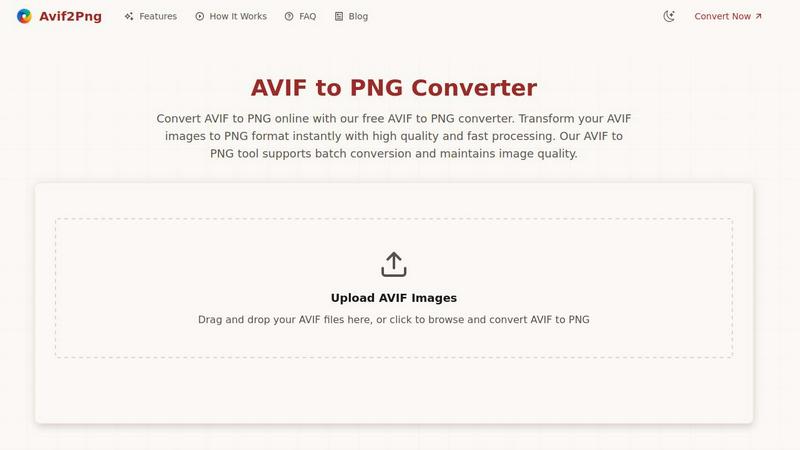
Bridge the compatibility gap by converting AVIF to universally supported PNG format with high-fidelity batch processing.
Last updated: March 1, 2026

SparkPix
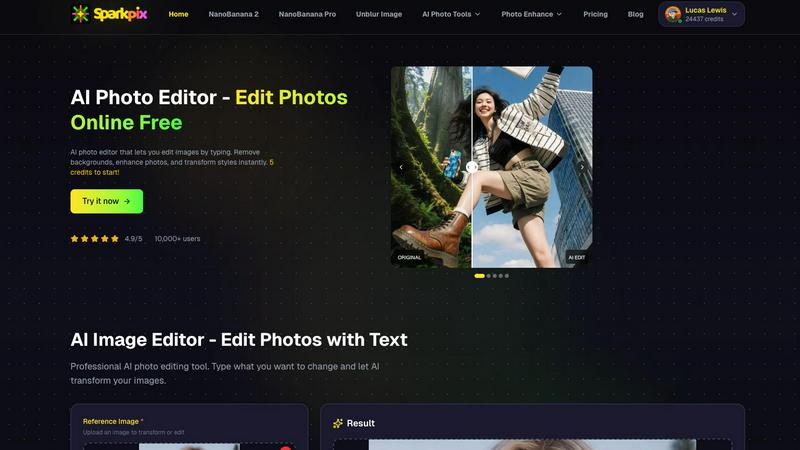
SparkPix is a developer-friendly AI photo editing API that integrates directly into your tech stack for programmatic image transformation.
Last updated: March 11, 2026
Visual Comparison
Avif2Png
SparkPix
Feature Comparison
Avif2Png
Lossless Batch Conversion
The tool's core engine supports processing multiple AVIF files simultaneously in a batch operation, converting them to PNG without any degradation in visual quality. This is crucial for maintaining the integrity of graphics, logos, and images with text during high-volume workflows, ensuring pixel-perfect results across all converted assets while saving significant manual processing time.
Zero-Configuration Web Integration
Avif2Png operates entirely client-side for upload/download with secure server-side processing, requiring no registration, API keys, or software installation. This makes it instantly compatible with any development environment or browser stack, allowing for seamless integration into ad-hoc workflows without disrupting existing toolchains or requiring complex setup procedures.
Secure, Ephemeral Processing
All file processing is conducted in a secure, isolated environment with a strict data hygiene policy. Uploaded AVIF files and the resulting PNG conversions are automatically purged from servers after a short period, ensuring that sensitive design assets or proprietary content are not retained, which aligns with enterprise-grade security and privacy standards for online tools.
Broad Format Fidelity & Compatibility
The conversion algorithm is specifically tuned to handle the AVIF codec's advanced features, correctly mapping its color profiles and transparency layers (alpha channels) to the PNG specification. This guarantees that the output files are fully compatible with all versions of image editing software (like Adobe Photoshop, GIMP), CMS platforms, and web browsers, eliminating rendering inconsistencies.
SparkPix
AI-Powered Text-to-Edit Engine
This foundational feature integrates a sophisticated natural language interface with a suite of specialized AI models. Users input descriptive commands (e.g., "remove the tourist in the red shirt," "enhance colors and upscale to 4K"), and the system parses the intent to route the task to the appropriate backend model—such as a segmentation network for object removal or a super-resolution GAN for enhancement. This architecture allows for precise, context-aware edits in under 30 seconds, functioning as a unified API for multiple image processing tasks without manual tool selection.
Advanced Background Removal & Replacement
Built on a state-of-the-art semantic segmentation model, this tool delivers one-click, high-fidelity background extraction for even complex scenes with fine details like hair or transparent objects. It offers seamless integration for e-commerce workflows, automatically generating transparent PNGs or compositing subjects onto new backgrounds specified by text. The underlying model is optimized for batch processing, ensuring consistency for product catalogs and portrait photography, and serves as a direct, watermark-free alternative to standalone services like remove.bg.
Intelligent Photo Restoration & Deblurring
This feature employs a combination of denoising autoencoders and deblurring neural networks (like DeblurGAN variants) to algorithmically repair damaged visual data. It can restore old photos by inpainting scratches and tears, colorizing black-and-white images through historical color palette prediction, and reversing motion blur or lens defocus. The system is trained on diverse datasets of degraded imagery, making it compatible with scanning artifacts, JPEG compression issues, and physical photo damage, ideal for digitizing and preserving archival content.
Multi-Style AI Image Generation & Transfer
Leveraging diffusion models and neural style transfer (NST) algorithms, this capability serves a dual function. It can generate original, high-resolution (up to 4K) images from text prompts, acting as a built-in creative asset generator. Concurrently, it can apply over 15 distinct artistic styles (e.g., anime, oil painting, pencil sketch) to uploaded images. This is powered by a modular system where different style weights and generative adversarial networks (GANs) are deployed based on the selected aesthetic, providing extensive creative flexibility for branding and social media content.
Use Cases
Avif2Png
Cross-Browser Web Asset Deployment
Front-end developers and webmasters use Avif2Png to convert AVIF-optimized images to PNG for fallback support in older browsers like Internet Explorer or specific versions of Safari that lack AVIF support. This ensures consistent visual presentation across all user agents without maintaining two separate modern image format libraries, simplifying the asset pipeline.
Graphic Design & Software Interoperability
Graphic designers working in applications with nascent or unstable AVIF support (such as certain versions of CorelDRAW or legacy design suites) can use Avif2Png to convert assets into a universally readable PNG format. This facilitates smooth collaboration and asset sharing across teams using different software stacks, preserving transparency and layer effects.
Content Management System (CMS) Integration
Content managers uploading to platforms like WordPress, Joomla, or custom-built CMS that may not yet have native AVIF processing modules can pre-convert their images. Using Avif2Png ensures immediate upload compatibility, prevents CMS errors, and maintains image quality for publication without waiting for platform updates to support newer formats.
Print and Publication Workflow Preparation
When preparing digital assets for print media or publishing platforms that require specific, lossless formats for high-resolution output, converting AVIF to PNG via Avif2Png is a critical step. It ensures the print service bureau's software can correctly interpret the file, maintaining color accuracy and sharp detail required for professional printing.
SparkPix
E-Commerce Product Image Automation
Online retailers and Shopify store owners can integrate SparkPix into their product upload pipeline to automate time-consuming tasks. The platform can batch-process hundreds of product shots to remove backgrounds, create consistent white-background images for marketplaces like Amazon, generate lifestyle mockups by placing products into scenes via text prompts, and enhance overall image quality for better conversion rates, all without manual Photoshop work.
Professional Social Media & Marketing Content Creation
Marketing teams and social media managers utilize SparkPix to rapidly produce high-volume, engaging visual content. They can create branded graphics, apply consistent artistic filters to campaign photos, remove unwanted elements from event pictures, generate custom artwork for posts using AI, and optimize image resolution for different platform specs (Instagram feed, YouTube thumbnails, LinkedIn articles), streamlining the entire content creation workflow in a browser.
Archival Photo Digitization & Restoration
Genealogists, historians, and individuals preserving family history use SparkPix to restore and enhance old physical photographs. The tool can digitally repair tears, eliminate stains and scratches, colorize black-and-white portraits, and sharpen blurred details in scanned images. This provides a powerful, accessible alternative to specialized software or manual restoration services, enabling bulk processing of personal archives.
On-Demand Professional Portrait & Document Editing
Professionals and individuals can instantly create compliant passport and visa photos by generating headshots with specific attire and background colors. Freelancers can also use the object remover to clean up portrait backgrounds or the enhancer to perfect LinkedIn profile pictures. This use case highlights the platform's utility for formal, business, and personal documentation needs with immediate, watermark-free results.
Overview
About Avif2Png
Avif2Png is a specialized, web-based conversion engine designed to bridge the critical compatibility gap between the modern AVIF (AV1 Image File Format) and the universally supported PNG (Portable Network Graphics) format. This tool is engineered for developers, designers, and content managers who operate within diverse tech stacks and require reliable, high-fidelity format translation. Its core value proposition lies in executing a seamless, lossless conversion pipeline that preserves alpha channels and image integrity, ensuring assets are ready for deployment across any platform or legacy system. By leveraging efficient server-side processing, Avif2Png solves a key integration pain point: utilizing AVIF's superior compression for internal workflows while guaranteeing PNG's ubiquitous browser and software compatibility for final output. It is an essential utility for modern web development and digital content pipelines where format interoperability is non-negotiable.
About SparkPix
SparkPix is a cutting-edge, web-based AI photo editing platform engineered to democratize professional-grade image manipulation. It functions as a comprehensive, cloud-native suite of tools that leverages advanced machine learning models to execute complex edits based on simple text prompts. The core value proposition is its seamless integration of natural language processing (NLP) with computer vision, eliminating the steep learning curve associated with traditional software like Adobe Photoshop. Designed for a broad tech stack, it serves developers, e-commerce managers, social media content creators, marketing professionals, and everyday users who require fast, efficient, and high-quality photo edits without installing software. Its API-friendly, browser-agnostic architecture ensures compatibility across desktop (Windows, macOS, Linux) and mobile (iOS, Android) environments, making it a versatile asset for embedding AI-powered imaging into existing workflows, from automating product photo backgrounds for Shopify stores to batch-restoring family archives. By offering a free tier with credits and scalable paid plans, SparkPix provides an accessible entry point into AI-driven visual content creation.
Frequently Asked Questions
Avif2Png FAQ
Is the AVIF to PNG conversion truly lossless?
Yes, the conversion process is designed to be lossless. Avif2Png decodes the AVIF file and re-encodes it into the PNG format using lossless compression algorithms. This means that for graphics, text, and images with flat colors, there is no loss in quality. The pixel data from the original AVIF is preserved exactly in the resulting PNG file.
Do you support batch conversion of multiple AVIF files?
Absolutely. Avif2Png features a robust batch processing system. You can drag and drop or select multiple AVIF files simultaneously. The tool will queue and convert each file individually, maintaining original quality, and then provide a bundled download or individual downloads for all the converted PNG images, streamlining bulk operations.
How do you handle the security and privacy of my uploaded images?
Security is a primary concern. All file transfers use secure encryption (HTTPS). The conversion process runs on isolated servers, and we operate on a strict ephemeral data policy. Both your original AVIF files and the converted PNGs are automatically and permanently deleted from our servers shortly after the conversion process is complete, leaving no residual data.
What are the main technical advantages of PNG over AVIF for compatibility?
While AVIF offers superior compression, PNG's advantages lie in its universal integration. PNG has decades of support across every web browser, all major and minor image editing applications, operating system native viewers, and document processors. It reliably supports lossless compression with alpha transparency, making it a dependable, lowest-common-denominator format for guaranteed compatibility.
SparkPix FAQ
What is the underlying technology stack for SparkPix?
SparkPix is built on a cloud-native microservices architecture, primarily utilizing Python with frameworks like FastAPI for backend services. It leverages multiple pre-trained and proprietary deep learning models, including Transformer-based models for prompt understanding, U-Net and Mask R-CNN architectures for segmentation tasks, GANs (Generative Adversarial Networks) for restoration and style transfer, and Diffusion models for image generation. The frontend is a responsive web application built with modern JavaScript frameworks, ensuring broad browser compatibility.
How does the credit system work and what is the cost per edit?
The platform operates on a credit-based system. Users start with 5 free credits upon sign-up, with no credit card required, and receive 1 additional credit daily. Each AI generation or major edit, such as applying a text prompt for transformation, background removal, or image generation, typically costs 5 credits. Simpler, one-click operations like basic background removal may cost less. Paid plans, starting at $9.99, offer larger credit packs (e.g., 350 credits) for high-volume users, providing a scalable cost structure.
Is there an API available for developers to integrate SparkPix?
Yes, SparkPix offers an API designed for developers to integrate its AI photo editing capabilities directly into their own applications, websites, or automated workflows. The API provides endpoints for all core features—background removal, photo enhancement, object removal, and text-based editing—allowing for server-to-server communication and batch processing. Documentation includes details on authentication (API keys), request/response formats, and rate limits, facilitating seamless integration into existing tech stacks.
Are the edited images free from watermarks and do I retain ownership?
Absolutely. All images processed through SparkPix, including those on the free tier, are delivered without any SparkPix watermark or branding. You retain full ownership of your original uploaded images and the AI-generated or edited results. The platform's terms of service grant you a license to use the output for personal or commercial purposes, making it suitable for professional work, client deliverables, and commercial product listings.
Alternatives
Avif2Png Alternatives
Avif2Png is a specialized online utility within the image conversion and optimization tech stack. It focuses on the specific task of transcoding AVIF files, a modern, high-efficiency format, into the universally compatible PNG format. This addresses a key compatibility gap for developers and designers integrating next-gen assets into legacy systems or broad-distribution workflows. Users often seek alternatives for various technical and operational reasons. These can include the need for different integration methods like command-line tools or APIs, requirements for additional output formats beyond PNG, or preferences for offline desktop applications versus cloud-based services. Platform-specific needs, such as native integration into a particular development environment or content management system, also drive the search for other solutions. When evaluating an alternative converter, key technical criteria include the supported input and output codecs, the quality of the transcoding engine, and processing speed. Operational factors are equally important: assess the deployment model (SaaS, CLI, library), available batch processing capabilities, and the tool's security and privacy policies regarding uploaded data. The ideal choice seamlessly fits into your existing development pipeline and toolchain.
SparkPix Alternatives
SparkPix is a web-based AI photo editor that operates within the browser-based image editing and generation category. It allows users to apply complex edits like background removal, restoration, and style transfer through simple text prompts, eliminating the need for traditional software expertise. Users often seek alternatives for various technical and operational reasons. These can include budget constraints, the need for different pricing structures, or a requirement for specific advanced features not covered. Others may prioritize offline functionality, deeper integration with existing creative software stacks, or platforms with more extensive API access for workflow automation. When evaluating an alternative, consider the core technology stack, such as the underlying AI models and their output quality. Assess compatibility with your existing tools and workflows, including support for necessary file formats and export options. Finally, examine the platform's scalability, API availability for developers, and how its subscription model aligns with your projected usage volume and team size.