
Code Word Solver - Missing Words Finder vs ScopeSnap
Side-by-side comparison to help you choose the right product.

Code Word Solver - Missing Words Finder
Unlock codewords effortlessly with our intuitive solver, designed for quick and accurate word discovery.
Last updated: February 27, 2026

ScopeSnap
ScopeSnap's AI instantly transforms discovery notes into structured project scopes and client-ready proposals.
Last updated: March 18, 2026
Visual Comparison
Code Word Solver - Missing Words Finder
ScopeSnap
Feature Comparison
Code Word Solver - Missing Words Finder
Single Pattern Solving
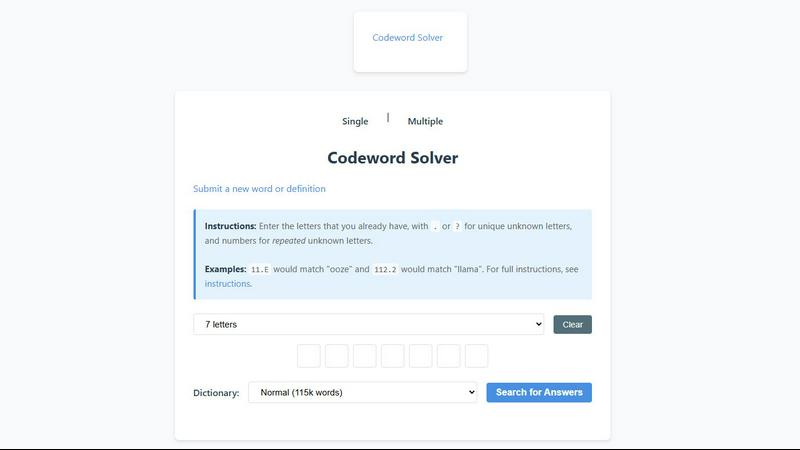
This feature allows users to input a single word pattern and receive a list of matching word candidates. By simply entering known letters alongside placeholders for unknown letters, the solver quickly filters through a vast database to provide you with potential solutions. This streamlined approach eliminates guesswork, making it easier to fill in the blanks in your codeword puzzle.
Multi-Pattern Solving
For those tackling more complex puzzles, the multi-pattern solving feature enables you to input two patterns simultaneously. This is particularly useful when the same number-letter relationships are present across different words in the puzzle. By analyzing the connections between linked words, the solver enhances your chances of finding the correct answers more quickly and efficiently.
Flexible Pattern Input
The solver offers a user-friendly interface for pattern input, where you can easily indicate known letters, unknown letters, and repeated letters. By using symbols like '.' or '?' for unknown letters and numbers for consistent repeats, you can create a precise representation of the puzzle. This flexible input method ensures that the solver understands your requirements and delivers accurate results.
Customizable Difficulty Dictionaries
Recognizing that different players have varying levels of expertise, the Code Word Solver provides multiple dictionary options. You can choose between hard (260k words), normal (115k words), and easy (20k words) dictionaries. This flexibility allows you to select a word list that best matches your skill level, ensuring a more tailored and enjoyable puzzle-solving experience.
ScopeSnap
AI-Powered Scope Generation
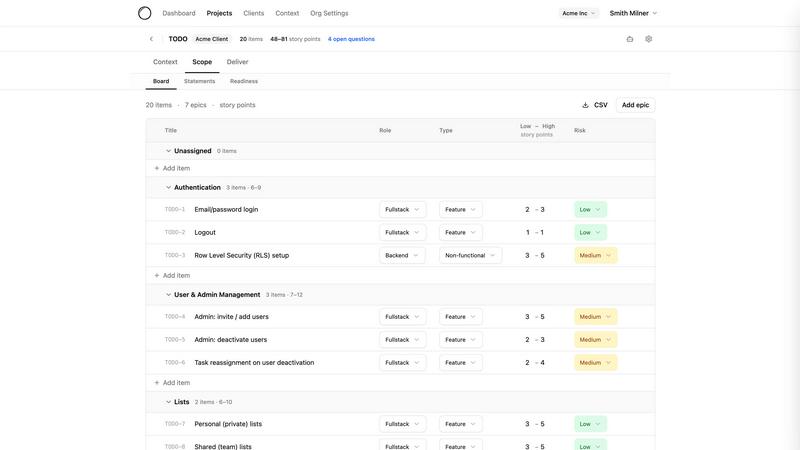
This core feature ingests raw, unstructured text from various sources like call transcripts, Slack exports, or handwritten notes. Using advanced language models, it automatically identifies key requirements, user actions, and system functionalities, structuring them into a preliminary project backlog complete with epics and detailed scope items. It intelligently flags assumptions and surfaces open questions for the team to review, providing a powerful head start on scope definition.
Interactive Scope Refinement Board
The generated scope is presented in a dynamic, kanban-style board interface where teams can collaboratively review, edit, and organize items. This feature allows for direct manipulation of the backlog: dragging items between stages, breaking down large epics, assigning development roles (e.g., Frontend, Backend, DevOps), and attaching custom time or complexity estimates to each task, ensuring every aspect of the project is quantified.
Automated Proposal & SOW Document Builder
Once the scope is finalized and estimated, this feature automates the creation of client-facing documentation. Users can select a template (Proposal or Statement of Work), and ScopeSnap populates it with the structured scope, estimates, assumptions, and defined deliverables. The output is a polished, professional PDF or shareable document, eliminating hours of manual copying, pasting, and formatting from disparate sources.
Integration-First Data Context
Understanding that discovery happens across tools, ScopeSnap is built with compatibility in mind. It supports direct paste-in from a wide array of sources and is designed for a workflow that sits alongside communication platforms like Zoom, Google Meet, email clients, and note-taking apps. This ensures all relevant project context can be easily aggregated into the scoping engine without disruptive context switching.
Use Cases
Code Word Solver - Missing Words Finder
Casual Puzzle Solving
For casual puzzle enthusiasts, the Code Word Solver simplifies the process of tackling codeword puzzles. By inputting known letters and using the solver to find possible matches, players can enjoy a more relaxed and enjoyable experience without the frustration of being stuck on challenging clues.
Competitive Puzzle Challenges
In competitive environments, such as puzzle competitions or timed challenges, using the Code Word Solver can provide a strategic advantage. By quickly generating potential word matches, players can save time and maintain their competitive edge, ultimately increasing their chances of winning.
Educational Tool for Learners
Teachers and educators can utilize the Code Word Solver as an educational tool to help students understand word patterns and develop problem-solving skills. By engaging with the solver, students can learn to recognize letter relationships and improve their vocabulary in a fun and interactive way.
Community Contribution and Improvement
The Code Word Solver allows users to submit new words and definitions, fostering a sense of community and collaboration. This feature encourages users to contribute to the database, ensuring that the solver continually improves and expands its coverage over time, benefiting all users in the process.
ScopeSnap
Freelance Developer Client Onboarding
For solo developers, ScopeSnap streamlines the process of converting initial client discussions into a fixed-scope proposal. After a discovery call, the freelancer can paste their notes and meeting transcript into the tool to quickly generate a structured scope, identify edge cases, and produce a credible, detailed estimate and SOW to secure the project with clear boundaries and expectations.
Software Agency Pre-Sales Scoping
Agencies can use ScopeSnap to bring consistency and speed to their sales engineering phase. Sales teams can input notes from multiple stakeholder interviews, and the platform will synthesize a unified scope document. This allows for rapid iteration with internal technical leads to validate feasibility and cost before presenting a polished, accurate proposal to the prospective client.
Technical Consultant Requirement Analysis
Consultants tasked with defining project specifications for third-party teams can use ScopeSnap as an analysis tool. By processing all gathered business and technical requirements, the AI helps identify gaps, dependencies, and implicit assumptions, enabling the consultant to deliver a comprehensive, well-structured scope of work document to the development team for execution.
Iterative Project Scope Refinement
For projects following agile or iterative methodologies, ScopeSnap can be used at the start of each new phase or sprint. Teams can feed in notes from refinement sessions or user feedback to quickly generate and estimate the backlog for the upcoming cycle, maintaining a living document that accurately reflects the evolving project trajectory.
Overview
About Code Word Solver - Missing Words Finder
Code Word Solver - Missing Words Finder is an innovative tool designed to enhance your experience with codeword puzzles, making them less frustrating and more enjoyable. This product is perfect for puzzle enthusiasts who often find themselves confronted with tricky codewords that require additional help. By leveraging the patterns you already know, this tool filters potential answers, allowing you to decode the puzzle grid confidently. Codewords operate on a unique mapping system where letters are replaced with numbers (1-26), and once you've identified the mapping for a specific letter, it applies universally throughout the puzzle. The solver supports both single and multiple pattern inputs, accommodating various solving strategies. Whether you're a casual player or a serious puzzle solver, this tool is tailored to help you solve codewords efficiently.
About ScopeSnap
ScopeSnap is an AI-powered scoping and proposal platform engineered for freelance developers, technical consultants, and software development agencies. It directly addresses the critical, yet often chaotic, phase between client discovery and project kickoff. The core value proposition is transforming unstructured input—such as meeting transcripts, email threads, and scattered notes—into a structured, actionable, and estimatable project scope. By leveraging AI to parse context and generate a preliminary backlog of epics and user stories, ScopeSnap mitigates the risk of missed requirements and vague deliverables that plague custom software estimation. The platform provides a centralized workspace to iteratively refine this scope, assign roles, set time estimates, and resolve ambiguities. Finally, it seamlessly compiles the polished scope into client-ready professional documents like Proposals or Statements of Work (SOW). This end-to-end workflow is designed for integration into modern development practices, replacing manual, error-prone processes with a systematic, tech-stack compatible tool that ensures clarity from the first conversation to the signed contract.
Frequently Asked Questions
Code Word Solver - Missing Words Finder FAQ
How does the Code Word Solver work?
The Code Word Solver filters potential answers based on the patterns you provide, using known letters, placeholders for unknown letters, and numbers for repeated letters to generate matching word candidates.
Can I use the solver for complex codewords with multiple patterns?
Yes, the solver supports both single pattern and multi-pattern solving. You can input two patterns at once, making it easier to solve linked words that share similar number-letter relationships.
What type of dictionaries are available in the solver?
The Code Word Solver offers three difficulty levels for its dictionaries: hard (260k words), normal (115k words), and easy (20k words). This allows users to select a word list that best suits their skill level.
How can I improve the word coverage in the solver?
If you encounter a word that is not in the database or wish to add an extra definition, you can submit it through the solver. This community-powered feature helps enhance the overall word coverage and keeps the solver relevant and useful.
ScopeSnap FAQ
What types of input does ScopeSnap accept for scope generation?
ScopeSnap is designed to process unstructured text from a wide variety of sources common in the discovery phase. You can directly paste in content from video call transcripts (e.g., Otter.ai, Rev), email correspondence, notes from apps like Notion or Google Docs, bullet-point lists, and even rough voice memo transcriptions. The AI is optimized to parse conversational language and extract actionable requirements.
How does ScopeSnap handle different tech stacks and project types?
The platform is technology-agnostic in its core scoping function. It focuses on identifying functional requirements, user stories, and features rather than prescribing implementations. During the refinement stage, you assign roles and estimates based on your team's specific expertise—whether it's a React frontend, a Node.js backend, mobile development, or cloud architecture. The output documents are templated to suit various project types, from web apps to SaaS platforms.
Can I collaborate with my team or client within ScopeSnap?
ScopeSnap provides a collaborative workspace for internal team refinement, allowing members to review, edit, and estimate the scope board. Client-facing sharing is typically handled through the generated Proposal or SOW documents, which are exported and sent via your existing communication channels. This maintains a clear separation between internal scoping work and the finalized client deliverable.
Is the AI-generated scope final, or does it require human review?
The AI-generated scope is a powerful starting point, but it is not final. It is explicitly designed for human-in-the-loop refinement. The platform surfaces open questions and flagged assumptions precisely to guide your review. Technical leads and project managers must critically review, adjust, break down, and estimate each item to ensure technical accuracy, completeness, and alignment with the client's true needs before generating a final proposal.
Alternatives
Code Word Solver - Missing Words Finder Alternatives
Code Word Solver - Missing Words Finder is a specialized online tool designed to assist users in solving codeword puzzles efficiently. This product falls under the category of puzzle-solving applications, offering features that streamline the process of decoding letters and numbers in various word games. Users often seek alternatives to such tools for reasons ranging from pricing and feature sets to specific platform compatibility, which can impact their overall experience. When searching for an alternative, it's essential to consider factors such as the comprehensiveness of the word database, the flexibility of input options, and the ease of use in adapting to different puzzle types. In the realm of codeword solvers, the user experience can vary significantly based on the interface, available features, and the level of support provided. It's crucial to look for options that allow for both single and multi-pattern solving, as well as the ability to choose from different difficulty dictionaries. Additionally, community support for expanding word coverage can enhance the effectiveness of any codeword solver, making it a valuable tool for both casual players and seasoned code-crackers alike.
ScopeSnap Alternatives
ScopeSnap is a project scoping and proposal generation tool in the productivity and management software category. It uses AI to help freelance developers and software agencies transform initial client discussions into structured, estimatable tasks and professional proposals. Users often explore alternatives to ScopeSnap for various reasons, such as specific budget constraints, the need for different feature sets, or deeper integration with their existing tech stack and project management ecosystem. The right tool must align with a team's operational workflow and technical environment. When evaluating alternatives, key considerations include the platform's ability to integrate with your current tools, its compatibility with your development methodology, and how it handles the iterative refinement of technical requirements. The focus should be on finding a solution that seamlessly fits into your existing software development lifecycle.