
Coursebricks vs ScopeSnap
Side-by-side comparison to help you choose the right product.

Coursebricks
Coursebricks is an all-in-one training management platform with deep CRM and payment integrations.
Last updated: March 1, 2026

ScopeSnap
ScopeSnap's AI instantly transforms discovery notes into structured project scopes and client-ready proposals.
Last updated: March 18, 2026
Visual Comparison
Coursebricks

ScopeSnap
Feature Comparison
Coursebricks
Unified Course Scheduling & Resource Management
This feature provides a single system of record for your entire training calendar. Administrators can assign instructors, book venues, and allocate training materials to each course session from a centralized dashboard. The platform tracks real-time availability and manages scheduling conflicts, ensuring optimal resource utilization without the need to juggle multiple spreadsheets or external tools, keeping all operational data synchronized.
Integrated Website & Checkout Engine
Coursebricks includes tools to build a professional training portal or deeply integrate with an existing website (including WordPress). This allows organizations to display and sell courses directly through their own branded site. The system handles the entire checkout flow, accepting secure credit card payments via Stripe or invoice-based bookings, while automatically capturing all customer and order data directly into the built-in CRM.
Automated Workflows & Communications
Move beyond manual emails with powerful, rule-based automation. This feature automates the entire student journey, from sending confirmation emails and pre-course materials upon registration to dispatching payment reminders, post-training surveys, and digital certificates upon completion. All communications are tracked, providing full visibility into engagement and eliminating repetitive administrative tasks.
Centralized CRM & Marketing Automation
Manage all leads, prospects, and past participants in a unified CRM. The platform enables targeted email marketing campaigns using advanced segmentation filters, allowing you to send personalized promotions to specific audiences. This integration of contact management and broadcast tools is designed to increase course enrollment rates and fill seats by delivering the right message to the right people at the right time.
ScopeSnap
AI-Powered Scope Generation
This core feature ingests raw, unstructured text from various sources like call transcripts, Slack exports, or handwritten notes. Using advanced language models, it automatically identifies key requirements, user actions, and system functionalities, structuring them into a preliminary project backlog complete with epics and detailed scope items. It intelligently flags assumptions and surfaces open questions for the team to review, providing a powerful head start on scope definition.
Interactive Scope Refinement Board
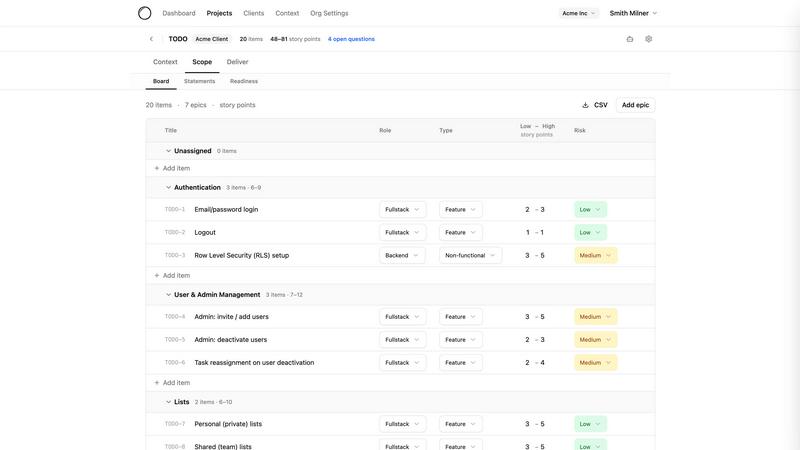
The generated scope is presented in a dynamic, kanban-style board interface where teams can collaboratively review, edit, and organize items. This feature allows for direct manipulation of the backlog: dragging items between stages, breaking down large epics, assigning development roles (e.g., Frontend, Backend, DevOps), and attaching custom time or complexity estimates to each task, ensuring every aspect of the project is quantified.
Automated Proposal & SOW Document Builder
Once the scope is finalized and estimated, this feature automates the creation of client-facing documentation. Users can select a template (Proposal or Statement of Work), and ScopeSnap populates it with the structured scope, estimates, assumptions, and defined deliverables. The output is a polished, professional PDF or shareable document, eliminating hours of manual copying, pasting, and formatting from disparate sources.
Integration-First Data Context
Understanding that discovery happens across tools, ScopeSnap is built with compatibility in mind. It supports direct paste-in from a wide array of sources and is designed for a workflow that sits alongside communication platforms like Zoom, Google Meet, email clients, and note-taking apps. This ensures all relevant project context can be easily aggregated into the scoping engine without disruptive context switching.
Use Cases
Coursebricks
Corporate Training Departments Scaling Operations
Internal L&D teams can use Coursebricks to manage a growing catalog of employee training sessions. The platform automates enrollment, handles room and trainer scheduling, distributes materials, and tracks completion for compliance reporting. Integration with HR systems via Zapier streamlines data flow, making it ideal for organizations looking to professionalize and scale their internal training delivery.
Professional Certification Bodies
Organizations that offer accredited certifications benefit from the end-to-end management capabilities. Coursebricks handles public course scheduling, secure online registrations and payments, automated delivery of study resources, and the generation and distribution of secure digital certificates upon successful completion, all while maintaining a rigorous audit trail.
Training Companies with a Multi-Venue Model
For providers who run courses at various client sites or rented venues, the unified scheduling and venue management features are critical. The system tracks venue availability, costs, and specifications, automatically associating them with specific sessions and managing instructor assignments, simplifying the logistics of a distributed training operation.
Universities & Colleges Managing Continuing Education
Academic institutions offering professional development and continuing education courses can leverage Coursebricks to create a public-facing storefront. It manages registrations and payments separately from core student systems, provides automated communication with non-degree students, and handles the administrative overhead of short-course programs efficiently.
ScopeSnap
Freelance Developer Client Onboarding
For solo developers, ScopeSnap streamlines the process of converting initial client discussions into a fixed-scope proposal. After a discovery call, the freelancer can paste their notes and meeting transcript into the tool to quickly generate a structured scope, identify edge cases, and produce a credible, detailed estimate and SOW to secure the project with clear boundaries and expectations.
Software Agency Pre-Sales Scoping
Agencies can use ScopeSnap to bring consistency and speed to their sales engineering phase. Sales teams can input notes from multiple stakeholder interviews, and the platform will synthesize a unified scope document. This allows for rapid iteration with internal technical leads to validate feasibility and cost before presenting a polished, accurate proposal to the prospective client.
Technical Consultant Requirement Analysis
Consultants tasked with defining project specifications for third-party teams can use ScopeSnap as an analysis tool. By processing all gathered business and technical requirements, the AI helps identify gaps, dependencies, and implicit assumptions, enabling the consultant to deliver a comprehensive, well-structured scope of work document to the development team for execution.
Iterative Project Scope Refinement
For projects following agile or iterative methodologies, ScopeSnap can be used at the start of each new phase or sprint. Teams can feed in notes from refinement sessions or user feedback to quickly generate and estimate the backlog for the upcoming cycle, maintaining a living document that accurately reflects the evolving project trajectory.
Overview
About Coursebricks
Coursebricks is a comprehensive, API-first training management software stack engineered to consolidate and automate the entire lifecycle of professional training programs. It serves as the central operational hub for corporate training providers, educational institutions, and professional certification bodies, replacing a fragmented collection of tools with a single, integrated platform. Its core value proposition lies in its deep native integrations and automation capabilities, which eliminate manual data entry and system-switching. By seamlessly connecting essential functions like course scheduling, registrations, payment processing (via Stripe), CRM, and financial reconciliation (with Xero), Coursebricks creates a cohesive data ecosystem. This tech-stack oriented approach empowers administrators to manage instructors, venues, materials, leads, and communications from a unified dashboard while offering learners a professional, integrated website and checkout experience. The platform's extensibility is further amplified through Zapier, enabling compatibility with over 8,000 additional applications, ensuring it can slot into and enhance any existing digital infrastructure.
About ScopeSnap
ScopeSnap is an AI-powered scoping and proposal platform engineered for freelance developers, technical consultants, and software development agencies. It directly addresses the critical, yet often chaotic, phase between client discovery and project kickoff. The core value proposition is transforming unstructured input—such as meeting transcripts, email threads, and scattered notes—into a structured, actionable, and estimatable project scope. By leveraging AI to parse context and generate a preliminary backlog of epics and user stories, ScopeSnap mitigates the risk of missed requirements and vague deliverables that plague custom software estimation. The platform provides a centralized workspace to iteratively refine this scope, assign roles, set time estimates, and resolve ambiguities. Finally, it seamlessly compiles the polished scope into client-ready professional documents like Proposals or Statements of Work (SOW). This end-to-end workflow is designed for integration into modern development practices, replacing manual, error-prone processes with a systematic, tech-stack compatible tool that ensures clarity from the first conversation to the signed contract.
Frequently Asked Questions
Coursebricks FAQ
What is a training management system?
A training management system (TMS) is a specialized software platform, like Coursebricks, designed to automate and centralize the administrative and operational tasks associated with delivering training programs. It integrates functionalities typically spread across separate tools—such as scheduling, registration, payment processing, CRM, communication, and reporting—into a single, cohesive stack to improve efficiency and data accuracy.
Do I need technical knowledge to use Coursebricks?
No, Coursebricks is built with a user-friendly interface that allows administrators to manage complex operations without coding. For advanced integrations and automations, the platform offers no-code connectors like Zapier and pre-built integrations with major services like Stripe, Xero, and WordPress, making it accessible to non-technical users while remaining powerful for tech teams.
Can I showcase my courses directly on my own website?
Yes. Coursebricks provides multiple options: you can use the included free website builder with custom domain support, or you can integrate its tools directly into your existing website (including WordPress sites). This allows you to maintain your brand identity while using Coursebricks as the powerful backend engine for your course catalog, scheduling, and checkout process.
Is my data secure?
Yes. Coursebricks employs enterprise-grade security practices to protect your data. This includes secure data encryption, regular backups, and compliance with modern data protection standards. You retain full ownership of your data, and the platform's architecture is designed to ensure the confidentiality and integrity of your organization's and learners' information.
ScopeSnap FAQ
What types of input does ScopeSnap accept for scope generation?
ScopeSnap is designed to process unstructured text from a wide variety of sources common in the discovery phase. You can directly paste in content from video call transcripts (e.g., Otter.ai, Rev), email correspondence, notes from apps like Notion or Google Docs, bullet-point lists, and even rough voice memo transcriptions. The AI is optimized to parse conversational language and extract actionable requirements.
How does ScopeSnap handle different tech stacks and project types?
The platform is technology-agnostic in its core scoping function. It focuses on identifying functional requirements, user stories, and features rather than prescribing implementations. During the refinement stage, you assign roles and estimates based on your team's specific expertise—whether it's a React frontend, a Node.js backend, mobile development, or cloud architecture. The output documents are templated to suit various project types, from web apps to SaaS platforms.
Can I collaborate with my team or client within ScopeSnap?
ScopeSnap provides a collaborative workspace for internal team refinement, allowing members to review, edit, and estimate the scope board. Client-facing sharing is typically handled through the generated Proposal or SOW documents, which are exported and sent via your existing communication channels. This maintains a clear separation between internal scoping work and the finalized client deliverable.
Is the AI-generated scope final, or does it require human review?
The AI-generated scope is a powerful starting point, but it is not final. It is explicitly designed for human-in-the-loop refinement. The platform surfaces open questions and flagged assumptions precisely to guide your review. Technical leads and project managers must critically review, adjust, break down, and estimate each item to ensure technical accuracy, completeness, and alignment with the client's true needs before generating a final proposal.
Alternatives
Coursebricks Alternatives
Coursebricks is a comprehensive training management platform within the productivity and management software category. It centralizes scheduling, registrations, payments, and CRM to streamline operations for training providers and educational institutions. Users often explore alternatives for various reasons, including specific budget constraints, the need for different feature sets, or particular integration requirements with their existing tech stack. The search can be driven by a need for deeper customization, a different pricing model, or compatibility with other core business systems. When evaluating an alternative, key considerations should include the platform's API robustness for custom integrations, its compatibility with your current payment processors and CRM, and the scalability of its automation workflows. The ideal solution should seamlessly connect with your existing digital ecosystem to avoid data silos and manual workarounds.
ScopeSnap Alternatives
ScopeSnap is a project scoping and proposal generation tool in the productivity and management software category. It uses AI to help freelance developers and software agencies transform initial client discussions into structured, estimatable tasks and professional proposals. Users often explore alternatives to ScopeSnap for various reasons, such as specific budget constraints, the need for different feature sets, or deeper integration with their existing tech stack and project management ecosystem. The right tool must align with a team's operational workflow and technical environment. When evaluating alternatives, key considerations include the platform's ability to integrate with your current tools, its compatibility with your development methodology, and how it handles the iterative refinement of technical requirements. The focus should be on finding a solution that seamlessly fits into your existing software development lifecycle.