
diffray vs OpenMark AI
Side-by-side comparison to help you choose the right product.

diffray
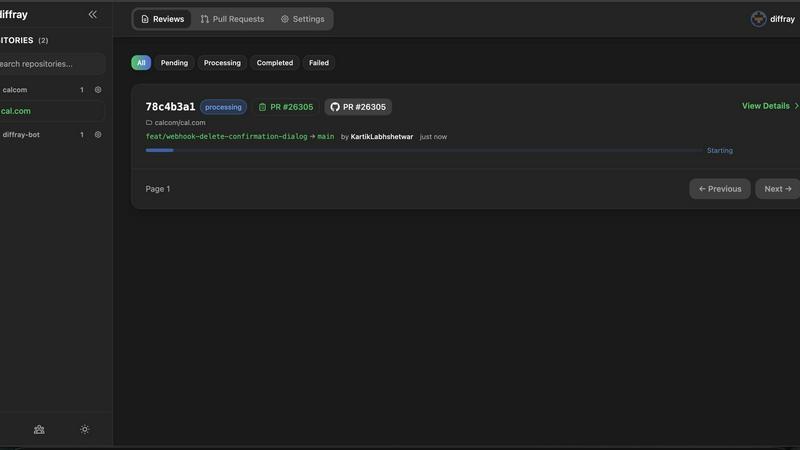
Diffray's AI code review identifies real bugs while minimizing false positives by 87%, ensuring efficient code quality.
Last updated: February 28, 2026

OpenMark AI benchmarks 100+ LLMs on your task: cost, speed, quality & stability. Browser-based; no provider API keys for hosted runs.
Visual Comparison
diffray
OpenMark AI
Overview
About diffray
diffray is an advanced multi-agent AI code review platform designed to address the limitations of traditional single-model tools. It is specifically tailored for software development teams that require precision and context in their code reviews. Unlike generic AI reviewers that often overwhelm developers with irrelevant style suggestions while neglecting critical issues, diffray leverages a specialized fleet of over 30 AI agents. Each agent is an expert in a distinct area, including security vulnerabilities, performance optimizations, bug detection, framework-specific best practices, and even SEO considerations for web applications. This targeted approach enables diffray to conduct thorough and contextual reviews of code, understanding not only the changes proposed in pull requests but also the broader context of the entire repository. By doing so, diffray dramatically reduces false positives by 87% and triples the identification of actionable issues. With seamless integration capabilities for platforms like GitHub, GitLab, Bitbucket, and on-premise setups, diffray transforms code review processes, cutting review times from an average of 45 minutes down to just 12 minutes per week. It is engineered for professional development teams that prioritize actionable insights and contextual understanding over generic feedback.
About OpenMark AI
OpenMark AI is a web application for task-level LLM benchmarking. You describe what you want to test in plain language, run the same prompts against many models in one session, and compare cost per request, latency, scored quality, and stability across repeat runs, so you see variance, not a single lucky output.
The product is built for developers and product teams who need to choose or validate a model before shipping an AI feature. Hosted benchmarking uses credits, so you do not need to configure separate OpenAI, Anthropic, or Google API keys for every comparison.
You get side-by-side results with real API calls to models, not cached marketing numbers. Use it when you care about cost efficiency (quality relative to what you pay), not just the cheapest token price on a datasheet.
OpenMark AI supports a large catalog of models and focuses on pre-deployment decisions: which model fits this workflow, at what cost, and whether outputs are consistent when you run the same task again. Free and paid plans are available; details are shown in the in-app billing section.