
LLMWise vs rfpaihub
Side-by-side comparison to help you choose the right product.

LLMWise
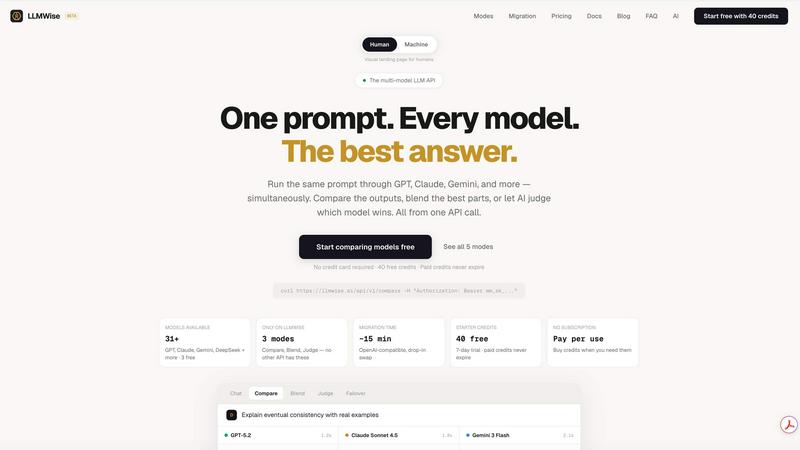
LLMWise offers a single API to seamlessly access and compare multiple AI models, charging only for what you use.
Last updated: February 27, 2026

rfpaihub
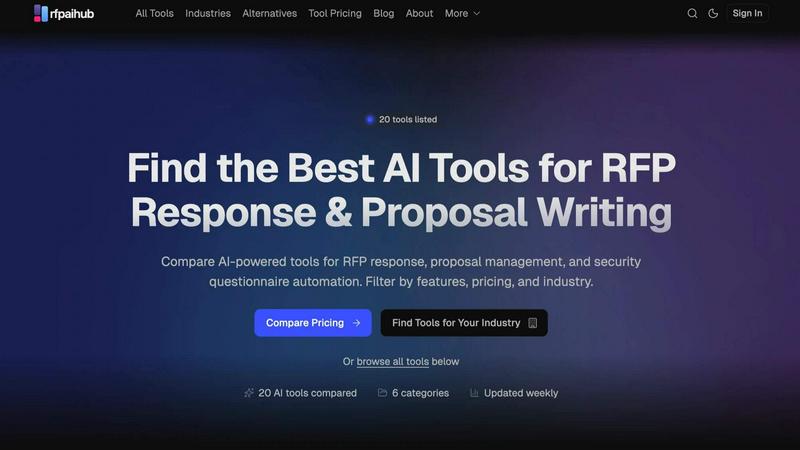
Rfpaihub is a tech stack hub to find and compare AI tools that automate RFP responses and integrate with your proposal workflow.
Last updated: April 13, 2026
Visual Comparison
LLMWise
rfpaihub
Feature Comparison
LLMWise
Smart Routing
LLMWise's smart routing feature automatically directs prompts to the most appropriate LLM based on the task at hand. For instance, code-related queries are sent to GPT, while creative writing prompts might go to Claude. This intelligent selection ensures optimal performance and accuracy for every request, allowing developers to focus on building rather than managing multiple APIs.
Compare & Blend
The compare and blend functionalities enable users to execute prompts across various models simultaneously. By comparing different outputs side-by-side, developers can easily identify which model performs best for their specific needs. The blend feature synthesizes the strongest responses from multiple models into a cohesive answer, significantly improving the overall quality of results.
Resilient Architecture
LLMWise is designed with resilience in mind, featuring a circuit-breaker failover mechanism that reroutes requests to backup models if a primary provider experiences downtime. This ensures that applications remain operational and reliable, minimizing disruptions and enhancing user experience even during outages.
Testing & Optimization
The platform provides robust testing and optimization tools, including benchmark suites and automated regression checks. Developers can conduct batch tests to evaluate performance in terms of speed, cost, and reliability, allowing for continuous improvement of their applications. This focus on optimization helps teams ensure they are leveraging resources efficiently while maintaining high-quality outputs.
rfpaihub
Curated Tool Comparison Engine
The platform's core feature is its detailed comparison matrix, allowing users to filter and evaluate AI RFP tools side-by-side based on specific technical attributes. Users can filter by integration capabilities (e.g., CRM like Salesforce, document repositories like SharePoint), core features such as AI drafting or security libraries, target industry, and team size. This goes beyond basic listings to provide a stack-oriented analysis, crucial for ensuring new software complements existing infrastructure without creating data silos or workflow disruptions.
Industry and Role-Based Filtering
Understanding that needs vary drastically between a fintech company handling complex DDQs and a SaaS startup crafting narrative proposals, RFP AI Hub offers advanced categorization. Users can browse tools specifically tagged for industries like Healthcare, Finance, or Government, or filter by primary user role such as Proposal Manager, Security Officer, or Sales Engineer. This ensures the recommendations are contextually relevant and address the unique compliance, terminology, and process requirements of different verticals and team functions.
In-Depth Tool Profiles and Analysis
Each listed tool features a comprehensive profile that breaks down its technical specifications and operational fit. Details typically include supported import/export formats, API availability, knowledge base structuring methodology, AI model partnerships, and granular feature lists for response drafting, collaboration, and analytics. This depth transforms the directory from a simple list into a research platform, giving technical evaluators the necessary data to assess long-term viability and scalability within their tech ecosystem.
Vendor-Neutral Directory with Clear Methodology
RFP AI Hub operates as an unbiased, free directory. Its editorial policy and published methodology ensure that comparisons are based on factual feature analysis and user-reported data, not paid placements. This vendor-neutral stance is a critical feature for buyers seeking objective information. The platform encourages tool submissions at no cost, fostering a comprehensive and current database that reflects the true state of the market, allowing for a trustworthy evaluation free from commercial bias.
Use Cases
LLMWise
Software Development
Developers can utilize LLMWise to streamline coding tasks by routing prompts directly to the most competent model for code generation. This not only saves time but also reduces the complexity of managing multiple API keys, making the development process smoother and more efficient.
Creative Writing
Writers can leverage the blend feature of LLMWise to generate more compelling narratives. By combining the strengths of different models, writers can enhance their creative outputs, producing high-quality content that resonates with their audience while benefiting from diverse perspectives.
Language Translation
LLMWise simplifies the translation process by utilizing the best models for language tasks. Developers can send translation prompts to models specifically trained for linguistic accuracy, ensuring that the translations are not only quick but also contextually and culturally appropriate.
AI Research and Development
Researchers can take advantage of the testing and optimization features to benchmark various models against specific criteria. This allows them to evaluate the effectiveness of different AI solutions, fostering innovation and helping to identify the most suitable models for their research projects.
rfpaihub
Technical Stack Integration Research
A company using a specific CRM (e.g., HubSpot), a cloud storage solution (e.g., Google Drive), and a project management tool (e.g., Jira) needs an RFP AI tool that integrates seamlessly. A sales operations manager uses RFP AI Hub to filter tools by these specific integration capabilities, comparing API documentation and pre-built connectors to identify solutions that will sync bid data, automate content pulls, and update records without manual intervention, ensuring a cohesive tech stack.
Security Compliance Team Tool Selection
A security team overwhelmed by completing hundreds of vendor security questionnaires annually needs an automation solution. The CISO directs a team member to use RFP AI Hub, filtering for the "Security Questionnaire Automation" category and further by compliance frameworks like SOC 2 or ISO 27001. They compare tools based on their curated library of pre-vetted security answers, audit trail features, and ability to handle complex question-answer mappings to select a platform that reduces review cycles and maintains answer integrity.
Scaling Proposal Operations for Growth
A fast-growing SaaS company's proposal team is bottlenecked by manual processes. The VP of Sales seeks to implement an AI-powered proposal management platform. Using RFP AI Hub, they filter tools by "Proposal Writing" features, team size ("Enterprise"), and look for advanced functionality like conditional formatting, brand control, and analytics dashboards. This enables them to compare solutions that not only draft content but also provide the governance and insight needed to scale operations efficiently.
Industry-Specific Solution Sourcing
A healthcare technology provider responding to RFPs from hospital systems must address highly specific regulatory and operational questions (e.g., HIPAA, EHR integration). A proposal specialist uses RFP AI Hub's industry filter for "Healthcare" to discover tools whose AI models and content libraries are trained on or cater to healthcare terminology and compliance requirements, significantly improving answer relevance and reducing the regulatory review burden.
Overview
About LLMWise
LLMWise is an innovative platform that streamlines access to numerous large language models (LLMs) through a single API. By integrating models from industry leaders such as OpenAI, Anthropic, Google, Meta, xAI, and DeepSeek, LLMWise offers developers a simplified way to leverage the best AI for any task without the hassle of managing multiple providers. Its intelligent routing system ensures that each prompt is matched to the most suitable model, whether it involves coding, creative writing, or translation tasks. With features like side-by-side comparison and output blending, users can enhance the quality of their results. Ideal for developers seeking to optimize their AI workflows, LLMWise eliminates complexity while providing powerful tools to enhance application performance.
About rfpaihub
RFP AI Hub is a specialized, free-to-use online directory designed for technical sales, proposal, and security teams navigating the complex landscape of AI-powered response automation. It functions as a centralized, curated platform for comparing software solutions that streamline the response process for Requests for Proposals (RFPs), security questionnaires (like SIG, CAIQ, VSA), and vendor assessments. The platform serves professionals who need to integrate these tools into their existing tech stack, focusing on compatibility, feature depth, and workflow-specific functionality. Its core value proposition lies in its ability to cut through market noise by providing a filtered, structured comparison based on critical technical and operational criteria, enabling teams to make informed, efficient software selection decisions that align with their specific integration needs and response workflows.
Frequently Asked Questions
LLMWise FAQ
How does LLMWise ensure optimal model selection?
LLMWise employs an intelligent routing system that analyzes each prompt and directs it to the best-performing model based on task type, ensuring optimal results for different applications.
Can I use my existing API keys with LLMWise?
Yes, LLMWise supports bring your own key (BYOK) functionality, allowing users to integrate their existing API keys from various providers, which helps in managing costs effectively.
What happens if a model fails during a request?
In the event of a model failure, LLMWise's resilient architecture features a circuit-breaker failover mechanism that reroutes requests to backup models, ensuring uninterrupted service and reliability.
Are there any hidden fees with LLMWise?
LLMWise operates on a pay-per-use model with no subscription fees. Users pay only for the credits they consume, and there are no hidden costs associated with using the platform.
rfpaihub FAQ
What types of tools does RFP AI Hub compare?
RFP AI Hub provides comparisons across a focused spectrum of AI-powered response automation software. Primary categories include dedicated RFP Response software, comprehensive Proposal Management platforms, and specialized Security Questionnaire Automation tools. The directory also covers supporting solutions for Knowledge Base management, Document Generation, and Contract & Bid Management, allowing users to find tools for every stage of the response lifecycle.
How does the platform ensure its comparisons are accurate and unbiased?
The platform operates on a clear, published editorial policy and methodology. It functions as a free directory, and tool inclusion is not contingent on payment. Comparisons are built on factual, verifiable data regarding features, integrations, and pricing gathered from vendor materials, product documentation, and user feedback. This vendor-neutral model is designed to eliminate commercial bias, providing a trusted resource for objective technical evaluation.
Is RFP AI Hub free for both tool seekers and software vendors?
Yes, the platform is completely free for end-users to browse, filter, and compare tools without requiring an account. For software vendors, submitting a product for listing and review on RFP AI Hub is also conducted at no cost. This approach aims to build a comprehensive and current market overview that benefits the entire ecosystem by lowering the barrier to information and discovery.
Can I use RFP AI Hub to find tools for my specific tech stack?
Absolutely. A core functionality of RFP AI Hub is its focus on integration and compatibility. The filtering system allows you to seek out tools based on their supported integrations with popular CRMs (Salesforce, Microsoft Dynamics), cloud storage services, communication platforms (Slack, Teams), and other business software. This enables you to prioritize solutions that will connect natively with your existing infrastructure.
Alternatives
LLMWise Alternatives
LLMWise is an innovative API platform that consolidates access to multiple large language models (LLMs) such as GPT, Claude, and Gemini, among others. It simplifies the AI integration process by providing intelligent routing that ensures users can leverage the best model for every specific task, whether it’s for creative writing, coding, or translation. As a solution designed for developers, LLMWise falls under the AI Assistants category, streamlining the complexities of managing different AI providers. Users often seek alternatives to LLMWise for various reasons, including pricing structures, feature sets, or specific platform requirements that may not be addressed by a single provider. When exploring alternatives, it is essential to consider factors such as ease of integration, model performance, pricing flexibility, and the ability to test and optimize outputs. Evaluating these aspects will help ensure that the chosen solution aligns with the specific needs of your project and enhances overall productivity.
rfpaihub Alternatives
RFP AI Hub is a specialized platform in the productivity and proposal management category. It serves as a centralized directory for comparing AI-powered tools that automate RFP responses, proposal creation, and security questionnaire handling. The platform allows users to filter options based on features, pricing, and industry fit to find the right technical solution. Users often explore alternatives to find a tool that aligns perfectly with their existing tech stack and workflow requirements. Common reasons include seeking different pricing models, more advanced or specific automation features, or better integration capabilities with their current CRM, document management, and collaboration systems. The need for a tool that seamlessly embeds into their operational environment is a primary driver. When evaluating alternatives, focus on core technical compatibility. Key considerations include the tool's API availability for custom integrations, its native connectors to essential platforms like Salesforce or Microsoft 365, and the depth of its AI customization for your specific industry knowledge base. The ideal solution should not only automate content but also fit invisibly into your established proposal tech stack.