
LLMWise vs Talk Journal
Side-by-side comparison to help you choose the right product.

LLMWise
LLMWise offers a single API to seamlessly access and compare multiple AI models, charging only for what you use.
Last updated: February 27, 2026

Talk Journal
Talk Journal converts your spoken thoughts into organized written entries across 34 languages.
Last updated: March 1, 2026
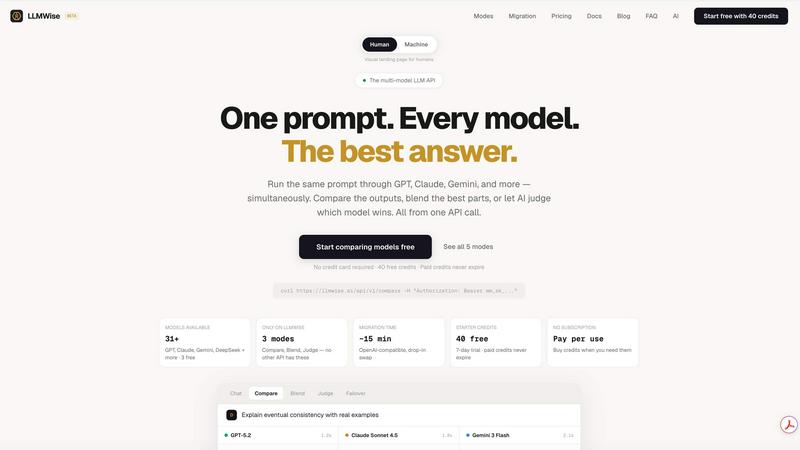
Visual Comparison
LLMWise
Talk Journal

Feature Comparison
LLMWise
Smart Routing
LLMWise's smart routing feature automatically directs prompts to the most appropriate LLM based on the task at hand. For instance, code-related queries are sent to GPT, while creative writing prompts might go to Claude. This intelligent selection ensures optimal performance and accuracy for every request, allowing developers to focus on building rather than managing multiple APIs.
Compare & Blend
The compare and blend functionalities enable users to execute prompts across various models simultaneously. By comparing different outputs side-by-side, developers can easily identify which model performs best for their specific needs. The blend feature synthesizes the strongest responses from multiple models into a cohesive answer, significantly improving the overall quality of results.
Resilient Architecture
LLMWise is designed with resilience in mind, featuring a circuit-breaker failover mechanism that reroutes requests to backup models if a primary provider experiences downtime. This ensures that applications remain operational and reliable, minimizing disruptions and enhancing user experience even during outages.
Testing & Optimization
The platform provides robust testing and optimization tools, including benchmark suites and automated regression checks. Developers can conduct batch tests to evaluate performance in terms of speed, cost, and reliability, allowing for continuous improvement of their applications. This focus on optimization helps teams ensure they are leveraging resources efficiently while maintaining high-quality outputs.
Talk Journal
AI-Powered Voice Transcription & Categorization
Talk Journal's core functionality is built on a robust speech recognition stack capable of processing audio in 34 languages. The system goes beyond simple transcription; it employs NLP models to analyze the content of your spoken entry and automatically file it into the relevant category—Wins, Appreciation, or Stories. This backend intelligence ensures your journal is organized from the moment you finish speaking, requiring no manual tagging or folder management from the user.
Encrypted, Persistent Data Storage
Security and data permanence are foundational to Talk Journal's architecture. All journal entries are encrypted both in transit and at rest, ensuring 100% privacy. A key differentiator is its policy of indefinite data access. The platform is designed so that your journal archive remains fully retrievable even if you choose to cancel your subscription, providing a permanent, vendor-lock-in-free repository for your personal history.
Multi-Language Voice Interface
The application supports a comprehensive suite of 34 languages for its voice input, including major global languages like English, Spanish, Chinese, and Hindi, as well as regional languages like Catalan and Estonian. This broad compatibility is powered by multilingual ASR (Automatic Speech Recognition) models, allowing users to interact with the journal in their native or most comfortable language, ensuring accurate transcription and a natural user experience.
Structured Journaling Framework
Talk Journal imposes a beneficial structure on the free-form practice of journaling through its three predefined entry types. This framework is integrated directly into the app's logic, guiding users to reflect on specific, positive aspects of their day. The "Wins" category captures achievements, "Appreciation" focuses on gratitude, and "Stories" is designed for narrative moments, creating a balanced and growth-oriented record without requiring the user to design the system themselves.
Use Cases
LLMWise
Software Development
Developers can utilize LLMWise to streamline coding tasks by routing prompts directly to the most competent model for code generation. This not only saves time but also reduces the complexity of managing multiple API keys, making the development process smoother and more efficient.
Creative Writing
Writers can leverage the blend feature of LLMWise to generate more compelling narratives. By combining the strengths of different models, writers can enhance their creative outputs, producing high-quality content that resonates with their audience while benefiting from diverse perspectives.
Language Translation
LLMWise simplifies the translation process by utilizing the best models for language tasks. Developers can send translation prompts to models specifically trained for linguistic accuracy, ensuring that the translations are not only quick but also contextually and culturally appropriate.
AI Research and Development
Researchers can take advantage of the testing and optimization features to benchmark various models against specific criteria. This allows them to evaluate the effectiveness of different AI solutions, fostering innovation and helping to identify the most suitable models for their research projects.
Talk Journal
Daily Professional Retrospective
Professionals and entrepreneurs can use Talk Journal to conduct a quick, voice-based end-of-day review. By verbally recounting daily "Wins" (e.g., closed deals, solved problems) and "Appreciation" (e.g., for team support), they create a searchable log of professional growth and positive interactions. This audio-logged data serves as valuable input for performance reviews, portfolio building, and maintaining a positive, documented mindset amidst a high-pressure work environment.
Mindfulness and Gratitude Practice Integration
Individuals engaged in mindfulness or gratitude practices find Talk Journal's "Appreciation" category a perfect digital complement. Instead of writing a list, users can speak their gratitude aloud, making the practice more accessible and emotional. The app's transcription and secure storage provide a lasting, reviewable record of positive focus, helping to reinforce neural pathways associated with thankfulness and well-being over time.
Audio-Based Life Logging and Memory Capture
For those wanting to document life's narrative without the hassle of typing, the "Stories" category functions as an audio diary. Parents can capture moments about their children, travelers can describe experiences, or anyone can record personal anecdotes. The voice format captures tone and emotion often lost in text, and the AI-cleaned transcription ensures these memories are preserved in an organized, readable format for the future.
Therapy and Coaching Session Notes
Clients working with therapists or coaches can use Talk Journal as a private, secure tool to verbalize insights, homework, or reflections after sessions. Speaking can be more fluid than writing for processing emotions. The automatic categorization can help separate actionable "Wins" from reflective "Stories," creating structured notes that can be referenced in future sessions to track progress and themes over the course of their journey.
Overview
About LLMWise
LLMWise is an innovative platform that streamlines access to numerous large language models (LLMs) through a single API. By integrating models from industry leaders such as OpenAI, Anthropic, Google, Meta, xAI, and DeepSeek, LLMWise offers developers a simplified way to leverage the best AI for any task without the hassle of managing multiple providers. Its intelligent routing system ensures that each prompt is matched to the most suitable model, whether it involves coding, creative writing, or translation tasks. With features like side-by-side comparison and output blending, users can enhance the quality of their results. Ideal for developers seeking to optimize their AI workflows, LLMWise eliminates complexity while providing powerful tools to enhance application performance.
About Talk Journal
Talk Journal is a sophisticated, voice-first journaling application engineered to streamline the capture and organization of daily reflections. It leverages advanced speech-to-text and natural language processing (NLP) technologies to transform spoken audio into clean, categorized written entries. The platform is architected for individuals seeking a frictionless method for personal documentation, including busy professionals, mindfulness practitioners, and anyone invested in personal growth. Its core value proposition lies in its seamless integration of voice input with intelligent post-processing, eliminating the traditional friction of manual typing. The system automatically categorizes entries into three distinct, psychologically-framed buckets: Wins (achievements), Appreciation (gratitude), and Stories (narrative moments). Built with a strong emphasis on data sovereignty and long-term access, Talk Journal ensures user entries remain encrypted and permanently accessible, even after subscription cancellation. This makes it not just a tool, but a durable, private digital archive for one's personal journey.
Frequently Asked Questions
LLMWise FAQ
How does LLMWise ensure optimal model selection?
LLMWise employs an intelligent routing system that analyzes each prompt and directs it to the best-performing model based on task type, ensuring optimal results for different applications.
Can I use my existing API keys with LLMWise?
Yes, LLMWise supports bring your own key (BYOK) functionality, allowing users to integrate their existing API keys from various providers, which helps in managing costs effectively.
What happens if a model fails during a request?
In the event of a model failure, LLMWise's resilient architecture features a circuit-breaker failover mechanism that reroutes requests to backup models, ensuring uninterrupted service and reliability.
Are there any hidden fees with LLMWise?
LLMWise operates on a pay-per-use model with no subscription fees. Users pay only for the credits they consume, and there are no hidden costs associated with using the platform.
Talk Journal FAQ
What happens to my journal entries if I cancel my subscription?
Your data remains fully accessible. A core tenet of Talk Journal's design is persistent data ownership. If you cancel your subscription, you retain indefinite access to your complete journal archive. Your encrypted entries are not deleted or held hostage, allowing you to export, review, or simply preserve your history without any ongoing cost.
How accurate is the voice transcription, especially with accents?
Talk Journal utilizes advanced, cloud-based Automatic Speech Recognition (ASR) services trained on diverse datasets to handle a wide array of accents and dialects within its 34 supported languages. While no system is 100% perfect, the AI provides highly accurate transcriptions which are then "cleaned" by secondary processing for readability. Accuracy is generally very high for clear speech in supported languages.
Is my voice data private and secure?
Yes, privacy is paramount. All audio recordings and their subsequent transcriptions are encrypted using industry-standard protocols during transmission to Talk Journal's servers and while at rest in storage. The company's privacy-first architecture ensures your spoken thoughts and written entries are treated as confidential data, with no human review of your content.
Can I use Talk Journal offline?
Based on the provided technical context, Talk Journal's core functionality relies on cloud processing for speech-to-text conversion, NLP categorization, and encryption syncing. Therefore, a stable internet connection is required to record, process, and save new entries. However, previously saved and transcribed entries are likely accessible for review within the app interface.
Alternatives
LLMWise Alternatives
LLMWise is an innovative API platform that consolidates access to multiple large language models (LLMs) such as GPT, Claude, and Gemini, among others. It simplifies the AI integration process by providing intelligent routing that ensures users can leverage the best model for every specific task, whether it’s for creative writing, coding, or translation. As a solution designed for developers, LLMWise falls under the AI Assistants category, streamlining the complexities of managing different AI providers. Users often seek alternatives to LLMWise for various reasons, including pricing structures, feature sets, or specific platform requirements that may not be addressed by a single provider. When exploring alternatives, it is essential to consider factors such as ease of integration, model performance, pricing flexibility, and the ability to test and optimize outputs. Evaluating these aspects will help ensure that the chosen solution aligns with the specific needs of your project and enhances overall productivity.
Talk Journal Alternatives
Talk Journal is a voice-first AI assistant designed for personal journaling and reflection. It operates within the category of AI-powered productivity and wellness tools, leveraging speech-to-text and natural language processing to transform spoken thoughts into organized written entries. Users often explore alternatives to Talk Journal for various reasons. These can include budget constraints, a need for different feature sets like deeper analytics or third-party app integrations, or specific platform requirements such as native desktop clients or compatibility with a particular smart home ecosystem. The search for a tool that better aligns with one's existing tech stack is common. When evaluating an alternative, consider its core architecture. Look for robust API support, compatibility with your preferred devices and operating systems, and the underlying AI model's accuracy for transcription and categorization. Data portability and encryption standards are also critical, ensuring your journal entries remain secure and can be exported if you switch platforms in the future.