
LLMWise vs TripleTen Burnout Test
Side-by-side comparison to help you choose the right product.

LLMWise
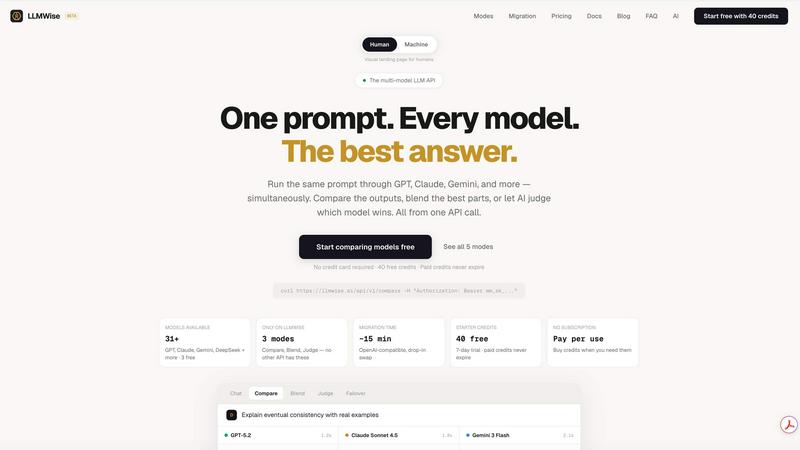
LLMWise offers a single API to seamlessly access and compare multiple AI models, charging only for what you use.
Last updated: February 27, 2026

TripleTen Burnout Test
TripleTen's Burnout Test diagnoses your risk and provides a personalized recovery plan.
Last updated: March 1, 2026
Visual Comparison
LLMWise
TripleTen Burnout Test
Feature Comparison
LLMWise
Smart Routing
LLMWise's smart routing feature automatically directs prompts to the most appropriate LLM based on the task at hand. For instance, code-related queries are sent to GPT, while creative writing prompts might go to Claude. This intelligent selection ensures optimal performance and accuracy for every request, allowing developers to focus on building rather than managing multiple APIs.
Compare & Blend
The compare and blend functionalities enable users to execute prompts across various models simultaneously. By comparing different outputs side-by-side, developers can easily identify which model performs best for their specific needs. The blend feature synthesizes the strongest responses from multiple models into a cohesive answer, significantly improving the overall quality of results.
Resilient Architecture
LLMWise is designed with resilience in mind, featuring a circuit-breaker failover mechanism that reroutes requests to backup models if a primary provider experiences downtime. This ensures that applications remain operational and reliable, minimizing disruptions and enhancing user experience even during outages.
Testing & Optimization
The platform provides robust testing and optimization tools, including benchmark suites and automated regression checks. Developers can conduct batch tests to evaluate performance in terms of speed, cost, and reliability, allowing for continuous improvement of their applications. This focus on optimization helps teams ensure they are leveraging resources efficiently while maintaining high-quality outputs.
TripleTen Burnout Test
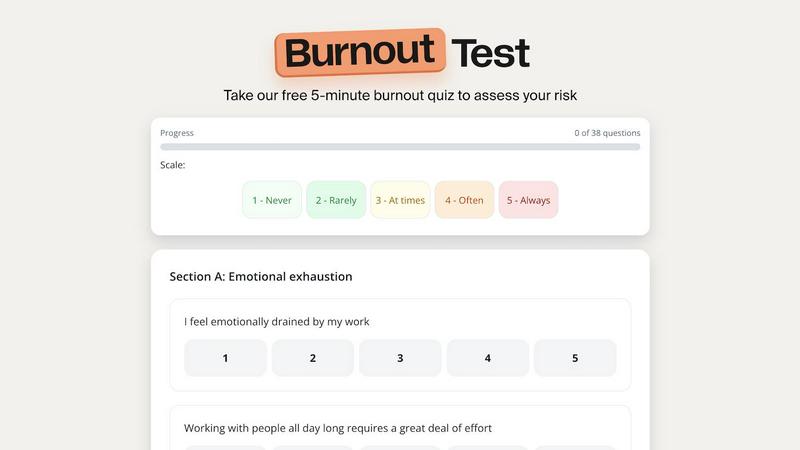
Validated 38-Question Diagnostic Engine
The core of the platform is a clinically-informed, 38-question assessment that maps responses across five critical burnout dimensions: emotional exhaustion, cynicism, professional efficacy, physical symptoms, and work-life balance. This structured diagnostic provides a comprehensive data layer, moving beyond anecdotal evidence to deliver a quantifiable analysis of an individual's mental well-being status, ensuring the output is reliable and actionable for integration into broader wellness or performance dashboards.
AI-Powered Burnout Risk Scoring
Following the diagnostic, the platform's proprietary AI engine synthesizes the multi-dimensional data to generate a personalized Burnout Risk Score. This single, data-driven metric provides immediate clarity on the user's current state, eliminating guesswork. The score serves as a key performance indicator (KPI) for mental health, allowing users and potentially their organizations to track changes over time and measure the efficacy of implemented recovery strategies.
Multi-Phase, Personalized Recovery Roadmap
The system does not stop at diagnosis. It automatically generates a tailored, phase-gated recovery plan based on the individual's unique risk profile. This roadmap is structured into distinct stages—Recognition, Crisis Management, and Rebuilding—providing context-specific, actionable strategies for immediate stabilization, short-term intervention, and long-term habit formation to prevent recurrence, creating a sustainable recovery protocol.
Tech-Stack Compatible Insights & Integration
Designed for the modern professional, the platform outputs structured, actionable insights that are compatible with personal and organizational tech stacks. Results and recovery plans are presented in a clear, modular format, enabling users to seamlessly integrate recommended actions into existing productivity tools, calendar systems, and wellness platforms, ensuring recovery becomes a managed component of the professional workflow.
Use Cases
LLMWise
Software Development
Developers can utilize LLMWise to streamline coding tasks by routing prompts directly to the most competent model for code generation. This not only saves time but also reduces the complexity of managing multiple API keys, making the development process smoother and more efficient.
Creative Writing
Writers can leverage the blend feature of LLMWise to generate more compelling narratives. By combining the strengths of different models, writers can enhance their creative outputs, producing high-quality content that resonates with their audience while benefiting from diverse perspectives.
Language Translation
LLMWise simplifies the translation process by utilizing the best models for language tasks. Developers can send translation prompts to models specifically trained for linguistic accuracy, ensuring that the translations are not only quick but also contextually and culturally appropriate.
AI Research and Development
Researchers can take advantage of the testing and optimization features to benchmark various models against specific criteria. This allows them to evaluate the effectiveness of different AI solutions, fostering innovation and helping to identify the most suitable models for their research projects.
TripleTen Burnout Test
Proactive Wellness Screening for High-Stress Roles
Organizations in tech, healthcare, and client services can deploy the test as a periodic wellness check for teams in high-burnout-risk positions. This provides HR and management with anonymized, aggregate data on team well-being, enabling proactive cultural or workload adjustments before critical talent attrition occurs, and demonstrating a data-backed commitment to employee health.
Individual Crisis Diagnosis and Triage
For professionals experiencing chronic fatigue, cynicism, or a sense of ineffectiveness, the test acts as a critical triage tool. It helps users distinguish between temporary stress and clinical burnout, providing the validated confirmation needed to justify taking immediate action, such as using sick days, seeking professional help, or initiating difficult conversations with management about workload.
Career Transition and Role Evaluation
Individuals considering a career change or evaluating a new job offer can use the Burnout Test framework to assess potential risk factors. By understanding the specific dimensions (e.g., work-life balance, professional efficacy) that contributed to past burnout, they can more effectively screen future opportunities for cultural and structural compatibility, making data-informed career decisions.
Post-Burnout Recovery Progress Tracking
For individuals actively in recovery, the platform serves as a benchmarking and tracking tool. By retaking the assessment at regular intervals, users can quantitatively measure improvements in their Burnout Risk Score across all five dimensions, validating the effectiveness of their recovery strategies and providing motivation through visible, data-driven progress.
Overview
About LLMWise
LLMWise is an innovative platform that streamlines access to numerous large language models (LLMs) through a single API. By integrating models from industry leaders such as OpenAI, Anthropic, Google, Meta, xAI, and DeepSeek, LLMWise offers developers a simplified way to leverage the best AI for any task without the hassle of managing multiple providers. Its intelligent routing system ensures that each prompt is matched to the most suitable model, whether it involves coding, creative writing, or translation tasks. With features like side-by-side comparison and output blending, users can enhance the quality of their results. Ideal for developers seeking to optimize their AI workflows, LLMWise eliminates complexity while providing powerful tools to enhance application performance.
About TripleTen Burnout Test
The TripleTen Burnout Test is a sophisticated, AI-powered diagnostic platform engineered to assess and mitigate professional burnout. It functions as a comprehensive screening tool, utilizing a validated 38-question assessment to analyze an individual's risk across five critical dimensions: emotional exhaustion, cynicism, professional efficacy, physical symptoms, and work-life balance. The platform is designed for professionals across all industries, particularly those in high-stress or high-touch roles like tech, healthcare, and customer service, who are experiencing symptoms of chronic workplace stress. Its core value proposition lies in transforming subjective feelings of overwhelm into actionable, data-driven insights. Unlike generic wellness advice, the system's AI engine performs a deep analysis of user responses to generate a personalized Burnout Risk Score and a tailored, multi-phase recovery plan. This plan provides immediate, short-term, and long-term strategies, offering a structured, tech-stack compatible approach to mental well-being that integrates recovery directly into the user's professional development lifecycle. It is the definitive tool for moving from crisis management to sustainable career health.
Frequently Asked Questions
LLMWise FAQ
How does LLMWise ensure optimal model selection?
LLMWise employs an intelligent routing system that analyzes each prompt and directs it to the best-performing model based on task type, ensuring optimal results for different applications.
Can I use my existing API keys with LLMWise?
Yes, LLMWise supports bring your own key (BYOK) functionality, allowing users to integrate their existing API keys from various providers, which helps in managing costs effectively.
What happens if a model fails during a request?
In the event of a model failure, LLMWise's resilient architecture features a circuit-breaker failover mechanism that reroutes requests to backup models, ensuring uninterrupted service and reliability.
Are there any hidden fees with LLMWise?
LLMWise operates on a pay-per-use model with no subscription fees. Users pay only for the credits they consume, and there are no hidden costs associated with using the platform.
TripleTen Burnout Test FAQ
How is the TripleTen Burnout Test different from a generic stress quiz?
The TripleTen Burnout Test is built on a validated diagnostic framework that assesses five specific, clinically-relevant dimensions of burnout, not just general stress. Its AI engine analyzes the interplay between these dimensions to generate a personalized risk score and a phased recovery roadmap. This output is structured, actionable, and designed for integration into a professional's workflow, unlike generic quizzes that offer one-size-fits-all advice without a data-driven foundation or long-term strategy.
What happens after I get my Burnout Risk Score?
Immediately after receiving your personalized Burnout Risk Score, the platform generates a tailored, multi-phase recovery plan. This plan is segmented into stages like Crisis Management and Rebuilding, providing specific, actionable steps aligned with your score's severity. These steps range from immediate boundary-setting tactics to long-term lifestyle and work habit adjustments, offering a clear protocol to follow rather than leaving you with just a number.
Is my data and diagnosis kept confidential?
Yes. The diagnostic process and results are designed for individual user privacy. The platform focuses on providing you with personal insights and a recovery roadmap. While organizations can use it for aggregate, anonymized team wellness trends, individual scores and responses are not shared unless explicitly and voluntarily disclosed by the user, ensuring a safe and private self-assessment environment.
Can this test help if I'm already in severe burnout?
Absolutely. The test is designed to diagnose across the entire spectrum of burnout severity. For those in severe burnout, the results provide critical validation of your experience, while the accompanying recovery plan specifically outlines a Crisis Management phase. This phase offers immediate, stabilizing actions—such as legitimizing the need for rest, professional help, and urgent boundary-setting—to halt the downward spiral and create a foundation for the subsequent rebuilding stages.
Alternatives
LLMWise Alternatives
LLMWise is an innovative API platform that consolidates access to multiple large language models (LLMs) such as GPT, Claude, and Gemini, among others. It simplifies the AI integration process by providing intelligent routing that ensures users can leverage the best model for every specific task, whether it’s for creative writing, coding, or translation. As a solution designed for developers, LLMWise falls under the AI Assistants category, streamlining the complexities of managing different AI providers. Users often seek alternatives to LLMWise for various reasons, including pricing structures, feature sets, or specific platform requirements that may not be addressed by a single provider. When exploring alternatives, it is essential to consider factors such as ease of integration, model performance, pricing flexibility, and the ability to test and optimize outputs. Evaluating these aspects will help ensure that the chosen solution aligns with the specific needs of your project and enhances overall productivity.
TripleTen Burnout Test Alternatives
The TripleTen Burnout Test is an AI-powered diagnostic platform within the AI Assistants category, designed to integrate structured mental well-being analysis into a professional's tech stack. It provides a data-driven burnout risk assessment and a personalized, actionable recovery plan, moving beyond generic wellness advice to deliver specific, phased strategies. Users often explore alternatives to find a solution that better aligns with their specific operational requirements. Common considerations include budget constraints, the need for different feature sets like team-level analytics or HRIS integrations, or a preference for a platform that complements their existing wellness and productivity tool ecosystem more seamlessly. When evaluating an alternative, prioritize solutions that offer validated diagnostic frameworks and generate actionable, personalized outputs. Key criteria should include the depth of the assessment engine, the ability to integrate findings into your existing workflow tools, and the platform's focus on providing a structured, tech-compatible roadmap for sustainable recovery, not just surface-level insights.