
Decode This Text vs MeetingMind
Side-by-side comparison to help you choose the right product.

Decode This Text
Decode This Text provides instant, human-like analysis of confusing conversations in just 30 seconds.
Last updated: February 28, 2026

MeetingMind
MeetingMind is a macOS AI assistant that auto-records and summarizes Zoom meetings into searchable notes.
Last updated: March 1, 2026
Visual Comparison
Decode This Text

MeetingMind
Feature Comparison
Decode This Text
Screenshot & Text Input Parsing
The platform supports multiple, flexible input methods for seamless integration into any user's tech stack. Users can directly paste message text or, more innovatively, upload a screenshot of their chat interface. The system's OCR (Optical Character Recognition) and parsing engine automatically extract and structure the conversation, eliminating manual transcription. This feature ensures compatibility with any messaging app (WhatsApp, iMessage, Slack, etc.), making the decoding process universally accessible and frictionless, regardless of the source platform.
Tone and Sentiment Analysis Engine
At its core, Decode This Text employs a robust sentiment analysis API that quantifies the emotional temperature of a message. It doesn't just label text as positive or negative; it provides a nuanced percentage-based score (e.g., 75% friendly, 40% effort) for tone, intent, and investment. This technical analysis identifies sarcasm, passive-aggression, or genuine warmth that might be missed by the human eye, offering an objective, data-backed read on the subtextual emotional state of the sender.
Behavioral Pattern Detection
This feature utilizes temporal and linguistic pattern recognition algorithms. It analyzes metadata and content patterns that users often overlook, such as consistent late-night messaging, avoidance of specific questions, gradual shortening of replies, or delayed response times. By flagging these behavioral cues, the tool provides insights into long-term communication trends, helping users understand if a change in interaction style is a one-off event or part of a significant pattern.
AI-Generated Response Suggestions
Integrated directly into the analysis workflow, this feature provides actionable output. After decoding a message, the system generates three tailored response options—calm, direct, or firm—formulated to align with the user's desired outcome and the analyzed context of the conversation. This turns analysis into immediate utility, offering compatible next steps that users can deploy with confidence, effectively closing the loop between interpretation and action.
MeetingMind
Automatic Zoom Detection & Recording
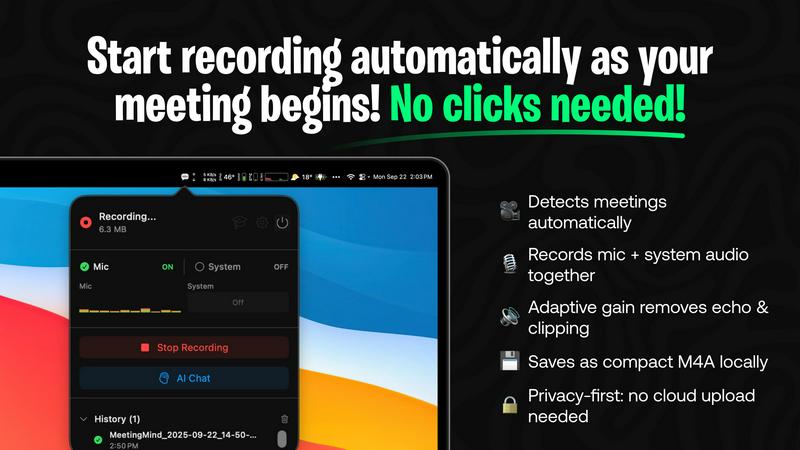
The application operates as a lightweight menu bar utility that continuously monitors system activity. Using advanced heuristics, it automatically detects when the user joins or starts a Zoom meeting, initiating recording without any manual clicks. It captures a high-fidelity audio stream by recording both the user's microphone input and the system's audio output simultaneously, employing adaptive gain control for optimal clarity. This hands-free operation is the foundation of its seamless integration into the user's workflow.
On-Device or Cloud AI Processing
MeetingMind offers unparalleled flexibility in its AI processing backend. Users can opt for complete privacy by running open-source large language models (LLMs) locally via an Ollama integration, ensuring no meeting data ever leaves their Mac. Alternatively, for more powerful summarization, they can connect to cloud-based models through the OpenRouter gateway. This hybrid architecture allows teams to balance performance requirements with stringent data security and compliance policies.
Interactive AI Chat & Live Transcription
During and after the meeting, users can interact with the captured content through an integrated AI chat interface. This allows for real-time querying of the discussion, such as asking for clarifications on points made or requesting immediate summaries of specific topics. The live transcription appears in the app with speaker attribution, creating an interactive transcript that serves as a live knowledge base for the ongoing conversation.
Markdown Export & Structured Output
All meeting intelligence is processed and exported in well-formatted markdown (.md) files. The AI doesn't just transcribe; it structures the output to include a concise summary, a bulleted list of key takeaways, clearly defined action items with potential owners, and the full, timestamped transcript. This format ensures immediate usability in note-taking apps like Obsidian or Notion, and for version control in developer workflows, making the information easy to search, share, and archive.
Use Cases
Decode This Text
Decoding Romantic and Dating Ambiguity
Users can paste confusing texts from dating apps or partners (e.g., "I'll let you know," or post-date radio silence). The tool analyzes tone and intent to clarify if the sender is genuinely busy, losing interest, or being avoidant. It helps answer pressing questions like "Why did they ghost after three months?" by providing a reality-check based on linguistic and behavioral evidence, preventing over-analysis and regretful replies.
Interpreting Professional and Workplace Communication
This use case focuses on integrating clarity into professional environments. Users can decode cryptic one-word emails from a boss, vague feedback like "we'll keep your resume on file," or nuanced Slack messages. The analysis clarifies underlying tones of anger, dissatisfaction, or genuine neutrality, and provides professionally compatible response strategies to navigate office politics and communication with appropriate tact.
Navigating Friends and Family Dynamics
The tool helps analyze group chat silences, passive-aggressive comments from relatives, or changing communication patterns from friends. By inputting these social exchanges, users receive an objective breakdown of the group or individual's dynamic, identifying potential conflicts, disengagement, or simple misunderstandings, enabling more empathetic and effective personal communication.
Pre-Send Message Validation and Review
Before sending an emotionally charged or important reply, users can input their drafted response into the system to analyze its likely perceived tone and impact. This proactive use case acts as a communication firewall, allowing individuals to stress-test their messages, adjust tone, and ensure their intent is clearly and effectively communicated, thereby preventing escalation or misunderstanding.
MeetingMind
Daily Engineering Stand-ups and Sprint Meetings
For software development teams conducting daily syncs or sprint planning on Zoom, MeetingMind automatically captures detailed technical discussions, feature decisions, and bug reports. The AI-generated action items ensure every ticket and TODO is clearly documented and assigned. Engineers can later query the transcript to recall specific implementation details or API decisions without relying on fragmented manual notes.
Client Consultations and Sales Demos
Professionals in consulting, sales, or agency roles use MeetingMind to fully focus on the client interaction during Zoom calls. The tool faithfully records every client requirement, concern, and feedback. Post-meeting, the AI summary highlights client pain points and agreed-upon next steps, enabling the rapid creation of accurate follow-up emails, proposals, and project briefs directly from the structured markdown output.
Remote Academic Research and Interviews
Researchers and students conducting qualitative interviews or collaborative research meetings over Zoom benefit from the verbatim, speaker-attributed transcript. The local processing option via Ollama is crucial for handling sensitive, unpublished research data confidentially. The searchable transcripts facilitate thematic analysis and easy citation of sources directly from the recorded conversation.
Executive Briefings and Strategic Planning
For leadership teams and board meetings where strategic direction is set, capturing nuance and context is vital. MeetingMind records the entire high-level discussion, and the AI chat feature allows executives to ask complex questions post-meeting to surface insights across different discussion threads. The concise summary and action items provide a clear, authoritative record for aligning the entire organization.
Overview
About Decode This Text
Decode This Text is a sophisticated AI-powered communication analysis engine designed to parse and interpret the subtext of digital conversations. It functions as a critical layer of intelligence for personal and professional communication, transforming ambiguous text messages, emails, and chat logs into actionable insights. The platform is engineered for individuals seeking to eliminate guesswork from their interactions, providing a clear breakdown of emotional tone, sender intent, and engagement patterns. Its core value proposition lies in its seamless integration into a user's daily workflow—acting as a real-time communication co-pilot. By leveraging advanced natural language processing (NLP) models, it deciphers context, detects non-obvious patterns like response timing and evasiveness, and generates contextually appropriate response options. This tool is built for anyone navigating complex digital dialogues, from analyzing a vague message from a date to interpreting a terse email from a manager, ensuring users respond with confidence and clarity, backed by data-driven analysis.
About MeetingMind
MeetingMind is a sophisticated, AI-native meeting intelligence application built exclusively for macOS. It functions as an autonomous meeting recorder and analyzer, specifically engineered to integrate seamlessly with the Zoom conferencing platform. The core value proposition is its ability to capture every detail of a meeting without user intervention, freeing professionals to engage fully in the discussion. It automatically detects when a Zoom meeting starts and begins recording both microphone and system audio, generating real-time, speaker-attributed transcripts. The application leverages a powerful, on-device AI stack, offering users a choice between local processing via Ollama models or cloud-based inference through OpenRouter. This ensures sensitive meeting data can remain entirely private on the user's Mac. The output is transformed into clean, searchable markdown documents containing full transcripts, AI-generated summaries, and extracted action items. Designed for individual professionals, remote teams, and organizations that rely on Zoom for daily collaboration, MeetingMind turns ephemeral conversations into structured, actionable knowledge assets, ensuring critical insights are never lost.
Frequently Asked Questions
Decode This Text FAQ
How does Decode This Text ensure my privacy and data security?
The platform is built with a privacy-first architecture. As stated, no human ever reads your texts. All analysis is performed by automated AI systems. Conversations are processed anonymously and are not stored for long-term profiling or used to train public models, ensuring complete confidentiality and integration into your personal communication security protocol.
What messaging platforms and formats are compatible?
The system is platform-agnostic due to its dual input method. It is compatible with any digital text source. You can directly copy-paste text from SMS, WhatsApp, Signal, Email, Slack, Discord, and social media DMs. Alternatively, the screenshot upload feature with OCR integration means you can use it with any app or platform that displays text on your screen, ensuring universal compatibility.
Can it analyze long conversation threads or only single messages?
Yes, the engine is designed to parse and analyze full conversation threads. When you paste a multi-message exchange or upload a screenshot of a long chat, the NLP model evaluates the context, flow, and patterns across the entire dialogue. This provides a more accurate and comprehensive analysis than a single message in isolation, as it understands relational dynamics and historical context.
How accurate is the AI's analysis compared to a human perspective?
The AI is trained on vast datasets of human communication and is designed to identify consistent linguistic and psychological cues. While not infallible, it provides an objective, data-driven perspective free from personal bias. Many users report it feeling like a "wise older sibling" because it highlights patterns and tones they were too emotionally involved to see, offering a highly effective and consistently available second opinion.
MeetingMind FAQ
How does the automatic Zoom detection work?
MeetingMind runs as a background service on your macOS system. It uses a combination of system-level APIs to detect audio session changes and process names associated with Zoom meetings. When it identifies a meeting is active, it automatically initiates the recording process for both microphone and system audio, requiring zero manual intervention from the user after the initial setup and permission grants.
What are the differences between local (Ollama) and cloud (OpenRouter) AI?
The local Ollama option runs open-source LLMs directly on your Mac's hardware (CPU/GPU). This provides 100% data privacy as no information is transmitted externally, but it requires sufficient system resources and may have slower processing times for very long meetings. The cloud OpenRouter option sends the transcript to a selected, powerful cloud model for processing, offering faster and often more sophisticated summaries, but the data leaves your device.
Is there a free version available?
Yes, MeetingMind offers a fully-featured free tier that includes 60 minutes of recording time per day. This includes automatic Zoom detection, live transcription, AI summaries using the chosen backend, and local processing. It is designed to be perpetually free, perfect for daily short meetings like stand-ups. An unlimited, one-time purchase upgrade is available for users requiring longer recording sessions.
What are the system requirements and compatibility?
MeetingMind is a native macOS application available on the Mac App Store. It requires macOS 14.0 (Sonoma) or later. The application is specifically engineered for compatibility with the Zoom conferencing application. For optimal performance with the local Ollama AI feature, a Mac with Apple Silicon (M-series chips) is recommended due to their superior neural engine capabilities for efficient AI inference.
Alternatives
Decode This Text Alternatives
Decode This Text is a productivity tool focused on communication analysis. It operates within the text interpretation and interpersonal intelligence software category, helping users parse ambiguous messages by providing insights into tone, intent, and suggested responses. Users often seek alternatives for various technical and operational reasons. Common drivers include budget constraints, the need for specific API integrations, or compatibility requirements with existing CRM or communication platforms like Slack or Microsoft Teams. Others may require more advanced features, such as batch processing or deeper sentiment analysis engines. When evaluating an alternative, prioritize its technical stack and integration capabilities. Assess whether it offers a RESTful API for custom workflows, supports real-time analysis within your primary communication apps, and provides data export options. Security protocols and data handling policies are also critical, especially for business use.
MeetingMind Alternatives
MeetingMind is a macOS-native AI meeting assistant in the productivity and management category. It specializes in auto-recording and transcribing Zoom meetings, using on-device or cloud AI to generate searchable summaries and action items directly from your desktop. Users often explore alternatives for various reasons, including budget constraints, the need for cross-platform compatibility beyond macOS, or specific feature requirements like integration with other video conferencing tools like Teams or Google Meet. Some may seek different AI models, more extensive team collaboration features, or a different approach to data privacy and storage. When evaluating alternatives, key considerations should include the supported operating systems and conferencing platforms, the underlying transcription and AI technology stack, data processing location (local vs. cloud), and the flexibility of the output formats. It's also crucial to assess how well a tool integrates into your existing workflow and tech ecosystem.