
Mod vs OpenMark AI
Side-by-side comparison to help you choose the right product.

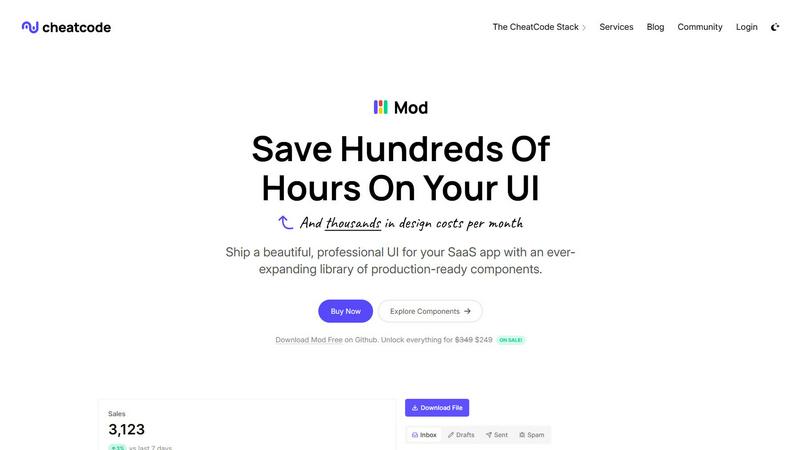
Mod is a CSS framework designed to accelerate SaaS app development with a versatile library of ready-to-use UI compon...

OpenMark AI benchmarks over 100 LLMs on your tasks, delivering actionable insights on cost, speed, quality, and stability without any setup.
Last updated: March 26, 2026
Visual Comparison
Mod
OpenMark AI
Feature Comparison
Mod
Comprehensive Component Library
Mod offers a rich library of over 88 components, including buttons, forms, modals, and navigation elements. This extensive range allows developers to mix and match components to tailor their applications to specific needs, reducing development time and effort.
Extensive Style Options
With 168 distinct styles at your disposal, Mod enables you to enhance your application’s aesthetic appeal. The variety of styles allows for customization of colors, typography, and layouts, ensuring that your UI can align perfectly with your brand's identity.
Dark Mode Support
Mod includes built-in support for dark mode, a crucial feature for modern applications. This allows users to toggle between light and dark themes, enhancing user experience and accessibility, particularly in low-light environments.
Framework-Agnostic Compatibility
One of Mod's key strengths is its framework-agnostic nature. It can be integrated with popular frameworks like Next.js, Nuxt, Vite, Svelte, Rails, and Django, making it an ideal choice for developers working across various tech stacks. This compatibility ensures that teams can leverage Mod's capabilities regardless of their existing technology choices.
OpenMark AI
Task-Level Benchmarking
OpenMark AI allows users to benchmark tasks by simply describing them in plain language. This user-friendly approach enables seamless testing across various models without the need for complex configurations or coding.
Real-Time Model Comparison
The platform provides side-by-side comparisons of real API calls to models, ensuring that users receive authentic performance metrics rather than relying on cached marketing data. This transparency enhances decision-making confidence.
Cost and Latency Analysis
With OpenMark AI, users can analyze the cost per API call and latency for each model tested. This feature is crucial for understanding the financial implications of using different AI models in real-world applications.
Consistency Checks
OpenMark AI emphasizes the importance of output reliability. Users can assess model performance consistency by running the same task multiple times, allowing them to make informed choices based on stability and predictability.
Use Cases
Mod
Rapid SaaS Development
For startups looking to launch quickly, Mod provides a comprehensive set of tools that facilitate rapid development of SaaS applications. By utilizing its extensive component library and style options, developers can create functional UIs in a fraction of the time.
Customizable Dashboards
Mod’s components can be used to create customizable dashboards for data visualization and user management. This is particularly useful for SaaS products that require user interaction with complex datasets, enabling developers to build intuitive interfaces.
E-commerce Applications
Developers can leverage Mod's responsive design and extensive styling options to build engaging e-commerce platforms. The ability to create visually appealing product pages and streamlined checkout processes can significantly enhance user experience and conversion rates.
Multi-Framework Projects
For teams working on projects that require integrations across different frameworks, Mod's framework-agnostic feature allows for a unified design language. This flexibility ensures that all components maintain consistency across various parts of the application, regardless of the underlying technology.
OpenMark AI
Model Selection for Development
OpenMark AI is ideal for developers who need to select the most suitable AI model for their applications. By benchmarking various models against specific tasks, teams can ensure they choose the best fit for their project requirements.
Pre-Deployment Validation
Product teams can use OpenMark AI to validate model performance before deploying AI features. This pre-deployment testing helps mitigate risks and ensures that the chosen model meets quality standards.
Cost Efficiency Analysis
Businesses can leverage OpenMark AI to analyze the cost efficiency of different models. By understanding the cost relative to output quality and latency, organizations can make informed decisions that optimize their AI investments.
Consistency in AI Outputs
For applications requiring consistent AI outputs, OpenMark AI allows users to verify model stability through repeated task runs. This is particularly useful in scenarios where reliability and accuracy are paramount.
Overview
About Mod
Mod is an advanced CSS framework specifically designed for building Software as a Service (SaaS) user interfaces. It is part of the CheatCode developer stack, which also includes Joystick for full-stack JavaScript development and Push for deployment solutions. Mod stands out with its extensive library of over 88 customizable components, 168 unique styles, and more than 1,500 icons, allowing developers to create visually appealing and highly functional applications quickly. The framework supports dark mode and is built on a responsive, mobile-first design philosophy, ensuring that applications look great on any device. Its framework-agnostic approach allows seamless integration with popular technologies such as Next.js, Nuxt, Vite, Svelte, Rails, and Django, making it a versatile choice for both solo developers and teams. The simple pricing model and regular yearly updates reduce design costs significantly, enabling developers to focus on innovation while efficiently shipping polished SaaS applications.
About OpenMark AI
OpenMark AI is an innovative web application designed for task-level benchmarking of large language models (LLMs). Built for developers and product teams, it allows users to efficiently assess which AI model best fits their specific needs. By simply describing the task in plain language, users can test and compare multiple models in a single session. The platform provides insights into cost per request, latency, scored quality, and output stability across repeated runs, enabling users to identify variance rather than relying on a single output. OpenMark AI facilitates the decision-making process before deploying AI features, ensuring that the selected model aligns with workflow requirements and budget constraints. With hosted benchmarking that eliminates the need for configuring separate API keys, teams can focus on what matters most—validating model performance. The application supports a diverse range of models and is ideal for those who prioritize cost efficiency relative to output quality, rather than merely the cheapest token pricing. Both free and paid plans are available to accommodate different user needs.
Frequently Asked Questions
Mod FAQ
What types of applications can be built using Mod?
Mod is ideal for building SaaS applications, e-commerce platforms, dashboards, and any other web application requiring a robust and customizable UI. Its extensive component and style library supports a wide range of use cases.
Is Mod easy to integrate with existing projects?
Yes, Mod is designed to be framework-agnostic, allowing for seamless integration with popular frameworks like Next.js, Nuxt, Vite, Svelte, Rails, and Django. This makes it straightforward to incorporate Mod into existing projects.
Does Mod support mobile-first design?
Absolutely. Mod is built on a responsive, mobile-first design philosophy, ensuring that applications created with it are optimized for all devices, providing an excellent user experience regardless of screen size.
How often does Mod receive updates?
Mod benefits from regular yearly updates, ensuring that developers have access to the latest features, improvements, and bug fixes. This commitment to keeping the framework current helps developers maintain and enhance their applications effectively.
OpenMark AI FAQ
How does OpenMark AI work?
OpenMark AI allows users to describe their tasks in plain language, testing these tasks across multiple models in a single session. It provides metrics on cost, latency, quality, and consistency to help users make informed decisions.
Do I need API keys to use OpenMark AI?
No, OpenMark AI is designed to streamline the benchmarking process. Users do not need to configure separate API keys for OpenAI, Anthropic, or Google, as the platform handles this for you.
What types of tasks can I benchmark?
OpenMark AI supports a wide range of tasks, including but not limited to classification, translation, data extraction, research, Q&A, and image analysis. This versatility makes it suitable for various applications.
Are there different pricing plans available?
Yes, OpenMark AI offers both free and paid plans to cater to different user needs. Details regarding these plans can be found in the in-app billing section when you sign up.