
OpenMark AI vs Skene
Side-by-side comparison to help you choose the right product.

OpenMark AI benchmarks over 100 LLMs on your tasks, delivering actionable insights on cost, speed, quality, and stability without any setup.
Last updated: March 26, 2026

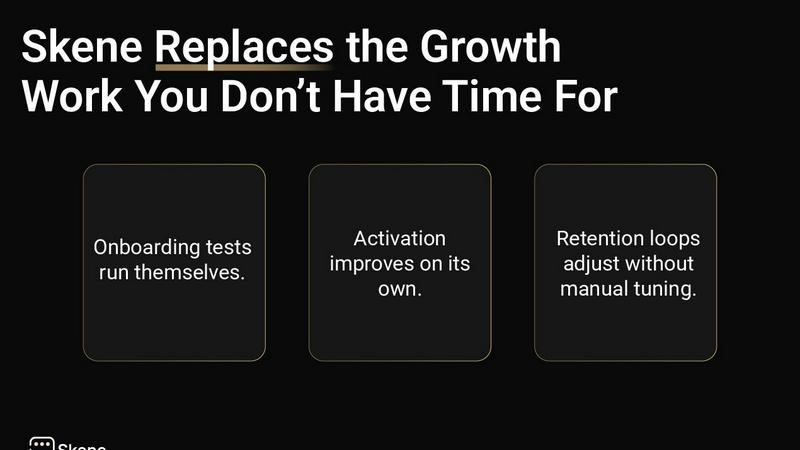
Skene is growth infrastructure you own and prompt directly into your codebase.
Last updated: February 28, 2026
Visual Comparison
OpenMark AI
Skene
Feature Comparison
OpenMark AI
Task-Level Benchmarking
OpenMark AI allows users to benchmark tasks by simply describing them in plain language. This user-friendly approach enables seamless testing across various models without the need for complex configurations or coding.
Real-Time Model Comparison
The platform provides side-by-side comparisons of real API calls to models, ensuring that users receive authentic performance metrics rather than relying on cached marketing data. This transparency enhances decision-making confidence.
Cost and Latency Analysis
With OpenMark AI, users can analyze the cost per API call and latency for each model tested. This feature is crucial for understanding the financial implications of using different AI models in real-world applications.
Consistency Checks
OpenMark AI emphasizes the importance of output reliability. Users can assess model performance consistency by running the same task multiple times, allowing them to make informed choices based on stability and predictability.
Skene
Codebase Signal Analysis
Skene performs deep, automated analysis of your connected GitHub or GitLab repository to extract actionable growth signals. It scans your framework, component structure, and user flow logic to identify onboarding friction points, activation opportunities, and retention risks directly from the source code, providing a foundational context layer for all subsequent AI-driven optimizations.
AI-Prompted Growth Implementation
Growth workflows are managed through natural language prompts within your existing development environment, such as Cursor or a terminal. After analysis, you can instruct Skene to generate and implement specific improvements—like refining an onboarding tour or adjusting a activation checkpoint—turning strategic insights into shipped code without manual intervention.
Self-Optimizing User Flows
The system continuously monitors user interactions against the signals in your codebase. It automatically A/B tests different user journey variations and implements the winning flows. This creates a closed feedback loop where onboarding and activation processes become smarter and more effective over time, with no manual dashboard tuning required.
Integrated Growth Manifest & Context
Skene generates a persistent growth-manifest.json file within your project (e.g., in ./skene-context/). This file acts as a centralized, version-controlled source of truth for all your product's growth logic, analytics definitions, and user journey states, ensuring your AI agents and tools have consistent, up-to-date context.
Use Cases
OpenMark AI
Model Selection for Development
OpenMark AI is ideal for developers who need to select the most suitable AI model for their applications. By benchmarking various models against specific tasks, teams can ensure they choose the best fit for their project requirements.
Pre-Deployment Validation
Product teams can use OpenMark AI to validate model performance before deploying AI features. This pre-deployment testing helps mitigate risks and ensures that the chosen model meets quality standards.
Cost Efficiency Analysis
Businesses can leverage OpenMark AI to analyze the cost efficiency of different models. By understanding the cost relative to output quality and latency, organizations can make informed decisions that optimize their AI investments.
Consistency in AI Outputs
For applications requiring consistent AI outputs, OpenMark AI allows users to verify model stability through repeated task runs. This is particularly useful in scenarios where reliability and accuracy are paramount.
Skene
Autonomous Onboarding Optimization
For SaaS products, Skene automatically analyzes where new users drop off during initial setup. It then generates, tests, and deploys refined onboarding tours and tooltips directly within the application's UI, significantly improving time-to-value and activation rates without any engineering overhead.
Continuous Activation Funnel Management
Startups can use Skene to perpetually audit and improve their core activation funnel. The system identifies which features are correlated with long-term retention, detects where users struggle to reach them, and prompts the implementation of guided flows or UI adjustments to boost key feature adoption.
Lifecycle Automation for Customer Success
Teams can automate complex customer lifecycle workflows based on code-level signals. For example, Skene can trigger re-engagement nudges or educational content when it detects a user has not interacted with a newly shipped feature, helping to drive adoption and reduce churn autonomously.
Tech Stack Consolidation for Developers
Development teams frustrated with managing multiple analytics, onboarding, and engagement tools can replace their entire legacy growth stack with Skene. It consolidates these functions into a single, code-native infrastructure that is owned, versioned, and modified within the same workflow used for feature development.
Overview
About OpenMark AI
OpenMark AI is an innovative web application designed for task-level benchmarking of large language models (LLMs). Built for developers and product teams, it allows users to efficiently assess which AI model best fits their specific needs. By simply describing the task in plain language, users can test and compare multiple models in a single session. The platform provides insights into cost per request, latency, scored quality, and output stability across repeated runs, enabling users to identify variance rather than relying on a single output. OpenMark AI facilitates the decision-making process before deploying AI features, ensuring that the selected model aligns with workflow requirements and budget constraints. With hosted benchmarking that eliminates the need for configuring separate API keys, teams can focus on what matters most—validating model performance. The application supports a diverse range of models and is ideal for those who prioritize cost efficiency relative to output quality, rather than merely the cheapest token pricing. Both free and paid plans are available to accommodate different user needs.
About Skene
Skene is an AI-powered Product-Led Growth (PLG) infrastructure designed for modern development teams, particularly indie developers and early-stage startups. It redefines growth tooling by integrating directly with your codebase and IDE, eliminating the need for external, siloed dashboards and brittle third-party scripts. Skene operates as a fully automated iteration engine that autonomously optimizes key growth funnels like onboarding, activation, and retention. By analyzing your repository structure and deriving signals directly from your code, it intelligently identifies friction points and activation drop-offs. It then automatically tests and implements improved user flows, creating a self-optimizing product experience. This "growth as code" philosophy allows developers to own, version, and prompt their growth infrastructure just like their core product, ensuring seamless compatibility with existing tech stacks and AI agents. The core value proposition is clear: replace a fragmented legacy growth stack with a unified, code-native system that ships growth loops instead of managing widgets, all without expanding your team.
Frequently Asked Questions
OpenMark AI FAQ
How does OpenMark AI work?
OpenMark AI allows users to describe their tasks in plain language, testing these tasks across multiple models in a single session. It provides metrics on cost, latency, quality, and consistency to help users make informed decisions.
Do I need API keys to use OpenMark AI?
No, OpenMark AI is designed to streamline the benchmarking process. Users do not need to configure separate API keys for OpenAI, Anthropic, or Google, as the platform handles this for you.
What types of tasks can I benchmark?
OpenMark AI supports a wide range of tasks, including but not limited to classification, translation, data extraction, research, Q&A, and image analysis. This versatility makes it suitable for various applications.
Are there different pricing plans available?
Yes, OpenMark AI offers both free and paid plans to cater to different user needs. Details regarding these plans can be found in the in-app billing section when you sign up.
Skene FAQ
How is Skene different from traditional customer experience software?
Traditional tools rely on manual tour creation, external JavaScript snippets, and brittle UI selectors that break with every deployment. Skene is fundamentally different; it reads your actual codebase to understand your application's structure and automatically generates and maintains all growth components. When you push new code, Skene's flows update themselves, ensuring robustness and deep integration.
How long does it take to set up?
Setup is designed to be completed in less than 60 seconds. You simply grant Skene read-only access to your GitHub or GitLab repository. The system then automatically analyzes your codebase to generate the initial PLG flows and context layer. No initial code changes or API modifications are required to get started.
Is my code secure?
Yes, security is a primary design consideration. Skene only ever requires read-only access to your repository. All code analysis is performed in a secure, isolated environment. Your proprietary code is not stored or used for any purpose other than generating your specific growth infrastructure and signals.
What kind of analytics do you provide?
Skene provides analytics focused on growth outcomes, not just pageviews. The dashboard shows real-time user progress through defined journeys, completion rates, engagement metrics, and bottleneck identification. You can track critical metrics like time-to-value and directly measure the impact of each automated improvement on your activation and retention goals.
Alternatives
OpenMark AI Alternatives
OpenMark AI is a web-based application designed for task-level benchmarking of large language models (LLMs). By allowing users to test over 100 models based on specific parameters such as cost, speed, quality, and stability, it caters primarily to developers and product teams who need to validate model performance before deploying AI features. Users often seek alternatives to OpenMark AI for various reasons, including pricing structures, specific feature requirements, and compatibility with different platforms or workflows. When selecting an alternative, it is crucial to consider factors like the breadth of model support, the ease of integration into existing systems, and the clarity of performance metrics provided to ensure effective and efficient benchmarking.
Skene Alternatives
Skene is an automated Product-Led Growth (PLG) iteration engine, falling into the productivity and growth management category. It integrates directly with your codebase to autonomously optimize user onboarding, activation, and retention loops, eliminating the need for manual growth teams. Users often explore alternatives for several reasons. These can include budget constraints, a need for different pricing models like subscription-based plans, or specific feature requirements not covered by Skene's automated, outcome-based approach. Platform compatibility, such as needing a solution for a different tech stack or a preference for more manual control via traditional dashboards, also drives the search. When evaluating an alternative, key considerations should be its integration method with your existing infrastructure and whether it supports your framework. Assess if the tool's automation level matches your needs, from fully autonomous optimization to manual A/B testing suites. Finally, scrutinize the pricing structure to ensure it aligns with your growth stage and budget.