
Agent to Agent Testing Platform vs Prefactor
Side-by-side comparison to help you choose the right product.

Agent to Agent Testing Platform
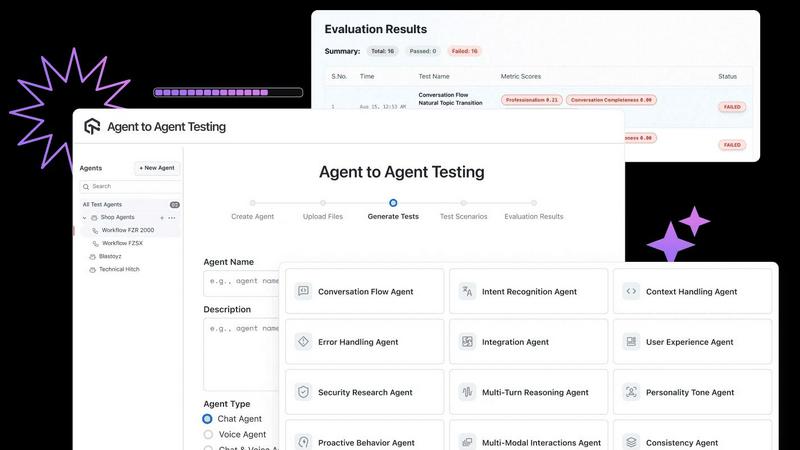
Validate AI agent behavior across chat, voice, and phone systems to detect risks and ensure compliance seamlessly.
Last updated: February 27, 2026

Prefactor
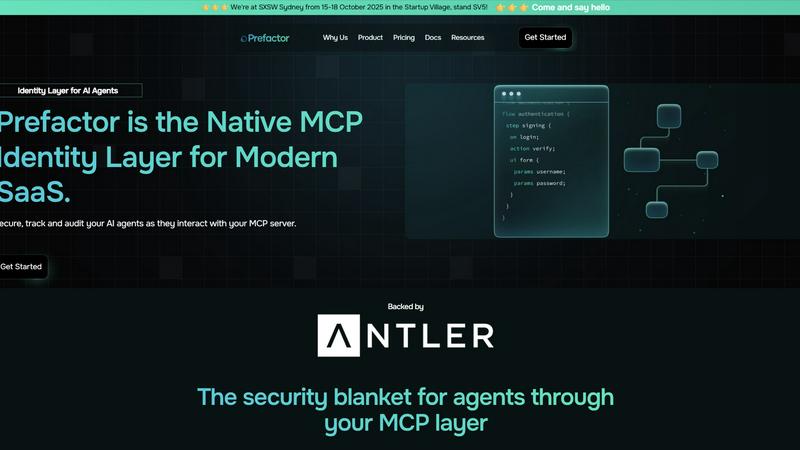
Prefactor is the essential control plane for governing AI agents in production at scale.
Last updated: March 1, 2026
Visual Comparison
Agent to Agent Testing Platform
Prefactor
Feature Comparison
Agent to Agent Testing Platform
Automated Scenario Generation
The platform offers automated scenario generation capabilities that create diverse and realistic test cases for AI agents. This includes simulating various interaction formats such as chat, voice, and phone calls, allowing for an extensive evaluation of the agent's performance across different contexts and user scenarios.
True Multi-Modal Understanding
Agent to Agent Testing Platform supports true multi-modal understanding by allowing users to define detailed requirements or upload Product Requirement Documents (PRDs) that include varied inputs such as images, audio, and video. This feature enables a more thorough assessment of how AI agents respond in genuine real-world situations.
Autonomous Test Scenario Generation
With access to a library of hundreds of pre-built scenarios, users can also create custom test cases tailored to specific AI behaviors. This functionality includes testing agents' personality tones, data privacy compliance, and intent recognition, thus providing a comprehensive evaluation of the agents under various conditions.
Regression Testing with Risk Scoring
The platform facilitates robust regression testing by providing insights into risk scoring for the AI agents being evaluated. This feature highlights potential areas of concern, enabling teams to prioritize critical issues, thereby optimizing testing efforts and ensuring the stability and reliability of AI systems.
Prefactor
Real-Time Agent Monitoring & Dashboard
Gain complete operational visibility across your entire agent infrastructure from a centralized dashboard. Monitor all agents in one place, tracking which are active or idle, what tools and data they are accessing via protocols like MCP, and where failures or anomalies emerge in real-time. This feature provides the actionable insights needed to prevent incidents before they cascade, offering teams immediate answers to "what is this agent doing right now?".
Compliance-Ready Audit Trails
Prefactor generates detailed, business-contextual audit logs that translate raw agent actions and API calls into understandable narratives for stakeholders and regulators. This goes beyond technical event recording to answer compliance questions clearly, enabling the generation of audit-ready reports in minutes, not weeks. Every agent action is logged and attributable, creating an immutable record designed to withstand regulatory scrutiny.
Identity-First Access Control
This feature brings proven human identity governance principles to AI agents. It provides dynamic client registration, delegated access, and fine-grained role and attribute-based controls (RBAC/ABAC). Every agent is issued a unique, first-class identity, and every action it performs is authenticated. This ensures permissions are precisely scoped, eliminating over-provisioned access and creating a fundamental layer of security.
Emergency Kill Switches & Cost Tracking
Maintain ultimate control with emergency kill switches to instantly deactivate any agent exhibiting unexpected or harmful behavior. Coupled with comprehensive cost tracking, this feature allows you to monitor agent compute costs across different providers, identify expensive execution patterns, and optimize spending. It provides both financial governance and a critical safety mechanism for production environments.
Use Cases
Agent to Agent Testing Platform
Quality Assurance for Chatbots
Enterprises can leverage the platform to ensure that their chatbots deliver accurate and effective responses in a variety of scenarios. This quality assurance process ensures that chatbots maintain high levels of user satisfaction and engagement.
Voice Assistant Evaluation
Organizations can utilize the Agent to Agent Testing Platform to rigorously test voice assistants across different accents and languages, ensuring that they understand and respond accurately to diverse user inquiries while maintaining a natural conversational flow.
Compliance and Ethical Testing
Businesses can perform compliance checks on their AI agents to identify and mitigate risks associated with bias and toxicity. This use case is crucial for maintaining ethical standards and ensuring that AI technologies serve diverse user groups without discrimination.
Performance Optimization for Phone Agents
The platform allows for the testing of phone agents in simulated environments that mimic real-world interactions. This use case is essential for optimizing the performance of voice calling agents, ensuring they exhibit professionalism and empathy during customer interactions.
Prefactor
Scaling AI Agents in Regulated Finance
A Fortune 500 financial services company can use Prefactor to move AI agent pilots from demo to approved production. The platform provides the necessary audit trails, real-time monitoring, and identity controls to satisfy internal compliance and security teams, answering critical questions about agent activity and data access before granting deployment authorization.
Governance for Healthcare AI Applications
Healthcare technology firms deploying AI agents for data analysis or patient interaction can leverage Prefactor to enforce strict access controls (like HIPAA-compliant scoping) and generate detailed audit logs. This ensures agent interactions with sensitive protected health information (PHI) are fully tracked, controlled, and explainable for compliance audits.
Managing Multi-Agent Workflows in Enterprise SaaS
SaaS companies building complex, multi-agent systems using frameworks like LangChain, CrewAI, or AutoGen can integrate Prefactor to govern cross-agent communication and tool usage. It provides a unified view and control plane, simplifying permission management across diverse agents and ensuring coherent security policy enforcement throughout automated workflows.
Cost-Optimized Agent Deployment in Mining & Resources
Industries like mining that rely on operational technology and data analysis can deploy AI agents for predictive maintenance or logistics. Prefactor helps track and optimize the cloud compute costs associated with these agents while ensuring their operations in critical environments are visible, controllable, and can be halted immediately if needed, aligning innovation with operational risk management.
Overview
About Agent to Agent Testing Platform
Agent to Agent Testing Platform is a revolutionary AI-native quality assurance framework specifically designed for validating the performance of AI agents in diverse real-world environments. As artificial intelligence systems evolve towards greater autonomy and complexity, traditional quality assurance (QA) methodologies, which were primarily developed for static software, become inadequate. This platform transcends basic prompt-level evaluations by offering comprehensive insights into multi-turn conversations, encompassing chat, voice, phone, and multimodal interactions. It empowers enterprises to effectively assess and validate the behavior of AI agents before deploying them in production. By introducing a dedicated assurance layer that utilizes advanced multi-agent test generation, the platform can identify long-tail failures, edge cases, and nuanced interaction patterns that are often overlooked by manual testing methods. With the capability to simulate thousands of realistic interactions, organizations can ensure their AI agents meet high standards of accuracy, reliability, and performance, addressing critical metrics such as bias, toxicity, and hallucinations.
About Prefactor
Prefactor is the enterprise-grade control plane specifically engineered for managing and governing AI agents in production, particularly within regulated environments. It solves the critical infrastructure gap that emerges when moving AI agent proofs-of-concept (POCs) into scalable, secure, and compliant deployments. The platform provides a unified source of truth for agent identity, access, and activity, aligning security, engineering, compliance, and product teams around shared governance. By integrating seamlessly into existing CI/CD pipelines and popular AI frameworks, Prefactor automates the complex authentication and permission management required for autonomous agents. Its core value proposition is transforming security from a bottleneck into a seamless layer of trust, enabling organizations in sectors like financial services, healthcare, and mining to innovate with AI agents without compromising on auditability, visibility, or control. Prefactor ensures every agent operates with a first-class, auditable identity, making it an essential piece of tech stack for any team serious about production AI agent deployments.
Frequently Asked Questions
Agent to Agent Testing Platform FAQ
What is Agent to Agent Testing Platform designed for?
The Agent to Agent Testing Platform is designed to validate AI agents in real-world environments, ensuring their performance across various interaction scenarios, including chat, voice, and phone calls.
How does the platform help in identifying long-tail failures?
The platform employs a dedicated assurance layer that uses multi-agent test generation to uncover long-tail failures and edge cases that traditional testing methods may miss, ensuring a comprehensive evaluation of AI behavior.
Can I create custom test scenarios?
Yes, users have the ability to create custom test scenarios tailored to their specific AI requirements, in addition to accessing a library of pre-built scenarios for comprehensive testing.
How does the platform ensure compliance with ethical standards?
The platform helps identify potential biases and toxicity in AI agents through automated scenario generation and detailed analytics, allowing organizations to address compliance and ethical considerations effectively.
Prefactor FAQ
What AI frameworks does Prefactor integrate with?
Prefactor is designed for broad compatibility and integrates seamlessly with popular AI agent frameworks including LangChain, CrewAI, and AutoGen. It also supports custom-built agent architectures. The platform is built to work with the Model Context Protocol (MCP), which is becoming the default standard for agents to access tools and data, ensuring you can deploy Prefactor's governance layer in hours, not months.
How does Prefactor handle agent identity and authentication?
Prefactor treats each AI agent as a first-class citizen with its own unique identity. It provides dynamic client registration systems and uses delegated authentication models. Each agent action is authenticated against this identity, and permissions are enforced through fine-grained role-based (RBAC) and attribute-based (ABAC) controls, mirroring enterprise human identity governance but built for autonomous software.
Is Prefactor suitable for non-regulated industries?
While Prefactor is specifically engineered for the stringent demands of regulated sectors like finance and healthcare, its core benefits of visibility, control, and operational management are valuable for any organization scaling AI agents. Companies experiencing growing pains with agent sprawl, lack of auditability, or cost overruns will find its control plane essential for sustainable, secure production deployments.
How does the real-time monitoring work?
The Prefactor control plane installs lightweight connectors or utilizes SDKs within your agent environment. These components securely stream metadata about agent status, activity, and tool usage back to the central dashboard in real-time. This does not typically require intercepting sensitive data payloads but focuses on access logs, performance metrics, and execution states, providing a live operational view.
Alternatives
Agent to Agent Testing Platform Alternatives
The Agent to Agent Testing Platform is a pioneering AI-native quality assurance framework designed to validate the behavior of AI agents across various modalities, including chat, voice, and phone interactions. As organizations increasingly adopt AI systems, they often seek alternatives due to concerns over pricing, feature sets, or specific platform compatibility requirements. Choosing an alternative involves evaluating the ability to conduct comprehensive testing, ensuring robust integration with existing systems, and verifying that the solution can scale to match the demands of real-world scenarios.
Prefactor Alternatives
Prefactor is a specialized control plane for governing and monitoring AI agents in regulated SaaS environments. It provides a unified platform for security, engineering, and compliance teams to manage agent identity, access, and audit trails at scale. Users may explore alternatives for various reasons, such as specific pricing models, the need for broader or narrower feature sets, or different integration requirements with their existing tech stack and CI/CD pipelines. Some may seek solutions that are more general-purpose or deeply embedded within a particular cloud provider's ecosystem. When evaluating alternatives, key considerations include the depth of real-time monitoring, the robustness of compliance-ready audit logs, and the flexibility of the identity and permissioning model. It's crucial to assess how well a solution integrates with your current infrastructure, its ability to provide a unified source of truth across teams, and its approach to automating security within development workflows.