
Code Word Solver - Missing Words Finder vs Psychiatry Exams
Side-by-side comparison to help you choose the right product.

Code Word Solver - Missing Words Finder
Unlock codewords effortlessly with our intuitive solver, designed for quick and accurate word discovery.
Last updated: February 27, 2026

Psychiatry Exams
Psychiatry Exams integrates AI models like Claude and GPT with verified NHS consultant expertise for MRCPsych exam.
Last updated: March 1, 2026
Visual Comparison
Code Word Solver - Missing Words Finder
Psychiatry Exams
Feature Comparison
Code Word Solver - Missing Words Finder
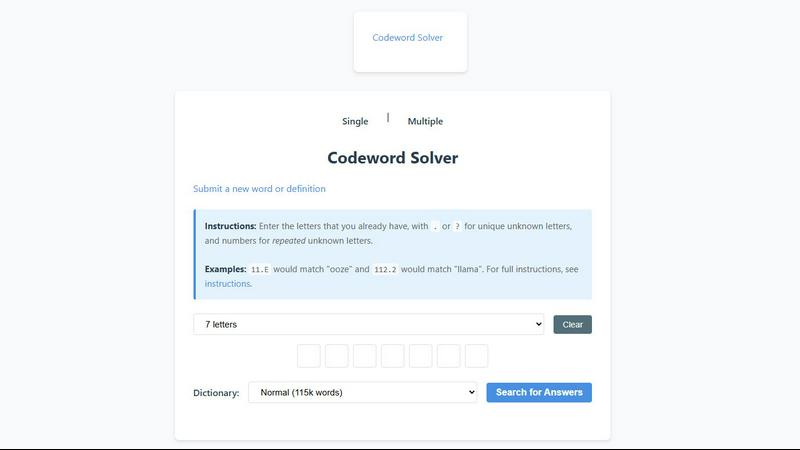
Single Pattern Solving
This feature allows users to input a single word pattern and receive a list of matching word candidates. By simply entering known letters alongside placeholders for unknown letters, the solver quickly filters through a vast database to provide you with potential solutions. This streamlined approach eliminates guesswork, making it easier to fill in the blanks in your codeword puzzle.
Multi-Pattern Solving
For those tackling more complex puzzles, the multi-pattern solving feature enables you to input two patterns simultaneously. This is particularly useful when the same number-letter relationships are present across different words in the puzzle. By analyzing the connections between linked words, the solver enhances your chances of finding the correct answers more quickly and efficiently.
Flexible Pattern Input
The solver offers a user-friendly interface for pattern input, where you can easily indicate known letters, unknown letters, and repeated letters. By using symbols like '.' or '?' for unknown letters and numbers for consistent repeats, you can create a precise representation of the puzzle. This flexible input method ensures that the solver understands your requirements and delivers accurate results.
Customizable Difficulty Dictionaries
Recognizing that different players have varying levels of expertise, the Code Word Solver provides multiple dictionary options. You can choose between hard (260k words), normal (115k words), and easy (20k words) dictionaries. This flexibility allows you to select a word list that best matches your skill level, ensuring a more tailored and enjoyable puzzle-solving experience.
Psychiatry Exams
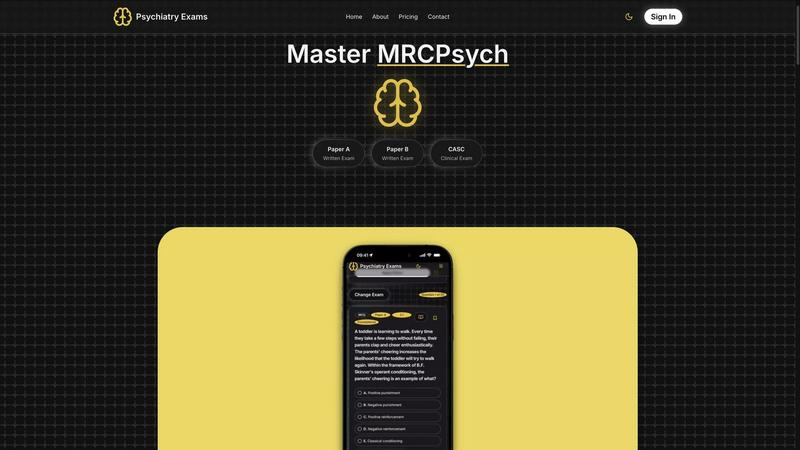
AI-Powered Explanation Engine
This core feature is built on a robust, multi-model AI stack integrating Claude Opus 4.5, Gemini 3, and GPT 5.2. The system is specifically fine-tuned on the official MRCPsych syllabus and vetted by NHS consultants. It generates detailed, nuanced explanations for every question, providing insights into correct and incorrect answer choices, ensuring learners understand the underlying principles rather than just memorizing facts.
Recalled & Verified Question Bank
The platform hosts a dynamic repository of over 2,400 questions, including a substantial database of 1,960+ recalled questions from actual exam sittings. Each question is rigorously adapted, verified, and moderated by a panel of eight NHS consultants, ensuring clinical accuracy, relevance, and alignment with current exam patterns and standards.
Active Learning & Credit Ecosystem
Psychiatry Exams implements a gamified, contributory framework where users can submit their own questions for the community. The system awards AI credits for contributions (+2 per submission, +3 upon approval), which can be used within the platform. This API-like interaction incentivizes deep engagement with the material, turning passive study into an active, participatory knowledge-building process.
Community-Driven Learning Hub
The platform extends beyond solo study with integrated community features, including a thriving WhatsApp community segmented by exam sitting, consultant-moderated discussion forums, and group calls. This creates a supportive, collaborative network for peer-to-peer learning, doubt resolution, and shared motivation, seamlessly blending social learning with structured digital content.
Use Cases
Code Word Solver - Missing Words Finder
Casual Puzzle Solving
For casual puzzle enthusiasts, the Code Word Solver simplifies the process of tackling codeword puzzles. By inputting known letters and using the solver to find possible matches, players can enjoy a more relaxed and enjoyable experience without the frustration of being stuck on challenging clues.
Competitive Puzzle Challenges
In competitive environments, such as puzzle competitions or timed challenges, using the Code Word Solver can provide a strategic advantage. By quickly generating potential word matches, players can save time and maintain their competitive edge, ultimately increasing their chances of winning.
Educational Tool for Learners
Teachers and educators can utilize the Code Word Solver as an educational tool to help students understand word patterns and develop problem-solving skills. By engaging with the solver, students can learn to recognize letter relationships and improve their vocabulary in a fun and interactive way.
Community Contribution and Improvement
The Code Word Solver allows users to submit new words and definitions, fostering a sense of community and collaboration. This feature encourages users to contribute to the database, ensuring that the solver continually improves and expands its coverage over time, benefiting all users in the process.
Psychiatry Exams
Structured Syllabus Mastery for Paper A/B
Trainees can systematically work through the complete question bank, which is fully mapped to the official Paper A and Paper B learning objectives. The AI-powered explanations and syllabus-linked study notes ensure comprehensive coverage, allowing users to identify and strengthen weak areas efficiently within a single, integrated platform.
CASC Clinical Skills Simulation
Candidates preparing for the Clinical Assessment of Skills and Competencies (CASC) can utilize the library of 15 CASC vignettes. This feature allows for realistic practice of clinical stations, with content designed to reflect the exam's format and complexity, aiding in the development of clinical reasoning, communication, and management planning skills.
Spaced Repetition for Long-Term Retention
The integrated flashcard system, featuring 108+ cards and utilizing spaced repetition algorithms, is ideal for mastering key psychiatric concepts, definitions, and criteria. This system optimizes memory consolidation, ensuring foundational knowledge is retained effectively throughout the preparation journey and beyond into clinical practice.
Collaborative Peer Review & Content Creation
Advanced users and those seeking deeper engagement can use the platform's submission framework to author and submit questions. This process involves peer and consultant moderation, providing invaluable feedback on clinical reasoning and question design, thereby cementing the submitter's own knowledge while contributing to the community's resource pool.
Overview
About Code Word Solver - Missing Words Finder
Code Word Solver - Missing Words Finder is an innovative tool designed to enhance your experience with codeword puzzles, making them less frustrating and more enjoyable. This product is perfect for puzzle enthusiasts who often find themselves confronted with tricky codewords that require additional help. By leveraging the patterns you already know, this tool filters potential answers, allowing you to decode the puzzle grid confidently. Codewords operate on a unique mapping system where letters are replaced with numbers (1-26), and once you've identified the mapping for a specific letter, it applies universally throughout the puzzle. The solver supports both single and multiple pattern inputs, accommodating various solving strategies. Whether you're a casual player or a serious puzzle solver, this tool is tailored to help you solve codewords efficiently.
About Psychiatry Exams
Psychiatry Exams is a sophisticated, AI-integrated digital platform engineered to serve as the definitive preparation suite for the MRCPsych examinations. It is architected specifically for psychiatry trainees and professionals seeking a comprehensive, efficient, and technologically advanced solution to navigate the demanding syllabus. The platform's core value proposition lies in its centralized, mobile-friendly ecosystem that consolidates high-yield study materials—including extensive question banks, flashcards, and mock exams—while directly addressing the significant financial and logistical burdens of traditional exam preparation. Its infrastructure is powered by a multi-model AI stack, featuring integrations with Claude Opus 4.5, Gemini 3, and GPT 5.2, which is meticulously trained on the latest Royal College syllabus updates to generate precise, high-quality explanations and content. Furthermore, the platform incorporates a unique community-driven and active learning model, featuring moderated question generation, peer review systems, and integrated discussion forums, fostering a collaborative environment that deepens conceptual understanding and enhances long-term knowledge retention for all users.
Frequently Asked Questions
Code Word Solver - Missing Words Finder FAQ
How does the Code Word Solver work?
The Code Word Solver filters potential answers based on the patterns you provide, using known letters, placeholders for unknown letters, and numbers for repeated letters to generate matching word candidates.
Can I use the solver for complex codewords with multiple patterns?
Yes, the solver supports both single pattern and multi-pattern solving. You can input two patterns at once, making it easier to solve linked words that share similar number-letter relationships.
What type of dictionaries are available in the solver?
The Code Word Solver offers three difficulty levels for its dictionaries: hard (260k words), normal (115k words), and easy (20k words). This allows users to select a word list that best suits their skill level.
How can I improve the word coverage in the solver?
If you encounter a word that is not in the database or wish to add an extra definition, you can submit it through the solver. This community-powered feature helps enhance the overall word coverage and keeps the solver relevant and useful.
Psychiatry Exams FAQ
How are the recalled questions verified for accuracy?
All recalled questions submitted by users undergo a rigorous, multi-stage verification process. They are first adapted to meet exam question standards and then reviewed by a panel of eight NHS consultants. These consultants cross-reference each question and its explanations with the latest Royal College syllabus, official reading materials, and clinical guidelines to ensure absolute accuracy and relevance.
What AI models are integrated, and how are they used?
The platform utilizes a sophisticated ensemble of large language models, specifically Claude Opus 4.5, Gemini 3, and GPT 5.2. These models are not used generically; they are trained and fine-tuned on the specific corpus of the MRCPsych syllabus and consultant-verified content. Their primary function is to generate comprehensive, paragraph-length explanations for questions, providing reasoning that mimics expert consultant teaching.
Can I use the platform effectively on mobile devices?
Yes, Psychiatry Exams is engineered as a fully responsive, mobile-first web application. The user interface and experience are optimized for smartphones and tablets, allowing you to access the entire question bank, flashcards, and community features seamlessly on-the-go, ensuring your study time is flexible and integrated into a busy clinical schedule.
How does the AI credit and contribution system work?
The system operates on a contributory model to incentivize active learning. Users earn +2 AI credits for each question they submit to the community bank. If the submission is approved by the consultant moderation panel, a bonus of +3 credits is awarded. These credits function as in-platform currency, which can be used to access premium features or content, creating a sustainable ecosystem of user-generated, high-quality material.
Alternatives
Code Word Solver - Missing Words Finder Alternatives
Code Word Solver - Missing Words Finder is a specialized online tool designed to assist users in solving codeword puzzles efficiently. This product falls under the category of puzzle-solving applications, offering features that streamline the process of decoding letters and numbers in various word games. Users often seek alternatives to such tools for reasons ranging from pricing and feature sets to specific platform compatibility, which can impact their overall experience. When searching for an alternative, it's essential to consider factors such as the comprehensiveness of the word database, the flexibility of input options, and the ease of use in adapting to different puzzle types. In the realm of codeword solvers, the user experience can vary significantly based on the interface, available features, and the level of support provided. It's crucial to look for options that allow for both single and multi-pattern solving, as well as the ability to choose from different difficulty dictionaries. Additionally, community support for expanding word coverage can enhance the effectiveness of any codeword solver, making it a valuable tool for both casual players and seasoned code-crackers alike.
Psychiatry Exams Alternatives
Psychiatry Exams is a specialized digital education platform designed for MRCPsych exam preparation. It falls within the Education & Learning category, specifically targeting medical professionals with a tech-forward approach that integrates AI models and community-driven content. Users often explore alternatives for several key reasons. These include budget constraints, as exam preparation can be costly, or a need for different feature integrations, such as specific study methodologies or platform compatibility with their existing workflow. The search for a tool that aligns perfectly with individual learning styles and technical ecosystems is common. When evaluating alternatives, candidates should prioritize platforms that offer robust, syllabus-aligned content verified by experts. Key considerations include the underlying technology stack for question generation and explanations, the flexibility of study modes like spaced repetition systems, and the security and mobility of the platform to fit a demanding clinical schedule.