
Psychiatry Exams vs Qeeebo
Side-by-side comparison to help you choose the right product.

Psychiatry Exams
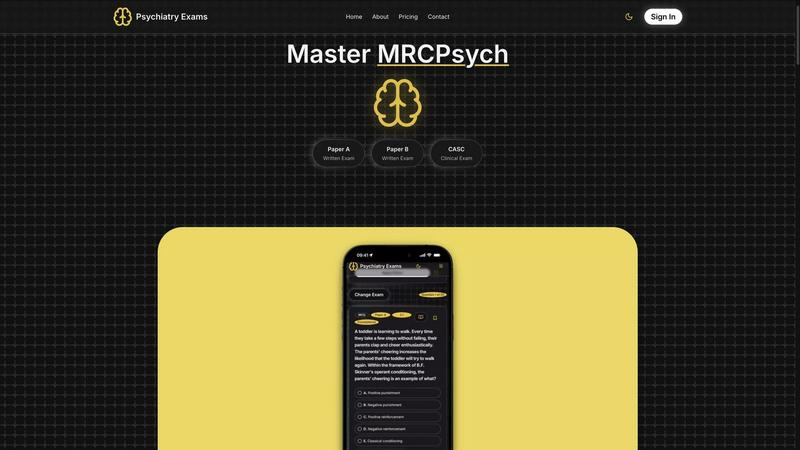
Psychiatry Exams integrates AI models like Claude and GPT with verified NHS consultant expertise for MRCPsych exam.
Last updated: March 1, 2026

Qeeebo
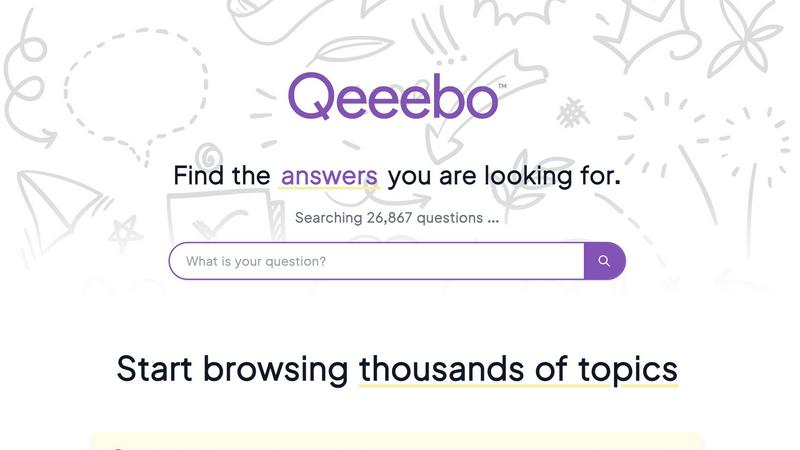
Qeeebo is an AI-powered Q&A platform that delivers instant, curated answers across thousands of integrated topics.
Last updated: March 1, 2026
Visual Comparison
Psychiatry Exams
Qeeebo
Feature Comparison
Psychiatry Exams
AI-Powered Explanation Engine
This core feature is built on a robust, multi-model AI stack integrating Claude Opus 4.5, Gemini 3, and GPT 5.2. The system is specifically fine-tuned on the official MRCPsych syllabus and vetted by NHS consultants. It generates detailed, nuanced explanations for every question, providing insights into correct and incorrect answer choices, ensuring learners understand the underlying principles rather than just memorizing facts.
Recalled & Verified Question Bank
The platform hosts a dynamic repository of over 2,400 questions, including a substantial database of 1,960+ recalled questions from actual exam sittings. Each question is rigorously adapted, verified, and moderated by a panel of eight NHS consultants, ensuring clinical accuracy, relevance, and alignment with current exam patterns and standards.
Active Learning & Credit Ecosystem
Psychiatry Exams implements a gamified, contributory framework where users can submit their own questions for the community. The system awards AI credits for contributions (+2 per submission, +3 upon approval), which can be used within the platform. This API-like interaction incentivizes deep engagement with the material, turning passive study into an active, participatory knowledge-building process.
Community-Driven Learning Hub
The platform extends beyond solo study with integrated community features, including a thriving WhatsApp community segmented by exam sitting, consultant-moderated discussion forums, and group calls. This creates a supportive, collaborative network for peer-to-peer learning, doubt resolution, and shared motivation, seamlessly blending social learning with structured digital content.
Qeeebo
AI-Curated Knowledge Repository
At its core, Qeeebo leverages a sophisticated AI stack to generate, structure, and curate a massive repository of Q&A pairs. This system ensures each entry adheres to a strict schema for consistency, automatically cross-references related topics, and filters out duplicate or low-quality content. The result is a clean, scalable database of knowledge that is machine-readable and primed for integration, setting it apart from unstructured forum data.
Qeeebo Facts (Long-Form Answers)
This feature delivers in-depth exploration of topics through a standardized long-form answer format. Each "Qeeebo Facts" entry provides 10 key facts on a subject, accompanied by detailed explanations and robust cross-references to interconnected questions. This creates a rich, hyperlinked knowledge graph that allows for deep, contextual learning and research, moving beyond simple snippet-based answers.
Immutable Daily Snapshots (Qeeebo Trends)
Qeeebo Trends captures breaking news and evolving topics as immutable daily snapshots. This feature provides a historical, version-controlled record of information, which is invaluable for tracking the evolution of news stories or factual claims over time. For developers and researchers, this offers a reliable, timestamped dataset for analysis, ensuring reproducibility and context in fast-moving domains.
Structured Topic Browsing & Search
The platform organizes knowledge into a clearly defined hierarchy of categories and subcategories, such as Technology/Artificial Intelligence, Science/Physics, and Business/Finance. This, combined with a powerful search engine spanning its entire repository, allows for both exploratory browsing and precise querying. The structured taxonomy ensures seamless navigation and compatibility with systematic research workflows.
Use Cases
Psychiatry Exams
Structured Syllabus Mastery for Paper A/B
Trainees can systematically work through the complete question bank, which is fully mapped to the official Paper A and Paper B learning objectives. The AI-powered explanations and syllabus-linked study notes ensure comprehensive coverage, allowing users to identify and strengthen weak areas efficiently within a single, integrated platform.
CASC Clinical Skills Simulation
Candidates preparing for the Clinical Assessment of Skills and Competencies (CASC) can utilize the library of 15 CASC vignettes. This feature allows for realistic practice of clinical stations, with content designed to reflect the exam's format and complexity, aiding in the development of clinical reasoning, communication, and management planning skills.
Spaced Repetition for Long-Term Retention
The integrated flashcard system, featuring 108+ cards and utilizing spaced repetition algorithms, is ideal for mastering key psychiatric concepts, definitions, and criteria. This system optimizes memory consolidation, ensuring foundational knowledge is retained effectively throughout the preparation journey and beyond into clinical practice.
Collaborative Peer Review & Content Creation
Advanced users and those seeking deeper engagement can use the platform's submission framework to author and submit questions. This process involves peer and consultant moderation, providing invaluable feedback on clinical reasoning and question design, thereby cementing the submitter's own knowledge while contributing to the community's resource pool.
Qeeebo
Academic and Research Reference Tool
Students and academics utilize Qeeebo as a starting point for research across disciplines like History, Philosophy, and Environmental Science. The platform's structured "Facts" format and cross-references provide a quick, reliable overview of complex topics, while the citation-friendly, curated content aids in building foundational understanding before diving into primary sources.
Developer and AI Training Data Source
Developers and data scientists integrate with Qeeebo's structured Q&A dataset via its accessible policies for search engines and AI systems. The clean, categorized, and consistently formatted content serves as high-quality training data for language models, chatbots, and knowledge graph applications, providing a scalable alternative to scraping noisy web forums.
Professional Skill Development and Quick Reference
Professionals in fields like Cybersecurity, Software Development, Finance, and Law use Qeeebo for quick, authoritative answers to technical and procedural questions. The platform's focus on clarity and conciseness allows for efficient problem-solving and continuous learning, directly supporting career development and on-the-job research.
Content Creation and Fact-Checking
Writers, journalists, and educators leverage Qeeebo's vast repository and daily "Trends" snapshots for fact-checking and content inspiration. The immutable snapshots of news events provide a verifiable timeline, while the comprehensive Q&A database offers verified information on everything from Historical Figures to current Climate Change data, ensuring content accuracy.
Overview
About Psychiatry Exams
Psychiatry Exams is a sophisticated, AI-integrated digital platform engineered to serve as the definitive preparation suite for the MRCPsych examinations. It is architected specifically for psychiatry trainees and professionals seeking a comprehensive, efficient, and technologically advanced solution to navigate the demanding syllabus. The platform's core value proposition lies in its centralized, mobile-friendly ecosystem that consolidates high-yield study materials—including extensive question banks, flashcards, and mock exams—while directly addressing the significant financial and logistical burdens of traditional exam preparation. Its infrastructure is powered by a multi-model AI stack, featuring integrations with Claude Opus 4.5, Gemini 3, and GPT 5.2, which is meticulously trained on the latest Royal College syllabus updates to generate precise, high-quality explanations and content. Furthermore, the platform incorporates a unique community-driven and active learning model, featuring moderated question generation, peer review systems, and integrated discussion forums, fostering a collaborative environment that deepens conceptual understanding and enhances long-term knowledge retention for all users.
About Qeeebo
Qeeebo is a next-generation, AI-curated question-and-answer platform architected to be a foundational knowledge layer for the web. It functions as a unified, structured repository designed to scale into one of the world's largest collections of human questions and answers. The platform serves a diverse tech stack and user base, including developers, researchers, students, and professionals, by providing reliable, instantly accessible information across over 92,000 questions and countless topics. Its core value proposition lies in its unique synthesis of advanced AI generation and meticulous human curation, which eliminates the noise and duplication common in traditional forums. This results in a coherent, organized knowledge system where every question follows a consistent schema and answers are concise, factual, and cross-referenced. For integrators and power users, Qeeebo offers structured data and immutable snapshots, making it a compatible and reliable source for applications in search, research, and AI training, all while maintaining clarity and accessibility for the casual learner.
Frequently Asked Questions
Psychiatry Exams FAQ
How are the recalled questions verified for accuracy?
All recalled questions submitted by users undergo a rigorous, multi-stage verification process. They are first adapted to meet exam question standards and then reviewed by a panel of eight NHS consultants. These consultants cross-reference each question and its explanations with the latest Royal College syllabus, official reading materials, and clinical guidelines to ensure absolute accuracy and relevance.
What AI models are integrated, and how are they used?
The platform utilizes a sophisticated ensemble of large language models, specifically Claude Opus 4.5, Gemini 3, and GPT 5.2. These models are not used generically; they are trained and fine-tuned on the specific corpus of the MRCPsych syllabus and consultant-verified content. Their primary function is to generate comprehensive, paragraph-length explanations for questions, providing reasoning that mimics expert consultant teaching.
Can I use the platform effectively on mobile devices?
Yes, Psychiatry Exams is engineered as a fully responsive, mobile-first web application. The user interface and experience are optimized for smartphones and tablets, allowing you to access the entire question bank, flashcards, and community features seamlessly on-the-go, ensuring your study time is flexible and integrated into a busy clinical schedule.
How does the AI credit and contribution system work?
The system operates on a contributory model to incentivize active learning. Users earn +2 AI credits for each question they submit to the community bank. If the submission is approved by the consultant moderation panel, a bonus of +3 credits is awarded. These credits function as in-platform currency, which can be used to access premium features or content, creating a sustainable ecosystem of user-generated, high-quality material.
Qeeebo FAQ
What is the primary technology stack behind Qeeebo?
Qeeebo is built on a foundation of advanced AI and machine learning models for content generation and curation, combined with a robust database architecture to manage over 92,000 structured questions and answers. The front-end and search functionality are designed for high performance and scalability, ensuring fast access to its growing knowledge graph. The platform's infrastructure supports features like immutable snapshots and API-accessible data.
How does Qeeebo ensure the accuracy of its answers?
Accuracy is maintained through a dual-layer system of AI generation and meticulous curation. AI creates initial content, which is then structured, fact-checked, and refined through automated and human-guided processes. The platform's editorial and corrections policies govern content quality, and the focus on cross-referencing within its own verified ecosystem helps maintain internal consistency and reliability.
Can Qeeebo content be integrated into other applications or websites?
Yes, within defined policies. Qeeebo permits automated access for search engines, research, and AI systems in accordance with its Content Use Policy. Limited excerpts can be shared with proper attribution. However, bulk republication, database mirroring, or commercial reuse without explicit authorization is prohibited. Developers should review the platform's policies for specific integration guidelines.
What differentiates Qeeebo from other Q&A sites like Quora or Stack Overflow?
Unlike community-driven platforms, Qeeebo is a centrally curated knowledge system. It eliminates forum noise, opinion-based answers, and duplication by using AI to generate and structure content uniformly. It is organized as a unified database rather than a discussion board, with features like "Qeeebo Facts" and daily snapshots ("Trends") designed for research and integration, not social interaction.
Alternatives
Psychiatry Exams Alternatives
Psychiatry Exams is a specialized digital education platform designed for MRCPsych exam preparation. It falls within the Education & Learning category, specifically targeting medical professionals with a tech-forward approach that integrates AI models and community-driven content. Users often explore alternatives for several key reasons. These include budget constraints, as exam preparation can be costly, or a need for different feature integrations, such as specific study methodologies or platform compatibility with their existing workflow. The search for a tool that aligns perfectly with individual learning styles and technical ecosystems is common. When evaluating alternatives, candidates should prioritize platforms that offer robust, syllabus-aligned content verified by experts. Key considerations include the underlying technology stack for question generation and explanations, the flexibility of study modes like spaced repetition systems, and the security and mobility of the platform to fit a demanding clinical schedule.
Qeeebo Alternatives
Qeeebo is an AI-curated Q&A platform in the education and learning technology space. It functions as a structured knowledge repository, leveraging AI generation and human curation to deliver concise, interconnected answers across thousands of topics. Its core value proposition lies in providing a unified, noise-free system for instant information discovery. Users often evaluate alternatives to Qeeebo based on specific integration requirements, feature sets, or platform compatibility needs. Common drivers include seeking different API access levels, custom data ingestion capabilities, specialized knowledge domain coverage, or alternative pricing and deployment models that better align with their existing tech stack and workflows. When assessing an alternative, key technical considerations include the underlying AI model's capabilities, the structure and exportability of the knowledge graph, API robustness for custom integrations, and data security protocols. The ideal solution should not only match the core functionality but also seamlessly interoperate with your organization's existing learning management systems, content platforms, and data ecosystems.