
Code Word Solver - Missing Words Finder vs Qeeebo
Side-by-side comparison to help you choose the right product.

Code Word Solver - Missing Words Finder
Unlock codewords effortlessly with our intuitive solver, designed for quick and accurate word discovery.
Last updated: February 27, 2026

Qeeebo
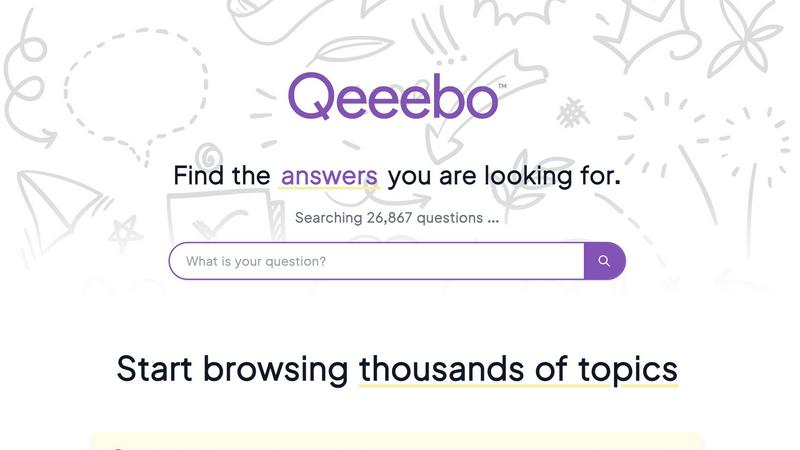
Qeeebo is an AI-powered Q&A platform that delivers instant, curated answers across thousands of integrated topics.
Last updated: March 1, 2026
Visual Comparison
Code Word Solver - Missing Words Finder
Qeeebo
Feature Comparison
Code Word Solver - Missing Words Finder
Single Pattern Solving
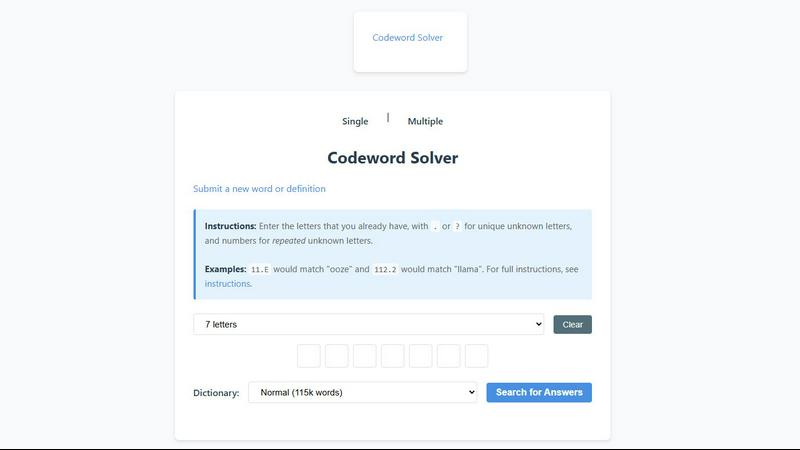
This feature allows users to input a single word pattern and receive a list of matching word candidates. By simply entering known letters alongside placeholders for unknown letters, the solver quickly filters through a vast database to provide you with potential solutions. This streamlined approach eliminates guesswork, making it easier to fill in the blanks in your codeword puzzle.
Multi-Pattern Solving
For those tackling more complex puzzles, the multi-pattern solving feature enables you to input two patterns simultaneously. This is particularly useful when the same number-letter relationships are present across different words in the puzzle. By analyzing the connections between linked words, the solver enhances your chances of finding the correct answers more quickly and efficiently.
Flexible Pattern Input
The solver offers a user-friendly interface for pattern input, where you can easily indicate known letters, unknown letters, and repeated letters. By using symbols like '.' or '?' for unknown letters and numbers for consistent repeats, you can create a precise representation of the puzzle. This flexible input method ensures that the solver understands your requirements and delivers accurate results.
Customizable Difficulty Dictionaries
Recognizing that different players have varying levels of expertise, the Code Word Solver provides multiple dictionary options. You can choose between hard (260k words), normal (115k words), and easy (20k words) dictionaries. This flexibility allows you to select a word list that best matches your skill level, ensuring a more tailored and enjoyable puzzle-solving experience.
Qeeebo
AI-Curated Knowledge Repository
At its core, Qeeebo leverages a sophisticated AI stack to generate, structure, and curate a massive repository of Q&A pairs. This system ensures each entry adheres to a strict schema for consistency, automatically cross-references related topics, and filters out duplicate or low-quality content. The result is a clean, scalable database of knowledge that is machine-readable and primed for integration, setting it apart from unstructured forum data.
Qeeebo Facts (Long-Form Answers)
This feature delivers in-depth exploration of topics through a standardized long-form answer format. Each "Qeeebo Facts" entry provides 10 key facts on a subject, accompanied by detailed explanations and robust cross-references to interconnected questions. This creates a rich, hyperlinked knowledge graph that allows for deep, contextual learning and research, moving beyond simple snippet-based answers.
Immutable Daily Snapshots (Qeeebo Trends)
Qeeebo Trends captures breaking news and evolving topics as immutable daily snapshots. This feature provides a historical, version-controlled record of information, which is invaluable for tracking the evolution of news stories or factual claims over time. For developers and researchers, this offers a reliable, timestamped dataset for analysis, ensuring reproducibility and context in fast-moving domains.
Structured Topic Browsing & Search
The platform organizes knowledge into a clearly defined hierarchy of categories and subcategories, such as Technology/Artificial Intelligence, Science/Physics, and Business/Finance. This, combined with a powerful search engine spanning its entire repository, allows for both exploratory browsing and precise querying. The structured taxonomy ensures seamless navigation and compatibility with systematic research workflows.
Use Cases
Code Word Solver - Missing Words Finder
Casual Puzzle Solving
For casual puzzle enthusiasts, the Code Word Solver simplifies the process of tackling codeword puzzles. By inputting known letters and using the solver to find possible matches, players can enjoy a more relaxed and enjoyable experience without the frustration of being stuck on challenging clues.
Competitive Puzzle Challenges
In competitive environments, such as puzzle competitions or timed challenges, using the Code Word Solver can provide a strategic advantage. By quickly generating potential word matches, players can save time and maintain their competitive edge, ultimately increasing their chances of winning.
Educational Tool for Learners
Teachers and educators can utilize the Code Word Solver as an educational tool to help students understand word patterns and develop problem-solving skills. By engaging with the solver, students can learn to recognize letter relationships and improve their vocabulary in a fun and interactive way.
Community Contribution and Improvement
The Code Word Solver allows users to submit new words and definitions, fostering a sense of community and collaboration. This feature encourages users to contribute to the database, ensuring that the solver continually improves and expands its coverage over time, benefiting all users in the process.
Qeeebo
Academic and Research Reference Tool
Students and academics utilize Qeeebo as a starting point for research across disciplines like History, Philosophy, and Environmental Science. The platform's structured "Facts" format and cross-references provide a quick, reliable overview of complex topics, while the citation-friendly, curated content aids in building foundational understanding before diving into primary sources.
Developer and AI Training Data Source
Developers and data scientists integrate with Qeeebo's structured Q&A dataset via its accessible policies for search engines and AI systems. The clean, categorized, and consistently formatted content serves as high-quality training data for language models, chatbots, and knowledge graph applications, providing a scalable alternative to scraping noisy web forums.
Professional Skill Development and Quick Reference
Professionals in fields like Cybersecurity, Software Development, Finance, and Law use Qeeebo for quick, authoritative answers to technical and procedural questions. The platform's focus on clarity and conciseness allows for efficient problem-solving and continuous learning, directly supporting career development and on-the-job research.
Content Creation and Fact-Checking
Writers, journalists, and educators leverage Qeeebo's vast repository and daily "Trends" snapshots for fact-checking and content inspiration. The immutable snapshots of news events provide a verifiable timeline, while the comprehensive Q&A database offers verified information on everything from Historical Figures to current Climate Change data, ensuring content accuracy.
Overview
About Code Word Solver - Missing Words Finder
Code Word Solver - Missing Words Finder is an innovative tool designed to enhance your experience with codeword puzzles, making them less frustrating and more enjoyable. This product is perfect for puzzle enthusiasts who often find themselves confronted with tricky codewords that require additional help. By leveraging the patterns you already know, this tool filters potential answers, allowing you to decode the puzzle grid confidently. Codewords operate on a unique mapping system where letters are replaced with numbers (1-26), and once you've identified the mapping for a specific letter, it applies universally throughout the puzzle. The solver supports both single and multiple pattern inputs, accommodating various solving strategies. Whether you're a casual player or a serious puzzle solver, this tool is tailored to help you solve codewords efficiently.
About Qeeebo
Qeeebo is a next-generation, AI-curated question-and-answer platform architected to be a foundational knowledge layer for the web. It functions as a unified, structured repository designed to scale into one of the world's largest collections of human questions and answers. The platform serves a diverse tech stack and user base, including developers, researchers, students, and professionals, by providing reliable, instantly accessible information across over 92,000 questions and countless topics. Its core value proposition lies in its unique synthesis of advanced AI generation and meticulous human curation, which eliminates the noise and duplication common in traditional forums. This results in a coherent, organized knowledge system where every question follows a consistent schema and answers are concise, factual, and cross-referenced. For integrators and power users, Qeeebo offers structured data and immutable snapshots, making it a compatible and reliable source for applications in search, research, and AI training, all while maintaining clarity and accessibility for the casual learner.
Frequently Asked Questions
Code Word Solver - Missing Words Finder FAQ
How does the Code Word Solver work?
The Code Word Solver filters potential answers based on the patterns you provide, using known letters, placeholders for unknown letters, and numbers for repeated letters to generate matching word candidates.
Can I use the solver for complex codewords with multiple patterns?
Yes, the solver supports both single pattern and multi-pattern solving. You can input two patterns at once, making it easier to solve linked words that share similar number-letter relationships.
What type of dictionaries are available in the solver?
The Code Word Solver offers three difficulty levels for its dictionaries: hard (260k words), normal (115k words), and easy (20k words). This allows users to select a word list that best suits their skill level.
How can I improve the word coverage in the solver?
If you encounter a word that is not in the database or wish to add an extra definition, you can submit it through the solver. This community-powered feature helps enhance the overall word coverage and keeps the solver relevant and useful.
Qeeebo FAQ
What is the primary technology stack behind Qeeebo?
Qeeebo is built on a foundation of advanced AI and machine learning models for content generation and curation, combined with a robust database architecture to manage over 92,000 structured questions and answers. The front-end and search functionality are designed for high performance and scalability, ensuring fast access to its growing knowledge graph. The platform's infrastructure supports features like immutable snapshots and API-accessible data.
How does Qeeebo ensure the accuracy of its answers?
Accuracy is maintained through a dual-layer system of AI generation and meticulous curation. AI creates initial content, which is then structured, fact-checked, and refined through automated and human-guided processes. The platform's editorial and corrections policies govern content quality, and the focus on cross-referencing within its own verified ecosystem helps maintain internal consistency and reliability.
Can Qeeebo content be integrated into other applications or websites?
Yes, within defined policies. Qeeebo permits automated access for search engines, research, and AI systems in accordance with its Content Use Policy. Limited excerpts can be shared with proper attribution. However, bulk republication, database mirroring, or commercial reuse without explicit authorization is prohibited. Developers should review the platform's policies for specific integration guidelines.
What differentiates Qeeebo from other Q&A sites like Quora or Stack Overflow?
Unlike community-driven platforms, Qeeebo is a centrally curated knowledge system. It eliminates forum noise, opinion-based answers, and duplication by using AI to generate and structure content uniformly. It is organized as a unified database rather than a discussion board, with features like "Qeeebo Facts" and daily snapshots ("Trends") designed for research and integration, not social interaction.
Alternatives
Code Word Solver - Missing Words Finder Alternatives
Code Word Solver - Missing Words Finder is a specialized online tool designed to assist users in solving codeword puzzles efficiently. This product falls under the category of puzzle-solving applications, offering features that streamline the process of decoding letters and numbers in various word games. Users often seek alternatives to such tools for reasons ranging from pricing and feature sets to specific platform compatibility, which can impact their overall experience. When searching for an alternative, it's essential to consider factors such as the comprehensiveness of the word database, the flexibility of input options, and the ease of use in adapting to different puzzle types. In the realm of codeword solvers, the user experience can vary significantly based on the interface, available features, and the level of support provided. It's crucial to look for options that allow for both single and multi-pattern solving, as well as the ability to choose from different difficulty dictionaries. Additionally, community support for expanding word coverage can enhance the effectiveness of any codeword solver, making it a valuable tool for both casual players and seasoned code-crackers alike.
Qeeebo Alternatives
Qeeebo is an AI-curated Q&A platform in the education and learning technology space. It functions as a structured knowledge repository, leveraging AI generation and human curation to deliver concise, interconnected answers across thousands of topics. Its core value proposition lies in providing a unified, noise-free system for instant information discovery. Users often evaluate alternatives to Qeeebo based on specific integration requirements, feature sets, or platform compatibility needs. Common drivers include seeking different API access levels, custom data ingestion capabilities, specialized knowledge domain coverage, or alternative pricing and deployment models that better align with their existing tech stack and workflows. When assessing an alternative, key technical considerations include the underlying AI model's capabilities, the structure and exportability of the knowledge graph, API robustness for custom integrations, and data security protocols. The ideal solution should not only match the core functionality but also seamlessly interoperate with your organization's existing learning management systems, content platforms, and data ecosystems.