
LLMWise vs QuickImg
Side-by-side comparison to help you choose the right product.

LLMWise
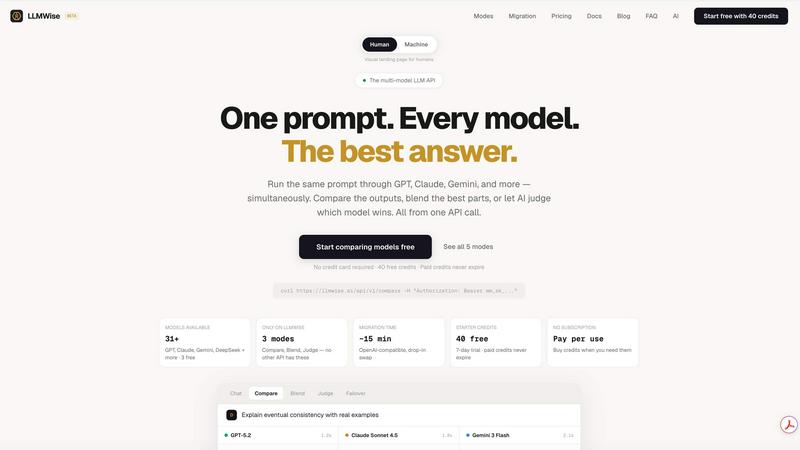
LLMWise offers a single API to seamlessly access and compare multiple AI models, charging only for what you use.
Last updated: February 27, 2026

QuickImg
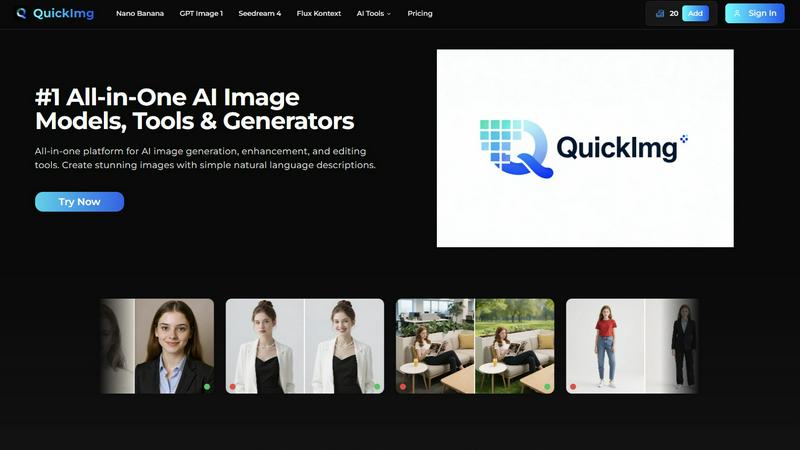
QuickImg integrates top AI image models and editing tools into one unified platform for seamless creative workflows.
Last updated: February 28, 2026
Visual Comparison
LLMWise
QuickImg
Feature Comparison
LLMWise
Smart Routing
LLMWise's smart routing feature automatically directs prompts to the most appropriate LLM based on the task at hand. For instance, code-related queries are sent to GPT, while creative writing prompts might go to Claude. This intelligent selection ensures optimal performance and accuracy for every request, allowing developers to focus on building rather than managing multiple APIs.
Compare & Blend
The compare and blend functionalities enable users to execute prompts across various models simultaneously. By comparing different outputs side-by-side, developers can easily identify which model performs best for their specific needs. The blend feature synthesizes the strongest responses from multiple models into a cohesive answer, significantly improving the overall quality of results.
Resilient Architecture
LLMWise is designed with resilience in mind, featuring a circuit-breaker failover mechanism that reroutes requests to backup models if a primary provider experiences downtime. This ensures that applications remain operational and reliable, minimizing disruptions and enhancing user experience even during outages.
Testing & Optimization
The platform provides robust testing and optimization tools, including benchmark suites and automated regression checks. Developers can conduct batch tests to evaluate performance in terms of speed, cost, and reliability, allowing for continuous improvement of their applications. This focus on optimization helps teams ensure they are leveraging resources efficiently while maintaining high-quality outputs.
QuickImg
Unified Multi-Model AI Platform
QuickImg provides centralized access to a curated suite of leading AI image models, including Nano Banana Pro, GPT Image 1, and Seedream 4. This integration allows users to select the optimal model for specific tasks—such as text rendering, 4K output, or character consistency—without switching between different applications or APIs. The platform handles backend compatibility, offering a consistent interface that simplifies workflow and ensures you always use the most effective tool for your project's requirements.
Advanced Natural Language Image Generation
The platform's intuitive engine interprets simple natural language descriptions to generate detailed, high-quality images. This feature removes the barrier of crafting intricate, technical prompts, making professional-grade image creation accessible to users of all skill levels. You can describe a scene, concept, or style in plain English, and QuickImg's integrated AI models will render the visual, streamlining the ideation-to-creation process for rapid content development.
Comprehensive AI-Powered Editing Tools
Beyond generation, QuickImg includes a full suite of one-click editing tools designed for technical precision and compatibility with standard formats. Features like AI Background Changer, PNG Maker, AI Image Upscaler, and Watermark Remover allow for non-destructive, high-fidelity edits. These tools are built to integrate results seamlessly into existing design stacks, supporting workflows that require clean, transparent, or high-resolution assets for web, print, or social media.
Ready-to-Use Templates and Batch Processing
QuickImg offers a library of pre-designed templates for common scenarios like product photos, social media banners, and marketing materials, enabling rapid deployment and brand consistency. Furthermore, its architecture supports efficient batch processing capabilities, allowing users to apply enhancements, upscaling, or formatting changes across multiple images simultaneously. This is crucial for teams managing large content libraries who need to optimize visuals at scale while maintaining technical quality.
Use Cases
LLMWise
Software Development
Developers can utilize LLMWise to streamline coding tasks by routing prompts directly to the most competent model for code generation. This not only saves time but also reduces the complexity of managing multiple API keys, making the development process smoother and more efficient.
Creative Writing
Writers can leverage the blend feature of LLMWise to generate more compelling narratives. By combining the strengths of different models, writers can enhance their creative outputs, producing high-quality content that resonates with their audience while benefiting from diverse perspectives.
Language Translation
LLMWise simplifies the translation process by utilizing the best models for language tasks. Developers can send translation prompts to models specifically trained for linguistic accuracy, ensuring that the translations are not only quick but also contextually and culturally appropriate.
AI Research and Development
Researchers can take advantage of the testing and optimization features to benchmark various models against specific criteria. This allows them to evaluate the effectiveness of different AI solutions, fostering innovation and helping to identify the most suitable models for their research projects.
QuickImg
Social Media Content Creation and Management
Marketing teams and social media managers can leverage QuickImg to rapidly produce a high volume of engaging, platform-specific visuals. Using natural language, they can generate unique images for posts, stories, and ads, then instantly edit them with tools for background removal, text overlay, and style conversion (e.g., Photo to Anime). This streamlines the content calendar pipeline and ensures brand visuals remain fresh and consistent across all channels.
E-commerce Product Image Optimization
E-commerce businesses can use QuickImg to enhance and standardize product photography at scale. The AI Image Upscaler improves thumbnail resolution, the Change Background Color tool creates uniform white or contextual backgrounds, and the PNG Maker generates transparent cutouts for catalogs. This creates a professional, cohesive storefront appearance and improves product presentation without extensive manual photo editing.
Concept Art and Character Design for Projects
Game developers, authors, and concept artists can utilize the AI Character Generator and models like Flux Kontext to visualize characters, avatars, and scenes with consistent styling. By describing character attributes, settings, or moods, they can quickly iterate on visual concepts, generate reference artwork, and maintain character consistency across multiple images, accelerating the pre-production and brainstorming phases of creative projects.
Professional Graphic Design and Asset Preparation
Graphic designers can integrate QuickImg into their workflow to expedite asset creation and modification. The platform assists in generating base artwork, removing unwanted elements or watermarks from stock imagery, upscaling low-res assets for print, and converting file formats. This compatibility-focused toolset acts as a powerful supplement to traditional design software, handling tedious tasks and freeing up time for high-level creative work.
Overview
About LLMWise
LLMWise is an innovative platform that streamlines access to numerous large language models (LLMs) through a single API. By integrating models from industry leaders such as OpenAI, Anthropic, Google, Meta, xAI, and DeepSeek, LLMWise offers developers a simplified way to leverage the best AI for any task without the hassle of managing multiple providers. Its intelligent routing system ensures that each prompt is matched to the most suitable model, whether it involves coding, creative writing, or translation tasks. With features like side-by-side comparison and output blending, users can enhance the quality of their results. Ideal for developers seeking to optimize their AI workflows, LLMWise eliminates complexity while providing powerful tools to enhance application performance.
About QuickImg
QuickImg is a comprehensive, multi-model AI image generation and editing platform engineered for seamless integration into modern digital workflows. It consolidates access to cutting-edge AI models like Nano Banana, GPT Image 1, Seedream 4, and Flux Kontext within a single, unified interface, eliminating the need to manage multiple disparate services. The platform's core value proposition lies in its tech-stack oriented design, which prioritizes compatibility and ease of use for both developers and creative professionals. By leveraging natural language processing, QuickImg democratizes advanced image creation, allowing users to generate, upscale, edit, and enhance visuals through simple descriptive prompts rather than complex technical commands. This makes it an indispensable tool for graphic designers, content creators, social media managers, and marketing teams who require high-volume, high-quality visual content that integrates smoothly with existing design software and publishing pipelines. QuickImg functions as an all-in-one solution, streamlining the entire image production lifecycle from initial concept to final, polished asset, thereby significantly boosting productivity and creative output.
Frequently Asked Questions
LLMWise FAQ
How does LLMWise ensure optimal model selection?
LLMWise employs an intelligent routing system that analyzes each prompt and directs it to the best-performing model based on task type, ensuring optimal results for different applications.
Can I use my existing API keys with LLMWise?
Yes, LLMWise supports bring your own key (BYOK) functionality, allowing users to integrate their existing API keys from various providers, which helps in managing costs effectively.
What happens if a model fails during a request?
In the event of a model failure, LLMWise's resilient architecture features a circuit-breaker failover mechanism that reroutes requests to backup models, ensuring uninterrupted service and reliability.
Are there any hidden fees with LLMWise?
LLMWise operates on a pay-per-use model with no subscription fees. Users pay only for the credits they consume, and there are no hidden costs associated with using the platform.
QuickImg FAQ
What AI models are integrated into QuickImg?
QuickImg integrates several state-of-the-art AI models to cater to different needs. This includes Google's Nano Banana Pro for advanced text rendering and high-resolution output, OpenAI's GPT Image 1 for superior multimodal understanding, ByteDance's Seedream 4 for ultra-fast 4K image generation, and Flux Kontext for precise editing with character consistency. This multi-model approach ensures you have the right tool for any specific image task.
Do I need technical expertise to write effective prompts?
No, technical expertise is not required. QuickImg is specifically designed with an intuitive natural language processing interface. You can generate and edit images using simple, descriptive sentences about what you want to create or change. The platform interprets everyday language, eliminating the complexity of traditional, parameter-heavy AI prompting systems.
How does QuickImg ensure the quality and resolution of output images?
QuickImg leverages advanced AI models like Seedream 4 and Nano Banana Pro that are engineered for high-fidelity output, supporting up to 4K resolution. Additionally, the dedicated AI Image Upscaler tool can enhance the resolution of existing images while preserving detail and quality. The platform is built to deliver production-ready visuals suitable for both digital displays and professional print media.
Can I use QuickImg for commercial purposes?
Yes, images generated and edited using QuickImg are typically intended for commercial use, including in marketing materials, digital content, and products. However, users should review the specific licensing terms and conditions provided by QuickImg to ensure compliance, particularly regarding the use of AI-generated content for their specific commercial applications and distribution channels.
Alternatives
LLMWise Alternatives
LLMWise is an innovative API platform that consolidates access to multiple large language models (LLMs) such as GPT, Claude, and Gemini, among others. It simplifies the AI integration process by providing intelligent routing that ensures users can leverage the best model for every specific task, whether it’s for creative writing, coding, or translation. As a solution designed for developers, LLMWise falls under the AI Assistants category, streamlining the complexities of managing different AI providers. Users often seek alternatives to LLMWise for various reasons, including pricing structures, feature sets, or specific platform requirements that may not be addressed by a single provider. When exploring alternatives, it is essential to consider factors such as ease of integration, model performance, pricing flexibility, and the ability to test and optimize outputs. Evaluating these aspects will help ensure that the chosen solution aligns with the specific needs of your project and enhances overall productivity.
QuickImg Alternatives
QuickImg is a comprehensive AI image generation and editing platform within the AI Assistants category. It leverages models like Nano Banana and GPT Image 1 to transform text descriptions into visuals, offering an all-in-one suite for creation, enhancement, and editing. Users often explore alternatives for various technical and operational reasons. This can include seeking different pricing structures, specific feature sets like API availability or unique AI models, or better compatibility with their existing tech stack and workflow tools such as CMS platforms or design software. When evaluating an alternative, key considerations should be its core AI model capabilities and output quality, the depth of its editing toolkit, and its integration potential. Assess how well it connects with your current applications, its scalability for team or project use, and the overall developer or user experience it provides within your operational environment.