
Shrinkpad vs Sketch To
Side-by-side comparison to help you choose the right product.

Shrinkpad
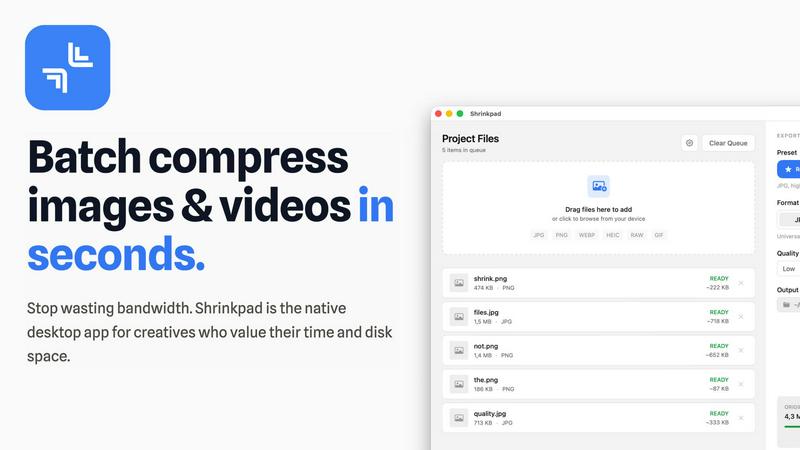
Shrinkpad is a native Mac app that batch compresses images and videos locally for faster, integrated workflows.
Last updated: February 28, 2026
Sketch To
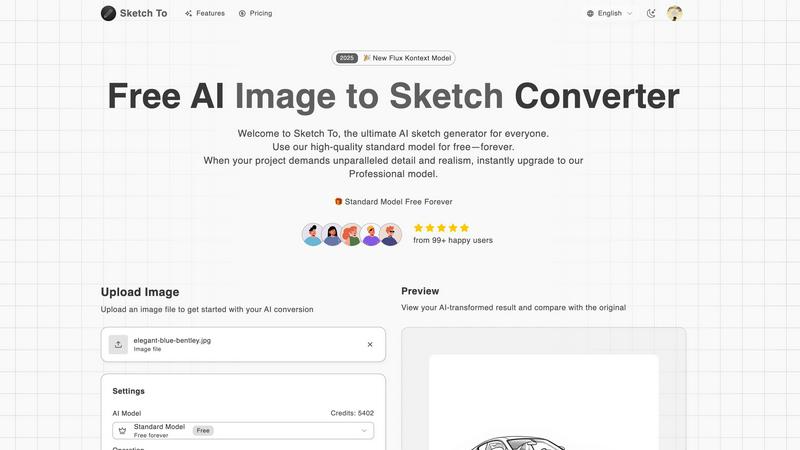
Sketch To is an AI-powered tool that instantly converts images to sketches and sketches back to images.
Last updated: March 2, 2026
Visual Comparison
Shrinkpad
Sketch To
Feature Comparison
Shrinkpad
Native macOS & Apple Silicon Optimization
Shrinkpad is built exclusively for macOS, utilizing Apple's Core Graphics, VideoToolbox, and AVFoundation frameworks for maximum performance and system integration. It is fully optimized for Apple Silicon (M1/M2/M3 chips), leveraging multi-threaded processing to compress thousands of images and videos in minutes. This deep integration with the macOS tech stack ensures unparalleled speed and stability compared to cross-platform or web-based tools.
Intelligent, Automated Quality Analysis
The application automatically analyzes the visual complexity of each asset to apply the perfect, format-specific compression ratio. This eliminates the guesswork from manual quality sliders, preventing artifacts while achieving maximum file size reduction. The intelligent algorithm ensures perceptual quality is maintained, making it ideal for batch processing where individual file inspection is impractical.
Comprehensive Format Support
Shrinkpad supports over 30 image formats—including JPG, PNG, WEBP, AVIF, HEIC, and professional RAW files—alongside all major video formats like MP4 and MOV. This extensive compatibility allows users to process mixed-media batches containing photos and videos together in a single operation, with the app automatically applying the optimal compression settings for each file type.
Advanced Folder Mode & Batch Processing
With its advanced Folder Mode, you can drag and drop an entire project directory onto Shrinkpad. It will automatically scan subfolders, detect all supported media files, and ignore non-media assets, readying hundreds or thousands of files for compression in one click. This feature, combined with auto-renaming and metadata stripping options, completely automates the optimization of exported assets from tools like Figma or Photoshop.
Sketch To
Advanced Dual-Direction AI Conversion Engine
The platform is powered by two distinct, optimized AI model stacks. One is fine-tuned for deconstructing photographs into line art and texture, accurately replicating mediums like pencil, charcoal, and ink. The complementary model is trained for generative reconstruction, intelligently interpreting sketch outlines and strokes to synthesize detailed, realistic images. This dual-engine architecture ensures specialized, high-quality outputs for each conversion direction, setting it apart from single-purpose filters.
Tiered AI Model Deployment (Standard & Pro)
Sketch To operates on a flexible, two-tier model system. The Standard Model is a highly efficient neural network optimized for speed and accessibility, perfect for non-commercial projects. The Professional Model is a more computationally intensive, advanced network that accesses a broader parameter set for superior detail, texture accuracy, and color depth. This tiered approach allows users to match the computational resource and output quality directly to their project's specific technical requirements and budget.
High-Resolution, Cloud-Based Processing Infrastructure
All conversions are executed on powerful, scalable cloud servers, removing the dependency on users' local hardware. This infrastructure supports batch processing of multiple images and delivers download-ready results in high-resolution formats (e.g., PNG, JPEG) suitable for both digital display and professional print media. The cloud-first design guarantees consistent performance, automatic updates to AI models, and universal access from any modern web browser.
Extensive Style Library and Model Configuration
Users have precise control over the output through a comprehensive library of pre-trained artistic styles—from Pencil Sketch and Watercolor to Concept Art. Beyond style selection, the platform offers advanced model configuration options, allowing for fine-tuning of parameters such as line intensity, shading granularity, and detail preservation. This level of control enables deep integration into specialized creative pipelines, from comic book illustration to architectural visualization.
Use Cases
Shrinkpad
Optimizing Web and Mobile Application Assets
Software developers and web designers use Shrinkpad to drastically reduce the size of image and video assets within app bundles and websites. By batch-compressing icons, screenshots, hero images, and promotional videos locally, they achieve faster load times, improved Largest Contentful Paint (LCP) scores, and smaller download sizes for end-users, directly impacting performance metrics and user experience.
Managing Photographer and Creator Media Libraries
Photographers and content creators dealing with large volumes of high-resolution photos and video footage utilize Shrinkpad to reclaim terabytes of disk space. The tool allows them to create optimized, web-ready versions of their portfolios or social media content from original RAW files and 4K videos in a single, automated batch process, all while keeping master files untouched and private.
Streamlining Design-to-Development Workflows
Design teams exporting assets from UI/UX tools like Figma, Sketch, or Adobe Photoshop can export everything at 2x or 4x resolution and use Shrinkpad as a final optimization step. It handles bulk compression, renaming, and format conversion, delivering production-ready assets to developers without manual, time-consuming export sessions for each screen density or format.
Preparing Assets for Presentations and Documents
Professionals preparing decks, reports, or client presentations containing numerous high-resolution screenshots and embedded videos can use Shrinkpad to compress these files en masse. This ensures the final document file size remains manageable for email distribution and cloud storage without sacrificing on-screen visual fidelity.
Sketch To
Digital Art and Concept Development
Artists and concept designers use the Sketch to Image function to rapidly breathe life into preliminary drawings. By uploading a basic concept sketch, the Pro model can generate multiple textured, lit, and detailed renderings, accelerating the ideation and iteration phases. This serves as a powerful brainstorming aid and a base layer for further refinement in software like Photoshop or Procreate.
Educational and Instructional Material Creation
Educators and trainers leverage the Image to Sketch converter to transform complex photographs, such as biological specimens or historical artifacts, into clear, simplified line drawings. These sketches are ideal for creating worksheets, presentations, and study guides, where removing photographic clutter enhances focus on key structural elements and improves comprehension.
Social Media and Content Marketing Asset Generation
Content creators and marketing professionals utilize the tool to produce unique, eye-catching graphics from product photos or portraits. Converting images into various sketch styles (e.g., Comic Sketch, Ink Sketch) creates a consistent and engaging aesthetic for posts, stories, and advertisements, helping brands stand out in crowded digital feeds without requiring a dedicated illustrator.
Architectural and Product Design Visualization
Architects, interior designers, and industrial designers can upload hand-drawn sketches or floor plans and use the Pro model to generate photorealistic previews of materials, lighting, and environmental context. This facilitates client presentations and stakeholder reviews early in the design process, providing a tangible vision before committing to full 3D rendering or physical prototyping.
Overview
About Shrinkpad
Shrinkpad is a native macOS application engineered for high-performance, batch compression of images and videos directly on your local machine. It leverages Apple's native frameworks, including Core Graphics, VideoToolbox, and AVFoundation, to process media files without ever requiring an internet connection or cloud upload. This architecture ensures complete data privacy and eliminates server-dependent bottlenecks. The app is built for a tech-savvy audience, including software developers needing to optimize app bundles, web designers reducing page load times, photographers managing large libraries, and content creators handling mixed-media projects. Its core value proposition is delivering a powerful, automated compression workflow that integrates seamlessly into the macOS ecosystem, offering significant storage savings—up to 90%—while maintaining perceptual quality through intelligent, format-specific algorithms. By handling hundreds of files in a single drag-and-drop operation, Shrinkpad replaces tedious, manual export and optimization steps with a streamlined, local-first tool.
About Sketch To
Sketch To is a cutting-edge, cloud-native AI platform engineered to perform bidirectional conversion between photographs and sketches. At its core, it leverages sophisticated deep learning models, specifically trained on vast datasets of artistic styles, to interpret and transform visual data with high fidelity. The platform serves a broad technical and creative audience, from digital artists and UX/UI designers seeking rapid prototyping tools to educators and content creators needing to generate unique visual assets. Its primary value proposition lies in its seamless, API-like accessibility and tiered model architecture. Users can immediately engage with a robust Standard Model using trial credits, which is built for efficiency and general use. For enterprise-grade requirements, the Professional Model offers a more complex neural network configuration, delivering photorealistic detail and commercial licensing. This eliminates the traditional barriers of expensive, installed software suites, offering a scalable, subscription-free solution that integrates effortlessly into modern digital workflows. The infrastructure is designed for instant processing, ensuring low-latency conversions that fit into fast-paced production environments, from social media content pipelines to professional design sprints.
Frequently Asked Questions
Shrinkpad FAQ
What file formats does Shrinkpad support?
Shrinkpad supports a wide array of image and video formats. For images, it handles JPG, PNG, WEBP, AVIF, HEIC, SVG, and over 30 formats including professional RAW files from camera manufacturers. For video, it supports major formats like MP4, MOV, and more. This allows for true mixed-media batch processing in a single workflow.
Does Shrinkpad support video compression?
Yes, Shrinkpad fully supports batch video compression. It utilizes macOS's native VideoToolbox and AVFoundation frameworks to efficiently compress video files like MP4 and MOV formats directly on your machine. You can process videos individually or mix them with image files in the same batch queue for a unified optimization workflow.
Are my files uploaded to the cloud?
No. Shrinkpad operates on a strict privacy-first principle. All compression processing is executed locally on your Mac using Apple's native frameworks. Your original files, intermediates, and optimized outputs never leave your device, ensuring complete data privacy and security, which is crucial for handling sensitive or proprietary assets.
Can I use Shrinkpad on multiple devices?
Licensing depends on the plan you purchase. The Personal plan includes a license for use on one device. The Team plan includes licenses for up to 10 devices, making it suitable for small studios or teams where multiple members need to use the application across different Macs.
Sketch To FAQ
What file formats and sizes does Sketch To support for upload?
The platform supports common raster image formats including JPG, PNG, and WebP. The current maximum file size for upload is 5MB per image to ensure swift processing within the cloud infrastructure. Output images are provided in high-quality PNG or JPEG format, with resolutions suitable for both web and print applications.
How do the credits system and the two AI models work?
Sketch To operates on a credit-based system. The Standard Model, ideal for personal and social media use, consumes 1 credit per conversion. The Professional Model, designed for commercial-grade detail, consumes 2 credits. New users receive free trial credits to test the Standard Model. Subsequent credits can be obtained via flexible credit packs or subscription plans, allowing you to scale usage based on project demands.
Is the content I generate with Sketch To free for commercial use?
Output generated using the free trial credits or the Standard Model is typically licensed for personal use. For full commercial rights, including use in products for sale, advertising, and client work, you must use the Professional Model under a paid plan. Always review the specific Terms of Service on the platform for the latest licensing details related to your chosen model and plan.
How does Sketch To ensure the privacy and security of my uploaded images?
Sketch To employs enterprise-grade security protocols. Image uploads and processing occur over encrypted HTTPS connections. The platform's privacy policy states that uploaded images are processed automatically and are not stored permanently on the servers after the conversion is complete and delivered, ensuring your original assets remain confidential.
Alternatives
Shrinkpad Alternatives
Shrinkpad is a native macOS application for local batch compression of images and videos, falling squarely into the media optimization and productivity software category. Users often seek alternatives for various reasons, including budget constraints, the need for cross-platform compatibility on Windows or Linux, or specific feature requirements not covered by a single tool. When evaluating alternatives, key technical considerations include the processing engine's architecture—whether it's a native app, a cross-platform framework, or a web service—and its impact on performance and privacy. Integration capabilities with your existing tech stack, such as CLI support for CI/CD pipelines or compatibility with specific file formats like AVIF or ProRes, are also critical. The ideal solution should align with your workflow's scale, security requirements, and quality benchmarks. Ultimately, the choice hinges on balancing processing power, platform support, and data sovereignty. A tool that compresses locally using hardware-accelerated frameworks offers a different value proposition than a cloud-based API or a multi-platform utility built on Electron.
Sketch To Alternatives
Sketch To is an AI-powered image-to-sketch and sketch-to-image conversion tool, operating within the image processing and creative software category. Users often seek alternatives to such tools due to specific technical requirements, such as API availability for custom integrations, different pricing structures beyond freemium models, or the need for platform-specific applications like native desktop software or mobile SDKs. When evaluating alternatives, developers and technical users should prioritize compatibility with their existing tech stack. Key considerations include the availability of a robust API for automation, support for specific programming languages or frameworks, the ability to handle batch processing workflows, and the tool's output format compatibility with downstream design or publishing platforms. The underlying AI model architecture is also a critical factor, as it determines processing speed, output quality, and the computational resources required for integration. A thorough assessment should balance these technical specifications with the project's scalability needs and budget constraints.