
ScopeSnap vs Skene
Side-by-side comparison to help you choose the right product.

ScopeSnap
ScopeSnap's AI instantly transforms discovery notes into structured project scopes and client-ready proposals.
Last updated: March 18, 2026

Skene is growth infrastructure you own and prompt directly into your codebase.
Last updated: February 28, 2026
Visual Comparison
ScopeSnap
Skene
Feature Comparison
ScopeSnap
AI-Powered Scope Generation
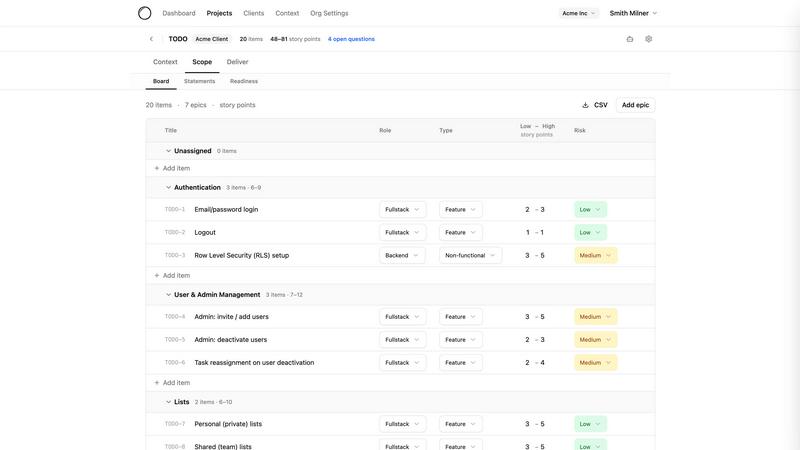
This core feature ingests raw, unstructured text from various sources like call transcripts, Slack exports, or handwritten notes. Using advanced language models, it automatically identifies key requirements, user actions, and system functionalities, structuring them into a preliminary project backlog complete with epics and detailed scope items. It intelligently flags assumptions and surfaces open questions for the team to review, providing a powerful head start on scope definition.
Interactive Scope Refinement Board
The generated scope is presented in a dynamic, kanban-style board interface where teams can collaboratively review, edit, and organize items. This feature allows for direct manipulation of the backlog: dragging items between stages, breaking down large epics, assigning development roles (e.g., Frontend, Backend, DevOps), and attaching custom time or complexity estimates to each task, ensuring every aspect of the project is quantified.
Automated Proposal & SOW Document Builder
Once the scope is finalized and estimated, this feature automates the creation of client-facing documentation. Users can select a template (Proposal or Statement of Work), and ScopeSnap populates it with the structured scope, estimates, assumptions, and defined deliverables. The output is a polished, professional PDF or shareable document, eliminating hours of manual copying, pasting, and formatting from disparate sources.
Integration-First Data Context
Understanding that discovery happens across tools, ScopeSnap is built with compatibility in mind. It supports direct paste-in from a wide array of sources and is designed for a workflow that sits alongside communication platforms like Zoom, Google Meet, email clients, and note-taking apps. This ensures all relevant project context can be easily aggregated into the scoping engine without disruptive context switching.
Skene
Codebase Signal Analysis
Skene performs deep, automated analysis of your connected GitHub or GitLab repository to extract actionable growth signals. It scans your framework, component structure, and user flow logic to identify onboarding friction points, activation opportunities, and retention risks directly from the source code, providing a foundational context layer for all subsequent AI-driven optimizations.
AI-Prompted Growth Implementation
Growth workflows are managed through natural language prompts within your existing development environment, such as Cursor or a terminal. After analysis, you can instruct Skene to generate and implement specific improvements—like refining an onboarding tour or adjusting a activation checkpoint—turning strategic insights into shipped code without manual intervention.
Self-Optimizing User Flows
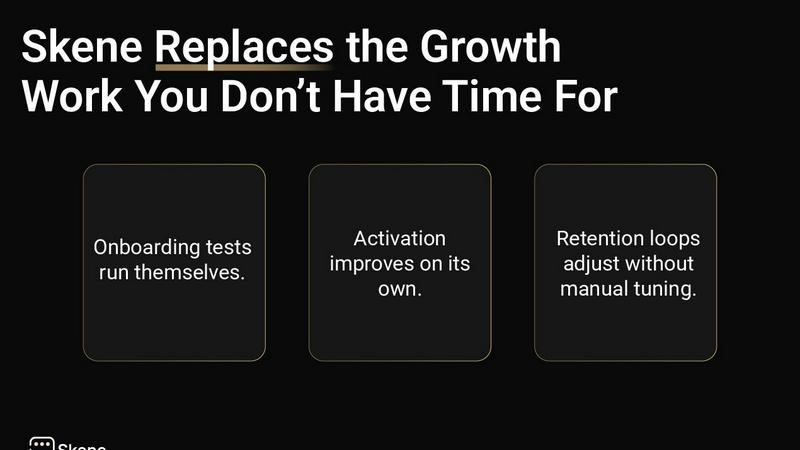
The system continuously monitors user interactions against the signals in your codebase. It automatically A/B tests different user journey variations and implements the winning flows. This creates a closed feedback loop where onboarding and activation processes become smarter and more effective over time, with no manual dashboard tuning required.
Integrated Growth Manifest & Context
Skene generates a persistent growth-manifest.json file within your project (e.g., in ./skene-context/). This file acts as a centralized, version-controlled source of truth for all your product's growth logic, analytics definitions, and user journey states, ensuring your AI agents and tools have consistent, up-to-date context.
Use Cases
ScopeSnap
Freelance Developer Client Onboarding
For solo developers, ScopeSnap streamlines the process of converting initial client discussions into a fixed-scope proposal. After a discovery call, the freelancer can paste their notes and meeting transcript into the tool to quickly generate a structured scope, identify edge cases, and produce a credible, detailed estimate and SOW to secure the project with clear boundaries and expectations.
Software Agency Pre-Sales Scoping
Agencies can use ScopeSnap to bring consistency and speed to their sales engineering phase. Sales teams can input notes from multiple stakeholder interviews, and the platform will synthesize a unified scope document. This allows for rapid iteration with internal technical leads to validate feasibility and cost before presenting a polished, accurate proposal to the prospective client.
Technical Consultant Requirement Analysis
Consultants tasked with defining project specifications for third-party teams can use ScopeSnap as an analysis tool. By processing all gathered business and technical requirements, the AI helps identify gaps, dependencies, and implicit assumptions, enabling the consultant to deliver a comprehensive, well-structured scope of work document to the development team for execution.
Iterative Project Scope Refinement
For projects following agile or iterative methodologies, ScopeSnap can be used at the start of each new phase or sprint. Teams can feed in notes from refinement sessions or user feedback to quickly generate and estimate the backlog for the upcoming cycle, maintaining a living document that accurately reflects the evolving project trajectory.
Skene
Autonomous Onboarding Optimization
For SaaS products, Skene automatically analyzes where new users drop off during initial setup. It then generates, tests, and deploys refined onboarding tours and tooltips directly within the application's UI, significantly improving time-to-value and activation rates without any engineering overhead.
Continuous Activation Funnel Management
Startups can use Skene to perpetually audit and improve their core activation funnel. The system identifies which features are correlated with long-term retention, detects where users struggle to reach them, and prompts the implementation of guided flows or UI adjustments to boost key feature adoption.
Lifecycle Automation for Customer Success
Teams can automate complex customer lifecycle workflows based on code-level signals. For example, Skene can trigger re-engagement nudges or educational content when it detects a user has not interacted with a newly shipped feature, helping to drive adoption and reduce churn autonomously.
Tech Stack Consolidation for Developers
Development teams frustrated with managing multiple analytics, onboarding, and engagement tools can replace their entire legacy growth stack with Skene. It consolidates these functions into a single, code-native infrastructure that is owned, versioned, and modified within the same workflow used for feature development.
Overview
About ScopeSnap
ScopeSnap is an AI-powered scoping and proposal platform engineered for freelance developers, technical consultants, and software development agencies. It directly addresses the critical, yet often chaotic, phase between client discovery and project kickoff. The core value proposition is transforming unstructured input—such as meeting transcripts, email threads, and scattered notes—into a structured, actionable, and estimatable project scope. By leveraging AI to parse context and generate a preliminary backlog of epics and user stories, ScopeSnap mitigates the risk of missed requirements and vague deliverables that plague custom software estimation. The platform provides a centralized workspace to iteratively refine this scope, assign roles, set time estimates, and resolve ambiguities. Finally, it seamlessly compiles the polished scope into client-ready professional documents like Proposals or Statements of Work (SOW). This end-to-end workflow is designed for integration into modern development practices, replacing manual, error-prone processes with a systematic, tech-stack compatible tool that ensures clarity from the first conversation to the signed contract.
About Skene
Skene is an AI-powered Product-Led Growth (PLG) infrastructure designed for modern development teams, particularly indie developers and early-stage startups. It redefines growth tooling by integrating directly with your codebase and IDE, eliminating the need for external, siloed dashboards and brittle third-party scripts. Skene operates as a fully automated iteration engine that autonomously optimizes key growth funnels like onboarding, activation, and retention. By analyzing your repository structure and deriving signals directly from your code, it intelligently identifies friction points and activation drop-offs. It then automatically tests and implements improved user flows, creating a self-optimizing product experience. This "growth as code" philosophy allows developers to own, version, and prompt their growth infrastructure just like their core product, ensuring seamless compatibility with existing tech stacks and AI agents. The core value proposition is clear: replace a fragmented legacy growth stack with a unified, code-native system that ships growth loops instead of managing widgets, all without expanding your team.
Frequently Asked Questions
ScopeSnap FAQ
What types of input does ScopeSnap accept for scope generation?
ScopeSnap is designed to process unstructured text from a wide variety of sources common in the discovery phase. You can directly paste in content from video call transcripts (e.g., Otter.ai, Rev), email correspondence, notes from apps like Notion or Google Docs, bullet-point lists, and even rough voice memo transcriptions. The AI is optimized to parse conversational language and extract actionable requirements.
How does ScopeSnap handle different tech stacks and project types?
The platform is technology-agnostic in its core scoping function. It focuses on identifying functional requirements, user stories, and features rather than prescribing implementations. During the refinement stage, you assign roles and estimates based on your team's specific expertise—whether it's a React frontend, a Node.js backend, mobile development, or cloud architecture. The output documents are templated to suit various project types, from web apps to SaaS platforms.
Can I collaborate with my team or client within ScopeSnap?
ScopeSnap provides a collaborative workspace for internal team refinement, allowing members to review, edit, and estimate the scope board. Client-facing sharing is typically handled through the generated Proposal or SOW documents, which are exported and sent via your existing communication channels. This maintains a clear separation between internal scoping work and the finalized client deliverable.
Is the AI-generated scope final, or does it require human review?
The AI-generated scope is a powerful starting point, but it is not final. It is explicitly designed for human-in-the-loop refinement. The platform surfaces open questions and flagged assumptions precisely to guide your review. Technical leads and project managers must critically review, adjust, break down, and estimate each item to ensure technical accuracy, completeness, and alignment with the client's true needs before generating a final proposal.
Skene FAQ
How is Skene different from traditional customer experience software?
Traditional tools rely on manual tour creation, external JavaScript snippets, and brittle UI selectors that break with every deployment. Skene is fundamentally different; it reads your actual codebase to understand your application's structure and automatically generates and maintains all growth components. When you push new code, Skene's flows update themselves, ensuring robustness and deep integration.
How long does it take to set up?
Setup is designed to be completed in less than 60 seconds. You simply grant Skene read-only access to your GitHub or GitLab repository. The system then automatically analyzes your codebase to generate the initial PLG flows and context layer. No initial code changes or API modifications are required to get started.
Is my code secure?
Yes, security is a primary design consideration. Skene only ever requires read-only access to your repository. All code analysis is performed in a secure, isolated environment. Your proprietary code is not stored or used for any purpose other than generating your specific growth infrastructure and signals.
What kind of analytics do you provide?
Skene provides analytics focused on growth outcomes, not just pageviews. The dashboard shows real-time user progress through defined journeys, completion rates, engagement metrics, and bottleneck identification. You can track critical metrics like time-to-value and directly measure the impact of each automated improvement on your activation and retention goals.
Alternatives
ScopeSnap Alternatives
ScopeSnap is a project scoping and proposal generation tool in the productivity and management software category. It uses AI to help freelance developers and software agencies transform initial client discussions into structured, estimatable tasks and professional proposals. Users often explore alternatives to ScopeSnap for various reasons, such as specific budget constraints, the need for different feature sets, or deeper integration with their existing tech stack and project management ecosystem. The right tool must align with a team's operational workflow and technical environment. When evaluating alternatives, key considerations include the platform's ability to integrate with your current tools, its compatibility with your development methodology, and how it handles the iterative refinement of technical requirements. The focus should be on finding a solution that seamlessly fits into your existing software development lifecycle.
Skene Alternatives
Skene is an automated Product-Led Growth (PLG) iteration engine, falling into the productivity and growth management category. It integrates directly with your codebase to autonomously optimize user onboarding, activation, and retention loops, eliminating the need for manual growth teams. Users often explore alternatives for several reasons. These can include budget constraints, a need for different pricing models like subscription-based plans, or specific feature requirements not covered by Skene's automated, outcome-based approach. Platform compatibility, such as needing a solution for a different tech stack or a preference for more manual control via traditional dashboards, also drives the search. When evaluating an alternative, key considerations should be its integration method with your existing infrastructure and whether it supports your framework. Assess if the tool's automation level matches your needs, from fully autonomous optimization to manual A/B testing suites. Finally, scrutinize the pricing structure to ensure it aligns with your growth stage and budget.