
Sketch To vs SparkPix
Side-by-side comparison to help you choose the right product.
Sketch To
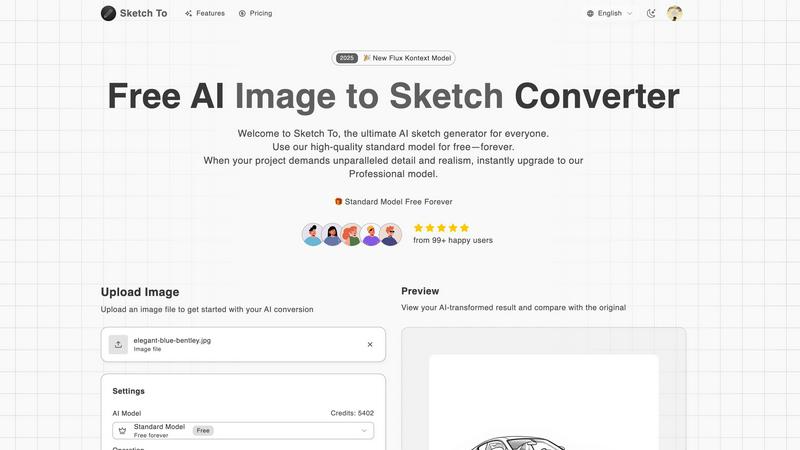
Sketch To is an AI-powered tool that instantly converts images to sketches and sketches back to images.
Last updated: March 2, 2026

SparkPix
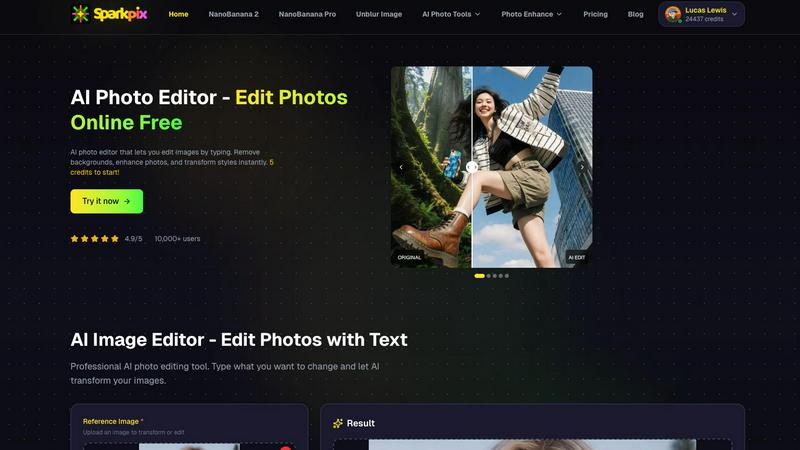
SparkPix is a developer-friendly AI photo editing API that integrates directly into your tech stack for programmatic image transformation.
Last updated: March 11, 2026
Visual Comparison
Sketch To
SparkPix
Feature Comparison
Sketch To
Advanced Dual-Direction AI Conversion Engine
The platform is powered by two distinct, optimized AI model stacks. One is fine-tuned for deconstructing photographs into line art and texture, accurately replicating mediums like pencil, charcoal, and ink. The complementary model is trained for generative reconstruction, intelligently interpreting sketch outlines and strokes to synthesize detailed, realistic images. This dual-engine architecture ensures specialized, high-quality outputs for each conversion direction, setting it apart from single-purpose filters.
Tiered AI Model Deployment (Standard & Pro)
Sketch To operates on a flexible, two-tier model system. The Standard Model is a highly efficient neural network optimized for speed and accessibility, perfect for non-commercial projects. The Professional Model is a more computationally intensive, advanced network that accesses a broader parameter set for superior detail, texture accuracy, and color depth. This tiered approach allows users to match the computational resource and output quality directly to their project's specific technical requirements and budget.
High-Resolution, Cloud-Based Processing Infrastructure
All conversions are executed on powerful, scalable cloud servers, removing the dependency on users' local hardware. This infrastructure supports batch processing of multiple images and delivers download-ready results in high-resolution formats (e.g., PNG, JPEG) suitable for both digital display and professional print media. The cloud-first design guarantees consistent performance, automatic updates to AI models, and universal access from any modern web browser.
Extensive Style Library and Model Configuration
Users have precise control over the output through a comprehensive library of pre-trained artistic styles—from Pencil Sketch and Watercolor to Concept Art. Beyond style selection, the platform offers advanced model configuration options, allowing for fine-tuning of parameters such as line intensity, shading granularity, and detail preservation. This level of control enables deep integration into specialized creative pipelines, from comic book illustration to architectural visualization.
SparkPix
AI-Powered Text-to-Edit Engine
This foundational feature integrates a sophisticated natural language interface with a suite of specialized AI models. Users input descriptive commands (e.g., "remove the tourist in the red shirt," "enhance colors and upscale to 4K"), and the system parses the intent to route the task to the appropriate backend model—such as a segmentation network for object removal or a super-resolution GAN for enhancement. This architecture allows for precise, context-aware edits in under 30 seconds, functioning as a unified API for multiple image processing tasks without manual tool selection.
Advanced Background Removal & Replacement
Built on a state-of-the-art semantic segmentation model, this tool delivers one-click, high-fidelity background extraction for even complex scenes with fine details like hair or transparent objects. It offers seamless integration for e-commerce workflows, automatically generating transparent PNGs or compositing subjects onto new backgrounds specified by text. The underlying model is optimized for batch processing, ensuring consistency for product catalogs and portrait photography, and serves as a direct, watermark-free alternative to standalone services like remove.bg.
Intelligent Photo Restoration & Deblurring
This feature employs a combination of denoising autoencoders and deblurring neural networks (like DeblurGAN variants) to algorithmically repair damaged visual data. It can restore old photos by inpainting scratches and tears, colorizing black-and-white images through historical color palette prediction, and reversing motion blur or lens defocus. The system is trained on diverse datasets of degraded imagery, making it compatible with scanning artifacts, JPEG compression issues, and physical photo damage, ideal for digitizing and preserving archival content.
Multi-Style AI Image Generation & Transfer
Leveraging diffusion models and neural style transfer (NST) algorithms, this capability serves a dual function. It can generate original, high-resolution (up to 4K) images from text prompts, acting as a built-in creative asset generator. Concurrently, it can apply over 15 distinct artistic styles (e.g., anime, oil painting, pencil sketch) to uploaded images. This is powered by a modular system where different style weights and generative adversarial networks (GANs) are deployed based on the selected aesthetic, providing extensive creative flexibility for branding and social media content.
Use Cases
Sketch To
Digital Art and Concept Development
Artists and concept designers use the Sketch to Image function to rapidly breathe life into preliminary drawings. By uploading a basic concept sketch, the Pro model can generate multiple textured, lit, and detailed renderings, accelerating the ideation and iteration phases. This serves as a powerful brainstorming aid and a base layer for further refinement in software like Photoshop or Procreate.
Educational and Instructional Material Creation
Educators and trainers leverage the Image to Sketch converter to transform complex photographs, such as biological specimens or historical artifacts, into clear, simplified line drawings. These sketches are ideal for creating worksheets, presentations, and study guides, where removing photographic clutter enhances focus on key structural elements and improves comprehension.
Social Media and Content Marketing Asset Generation
Content creators and marketing professionals utilize the tool to produce unique, eye-catching graphics from product photos or portraits. Converting images into various sketch styles (e.g., Comic Sketch, Ink Sketch) creates a consistent and engaging aesthetic for posts, stories, and advertisements, helping brands stand out in crowded digital feeds without requiring a dedicated illustrator.
Architectural and Product Design Visualization
Architects, interior designers, and industrial designers can upload hand-drawn sketches or floor plans and use the Pro model to generate photorealistic previews of materials, lighting, and environmental context. This facilitates client presentations and stakeholder reviews early in the design process, providing a tangible vision before committing to full 3D rendering or physical prototyping.
SparkPix
E-Commerce Product Image Automation
Online retailers and Shopify store owners can integrate SparkPix into their product upload pipeline to automate time-consuming tasks. The platform can batch-process hundreds of product shots to remove backgrounds, create consistent white-background images for marketplaces like Amazon, generate lifestyle mockups by placing products into scenes via text prompts, and enhance overall image quality for better conversion rates, all without manual Photoshop work.
Professional Social Media & Marketing Content Creation
Marketing teams and social media managers utilize SparkPix to rapidly produce high-volume, engaging visual content. They can create branded graphics, apply consistent artistic filters to campaign photos, remove unwanted elements from event pictures, generate custom artwork for posts using AI, and optimize image resolution for different platform specs (Instagram feed, YouTube thumbnails, LinkedIn articles), streamlining the entire content creation workflow in a browser.
Archival Photo Digitization & Restoration
Genealogists, historians, and individuals preserving family history use SparkPix to restore and enhance old physical photographs. The tool can digitally repair tears, eliminate stains and scratches, colorize black-and-white portraits, and sharpen blurred details in scanned images. This provides a powerful, accessible alternative to specialized software or manual restoration services, enabling bulk processing of personal archives.
On-Demand Professional Portrait & Document Editing
Professionals and individuals can instantly create compliant passport and visa photos by generating headshots with specific attire and background colors. Freelancers can also use the object remover to clean up portrait backgrounds or the enhancer to perfect LinkedIn profile pictures. This use case highlights the platform's utility for formal, business, and personal documentation needs with immediate, watermark-free results.
Overview
About Sketch To
Sketch To is a cutting-edge, cloud-native AI platform engineered to perform bidirectional conversion between photographs and sketches. At its core, it leverages sophisticated deep learning models, specifically trained on vast datasets of artistic styles, to interpret and transform visual data with high fidelity. The platform serves a broad technical and creative audience, from digital artists and UX/UI designers seeking rapid prototyping tools to educators and content creators needing to generate unique visual assets. Its primary value proposition lies in its seamless, API-like accessibility and tiered model architecture. Users can immediately engage with a robust Standard Model using trial credits, which is built for efficiency and general use. For enterprise-grade requirements, the Professional Model offers a more complex neural network configuration, delivering photorealistic detail and commercial licensing. This eliminates the traditional barriers of expensive, installed software suites, offering a scalable, subscription-free solution that integrates effortlessly into modern digital workflows. The infrastructure is designed for instant processing, ensuring low-latency conversions that fit into fast-paced production environments, from social media content pipelines to professional design sprints.
About SparkPix
SparkPix is a cutting-edge, web-based AI photo editing platform engineered to democratize professional-grade image manipulation. It functions as a comprehensive, cloud-native suite of tools that leverages advanced machine learning models to execute complex edits based on simple text prompts. The core value proposition is its seamless integration of natural language processing (NLP) with computer vision, eliminating the steep learning curve associated with traditional software like Adobe Photoshop. Designed for a broad tech stack, it serves developers, e-commerce managers, social media content creators, marketing professionals, and everyday users who require fast, efficient, and high-quality photo edits without installing software. Its API-friendly, browser-agnostic architecture ensures compatibility across desktop (Windows, macOS, Linux) and mobile (iOS, Android) environments, making it a versatile asset for embedding AI-powered imaging into existing workflows, from automating product photo backgrounds for Shopify stores to batch-restoring family archives. By offering a free tier with credits and scalable paid plans, SparkPix provides an accessible entry point into AI-driven visual content creation.
Frequently Asked Questions
Sketch To FAQ
What file formats and sizes does Sketch To support for upload?
The platform supports common raster image formats including JPG, PNG, and WebP. The current maximum file size for upload is 5MB per image to ensure swift processing within the cloud infrastructure. Output images are provided in high-quality PNG or JPEG format, with resolutions suitable for both web and print applications.
How do the credits system and the two AI models work?
Sketch To operates on a credit-based system. The Standard Model, ideal for personal and social media use, consumes 1 credit per conversion. The Professional Model, designed for commercial-grade detail, consumes 2 credits. New users receive free trial credits to test the Standard Model. Subsequent credits can be obtained via flexible credit packs or subscription plans, allowing you to scale usage based on project demands.
Is the content I generate with Sketch To free for commercial use?
Output generated using the free trial credits or the Standard Model is typically licensed for personal use. For full commercial rights, including use in products for sale, advertising, and client work, you must use the Professional Model under a paid plan. Always review the specific Terms of Service on the platform for the latest licensing details related to your chosen model and plan.
How does Sketch To ensure the privacy and security of my uploaded images?
Sketch To employs enterprise-grade security protocols. Image uploads and processing occur over encrypted HTTPS connections. The platform's privacy policy states that uploaded images are processed automatically and are not stored permanently on the servers after the conversion is complete and delivered, ensuring your original assets remain confidential.
SparkPix FAQ
What is the underlying technology stack for SparkPix?
SparkPix is built on a cloud-native microservices architecture, primarily utilizing Python with frameworks like FastAPI for backend services. It leverages multiple pre-trained and proprietary deep learning models, including Transformer-based models for prompt understanding, U-Net and Mask R-CNN architectures for segmentation tasks, GANs (Generative Adversarial Networks) for restoration and style transfer, and Diffusion models for image generation. The frontend is a responsive web application built with modern JavaScript frameworks, ensuring broad browser compatibility.
How does the credit system work and what is the cost per edit?
The platform operates on a credit-based system. Users start with 5 free credits upon sign-up, with no credit card required, and receive 1 additional credit daily. Each AI generation or major edit, such as applying a text prompt for transformation, background removal, or image generation, typically costs 5 credits. Simpler, one-click operations like basic background removal may cost less. Paid plans, starting at $9.99, offer larger credit packs (e.g., 350 credits) for high-volume users, providing a scalable cost structure.
Is there an API available for developers to integrate SparkPix?
Yes, SparkPix offers an API designed for developers to integrate its AI photo editing capabilities directly into their own applications, websites, or automated workflows. The API provides endpoints for all core features—background removal, photo enhancement, object removal, and text-based editing—allowing for server-to-server communication and batch processing. Documentation includes details on authentication (API keys), request/response formats, and rate limits, facilitating seamless integration into existing tech stacks.
Are the edited images free from watermarks and do I retain ownership?
Absolutely. All images processed through SparkPix, including those on the free tier, are delivered without any SparkPix watermark or branding. You retain full ownership of your original uploaded images and the AI-generated or edited results. The platform's terms of service grant you a license to use the output for personal or commercial purposes, making it suitable for professional work, client deliverables, and commercial product listings.
Alternatives
Sketch To Alternatives
Sketch To is an AI-powered image-to-sketch and sketch-to-image conversion tool, operating within the image processing and creative software category. Users often seek alternatives to such tools due to specific technical requirements, such as API availability for custom integrations, different pricing structures beyond freemium models, or the need for platform-specific applications like native desktop software or mobile SDKs. When evaluating alternatives, developers and technical users should prioritize compatibility with their existing tech stack. Key considerations include the availability of a robust API for automation, support for specific programming languages or frameworks, the ability to handle batch processing workflows, and the tool's output format compatibility with downstream design or publishing platforms. The underlying AI model architecture is also a critical factor, as it determines processing speed, output quality, and the computational resources required for integration. A thorough assessment should balance these technical specifications with the project's scalability needs and budget constraints.
SparkPix Alternatives
SparkPix is a web-based AI photo editor that operates within the browser-based image editing and generation category. It allows users to apply complex edits like background removal, restoration, and style transfer through simple text prompts, eliminating the need for traditional software expertise. Users often seek alternatives for various technical and operational reasons. These can include budget constraints, the need for different pricing structures, or a requirement for specific advanced features not covered. Others may prioritize offline functionality, deeper integration with existing creative software stacks, or platforms with more extensive API access for workflow automation. When evaluating an alternative, consider the core technology stack, such as the underlying AI models and their output quality. Assess compatibility with your existing tools and workflows, including support for necessary file formats and export options. Finally, examine the platform's scalability, API availability for developers, and how its subscription model aligns with your projected usage volume and team size.