
Agent to Agent Testing Platform vs SVG to 3D
Side-by-side comparison to help you choose the right product.

Agent to Agent Testing Platform
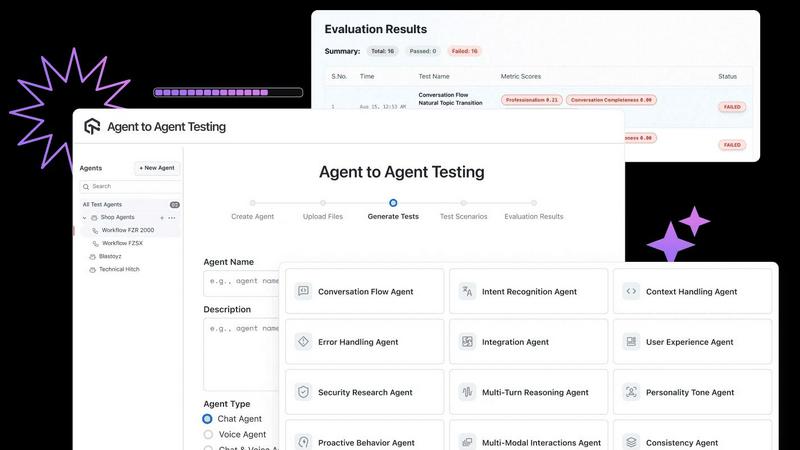
Validate AI agent behavior across chat, voice, and phone systems to detect risks and ensure compliance seamlessly.
Last updated: February 27, 2026
SVG to 3D
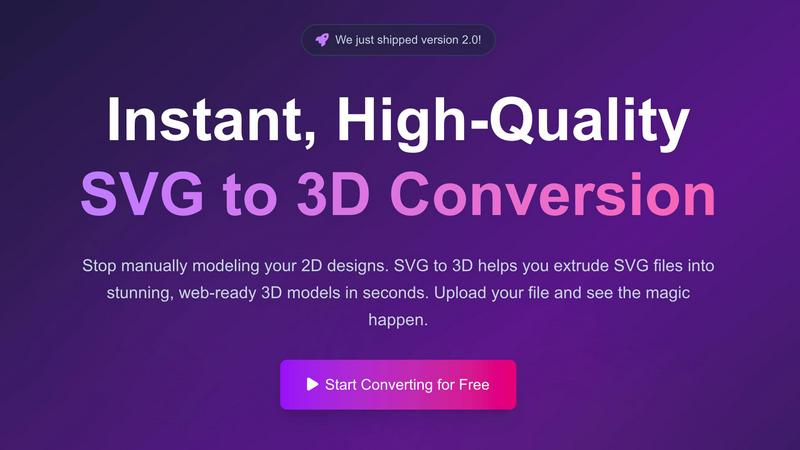
Effortlessly convert SVG files into high-quality, web-ready 3D models with advanced controls and fast processing.
Last updated: February 27, 2026
Visual Comparison
Agent to Agent Testing Platform
SVG to 3D
Feature Comparison
Agent to Agent Testing Platform
Automated Scenario Generation
The platform offers automated scenario generation capabilities that create diverse and realistic test cases for AI agents. This includes simulating various interaction formats such as chat, voice, and phone calls, allowing for an extensive evaluation of the agent's performance across different contexts and user scenarios.
True Multi-Modal Understanding
Agent to Agent Testing Platform supports true multi-modal understanding by allowing users to define detailed requirements or upload Product Requirement Documents (PRDs) that include varied inputs such as images, audio, and video. This feature enables a more thorough assessment of how AI agents respond in genuine real-world situations.
Autonomous Test Scenario Generation
With access to a library of hundreds of pre-built scenarios, users can also create custom test cases tailored to specific AI behaviors. This functionality includes testing agents' personality tones, data privacy compliance, and intent recognition, thus providing a comprehensive evaluation of the agents under various conditions.
Regression Testing with Risk Scoring
The platform facilitates robust regression testing by providing insights into risk scoring for the AI agents being evaluated. This feature highlights potential areas of concern, enabling teams to prioritize critical issues, thereby optimizing testing efforts and ensuring the stability and reliability of AI systems.
SVG to 3D
One-Click GLB Export
SVG to 3D allows users to export 3D models as GLB files with just one click. This feature is tailored for web developers, making it easy to integrate the 3D models into websites using Three.js or React Three Fiber, adding a dynamic visual element to any project.
3D-Print Ready STL Files
The tool supports clean STL exports, which are essential for 3D printing. Users can directly take their 3D models from SVG to STL, ensuring a hassle-free transition from digital design to physical object, ideal for fabrication and prototyping.
Real-Time 3D Preview and Adjustments
Users can fine-tune every aspect of their 3D models with real-time previews. This feature allows for adjustments to thickness, bevels, and the application of PBR materials, helping to ensure the final output is polished and professional.
Privacy and Security First
SVG to 3D prioritizes user privacy by processing files locally in the browser whenever possible. This means that sensitive designs remain secure, with no need for uploads to external servers, giving users peace of mind while working on their projects.
Use Cases
Agent to Agent Testing Platform
Quality Assurance for Chatbots
Enterprises can leverage the platform to ensure that their chatbots deliver accurate and effective responses in a variety of scenarios. This quality assurance process ensures that chatbots maintain high levels of user satisfaction and engagement.
Voice Assistant Evaluation
Organizations can utilize the Agent to Agent Testing Platform to rigorously test voice assistants across different accents and languages, ensuring that they understand and respond accurately to diverse user inquiries while maintaining a natural conversational flow.
Compliance and Ethical Testing
Businesses can perform compliance checks on their AI agents to identify and mitigate risks associated with bias and toxicity. This use case is crucial for maintaining ethical standards and ensuring that AI technologies serve diverse user groups without discrimination.
Performance Optimization for Phone Agents
The platform allows for the testing of phone agents in simulated environments that mimic real-world interactions. This use case is essential for optimizing the performance of voice calling agents, ensuring they exhibit professionalism and empathy during customer interactions.
SVG to 3D
Web Development Enhancement
Web developers can utilize SVG to 3D to convert flat SVG icons into interactive 3D models. This capability enhances user engagement on websites, allowing for visually striking interfaces that capture users' attention.
3D Printing Prototyping
Designers and engineers can convert their 2D designs into 3D models that are ready for 3D printing. This use case is crucial for those looking to fabricate prototypes or custom parts without the need for complex CAD software.
UI/UX Design Mockups
UI/UX designers can leverage the tool to present depth in their design mockups. By creating 3D representations of UI elements, they can impress clients and stakeholders with more realistic and engaging presentations of their concepts.
Creative Artwork and Logo Design
Artists and graphic designers can transform their 2D artwork and logos into 3D models, allowing for new creative expressions and applications. This feature opens up possibilities for unique branding, merchandise, and digital art installations.
Overview
About Agent to Agent Testing Platform
Agent to Agent Testing Platform is a revolutionary AI-native quality assurance framework specifically designed for validating the performance of AI agents in diverse real-world environments. As artificial intelligence systems evolve towards greater autonomy and complexity, traditional quality assurance (QA) methodologies, which were primarily developed for static software, become inadequate. This platform transcends basic prompt-level evaluations by offering comprehensive insights into multi-turn conversations, encompassing chat, voice, phone, and multimodal interactions. It empowers enterprises to effectively assess and validate the behavior of AI agents before deploying them in production. By introducing a dedicated assurance layer that utilizes advanced multi-agent test generation, the platform can identify long-tail failures, edge cases, and nuanced interaction patterns that are often overlooked by manual testing methods. With the capability to simulate thousands of realistic interactions, organizations can ensure their AI agents meet high standards of accuracy, reliability, and performance, addressing critical metrics such as bias, toxicity, and hallucinations.
About SVG to 3D
SVG to 3D is a powerful online tool designed to transform 2D SVG vector graphics into high-quality 3D models. It caters to web developers, designers, and 3D printing enthusiasts who seek a fast, efficient, and user-friendly solution for converting their designs. With SVG to 3D, you can quickly extrude logos, icons, and artwork without the need for heavyweight software like Blender or Cinema 4D. The tool is optimized for seamless integration into web projects, allowing for the generation of lightweight GLB files ideal for use in Three.js and React Three Fiber. By providing advanced controls for fine-tuning your models, SVG to 3D empowers users to create stunning, professional-grade 3D assets in mere seconds, enhancing efficiency in design workflows.
Frequently Asked Questions
Agent to Agent Testing Platform FAQ
What is Agent to Agent Testing Platform designed for?
The Agent to Agent Testing Platform is designed to validate AI agents in real-world environments, ensuring their performance across various interaction scenarios, including chat, voice, and phone calls.
How does the platform help in identifying long-tail failures?
The platform employs a dedicated assurance layer that uses multi-agent test generation to uncover long-tail failures and edge cases that traditional testing methods may miss, ensuring a comprehensive evaluation of AI behavior.
Can I create custom test scenarios?
Yes, users have the ability to create custom test scenarios tailored to their specific AI requirements, in addition to accessing a library of pre-built scenarios for comprehensive testing.
How does the platform ensure compliance with ethical standards?
The platform helps identify potential biases and toxicity in AI agents through automated scenario generation and detailed analytics, allowing organizations to address compliance and ethical considerations effectively.
SVG to 3D FAQ
How do I start converting my SVG files to 3D?
To get started, simply upload your SVG file using the drag-and-drop interface or by clicking to browse your files. The process is quick and user-friendly.
What file formats can I export my 3D models in?
SVG to 3D offers multiple export formats, including GLB, GLTF, OBJ, and STL. This versatility ensures your models are compatible with various applications and platforms.
Is there a limit to the size of SVG files I can upload?
Yes, there is a maximum file size limit of 5 MB for SVG uploads. This ensures fast processing and efficient conversions.
Is my data secure when using SVG to 3D?
Absolutely. The tool processes files locally in your browser, minimizing risk and ensuring that your data remains private and secure without external uploads.
Alternatives
Agent to Agent Testing Platform Alternatives
The Agent to Agent Testing Platform is a pioneering AI-native quality assurance framework designed to validate the behavior of AI agents across various modalities, including chat, voice, and phone interactions. As organizations increasingly adopt AI systems, they often seek alternatives due to concerns over pricing, feature sets, or specific platform compatibility requirements. Choosing an alternative involves evaluating the ability to conduct comprehensive testing, ensuring robust integration with existing systems, and verifying that the solution can scale to match the demands of real-world scenarios.
SVG to 3D Alternatives
SVG to 3D is a specialized tool designed to transform 2D SVG vector graphics into high-quality 3D models. It falls under the category of AI Assistants, specifically tailored for web developers, designers, and 3D printing enthusiasts seeking an efficient way to create 3D assets from flat designs. Users often explore alternatives to SVG to 3D due to various factors such as pricing, available features, or compatibility with their specific platforms and workflows. When selecting an alternative, it is essential to consider factors like ease of use, export options, and the software’s ability to integrate seamlessly with existing projects. Look for tools that offer real-time previews, diverse export formats, and user-friendly interfaces, ensuring that you can effectively meet your project requirements without unnecessary complexity.