
Renderly vs WavespeedAI
Side-by-side comparison to help you choose the right product.

Renderly
Renderly automates video production at scale, enabling thousands of personalized videos through a powerful API and.
Last updated: February 27, 2026

WavespeedAI is a unified API platform for seamless integration of cutting-edge AI image and video generation models.
Last updated: March 1, 2026
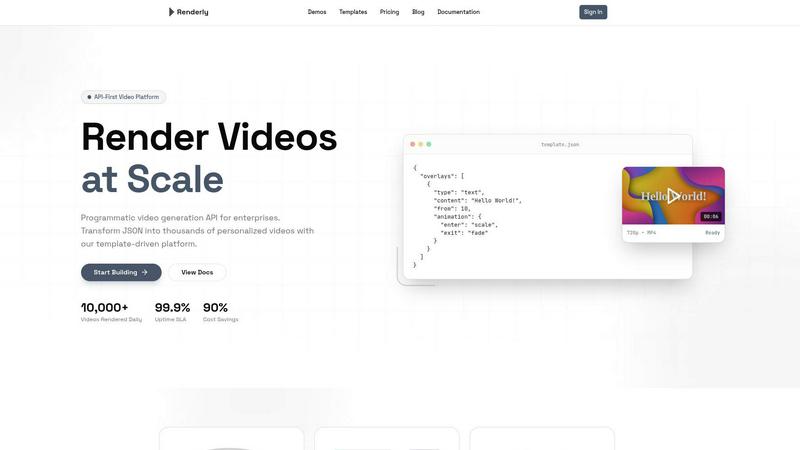
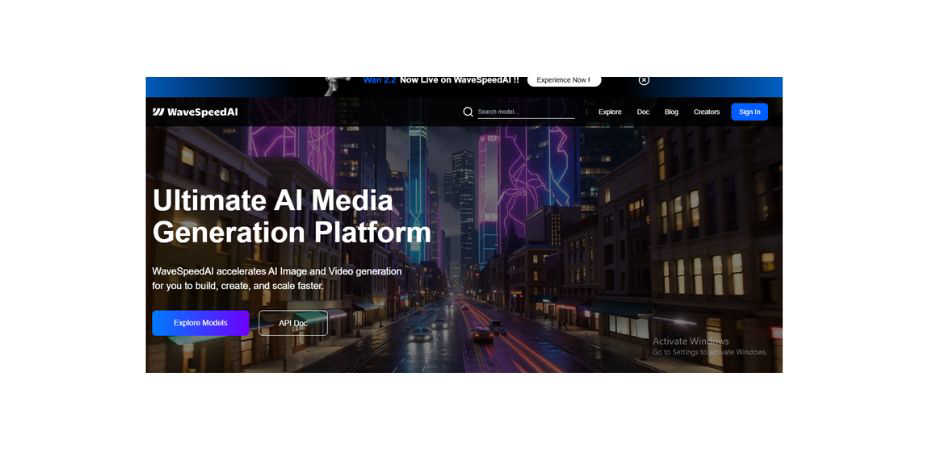
Visual Comparison
Renderly
WavespeedAI
Feature Comparison
Renderly
API-First Architecture
Renderly's RESTful API is designed for high-volume video generation, allowing seamless integration into existing workflows. Developers can harness the power of programmatic video generation to create vast amounts of content efficiently.
Template Management
The platform features a centralized template library that supports JSON configuration and dynamic content. Users can manage and version control templates, ensuring consistency and flexibility in video production.
Scalable Infrastructure
Renderly provides cloud-native infrastructure capable of auto-scaling to handle fluctuating workloads. This ensures that users can reliably generate thousands of videos concurrently without performance degradation.
Credit-Based Billing
Renderly offers a transparent pay-per-render pricing model, allowing enterprises to pay only for what they render. This approach includes volume discounts, making it a cost-effective solution for large-scale video production.
WavespeedAI
Unified Multi-Model API Gateway
WavespeedAI provides a single, consistent RESTful API endpoint to access dozens of state-of-the-art AI models from various vendors. This eliminates the need for developers to manage multiple API keys, SDKs, and rate limits across different providers. The platform handles request routing, model versioning, and fallback strategies, ensuring high availability and optimal performance for critical generation tasks within your application's backend.
Advanced Model Orchestration & Optimization
The platform is not just an aggregator; it features proprietary optimizations for speed and quality. WavespeedAI fine-tunes and deploys models for enhanced inference performance, offering "Pro" and "Ultra" tiers for resource-intensive tasks. This technical orchestration layer allows users to select models based on specific needs—such as speed versus detail—and leverages the platform's infrastructure to deliver generation results faster than direct API calls to the source providers.
Integrated AI Toolchain for Pre & Post-Processing
Beyond core generation, WavespeedAI offers a suite of integrated AI tools essential for a complete media pipeline. This includes specialized models for object detection and segmentation (e.g., SAM3), content moderation (Molmo2), motion control, and video upscaling. This allows developers to build sophisticated, multi-stage media workflows—like generating a video, detecting objects within it, and then applying targeted edits—all within a single, compatible technical environment.
Developer-Centric Infrastructure & SDKs
Built for seamless integration, WavespeedAI offers comprehensive documentation, client SDKs, and developer tools. Features likely include detailed usage analytics, batch processing capabilities, and webhook support for asynchronous job completion. This infrastructure-centric approach ensures that engineering teams can embed powerful AI media generation into their products with minimal friction, focusing on their core application logic rather than AI infrastructure management.
Use Cases
Renderly
Personalized Marketing Videos
Businesses can use Renderly to generate personalized marketing videos at scale, addressing individual customer preferences and behaviors, thereby enhancing engagement and conversion rates.
Social Media Content Creation
Social media managers can automate the creation of bulk video content tailored for different platforms, ensuring timely and consistent messaging across channels while saving time and resources.
Data-Driven Motion Graphics
Renderly empowers data visualization by enabling users to create data-driven motion graphics that can dynamically update based on real-time data, perfect for reports and presentations.
E-Learning Video Production
Educational institutions can leverage Renderly to produce personalized e-learning videos, adapting content to various learning styles and improving the overall educational experience for students.
WavespeedAI
Scalable Content Generation for SaaS Platforms
SaaS companies in marketing, e-commerce, or social media can integrate WavespeedAI's API to offer automated visual content creation as a feature to their own users. For instance, an e-commerce platform can generate product demonstration videos or lifestyle imagery from text descriptions at scale, providing value-added services without building their own AI model training and serving infrastructure from scratch.
Rapid Prototyping and A/B Testing for Ad Agencies
Marketing and advertising teams can leverage the platform's diverse model library to rapidly produce multiple high-fidelity visual variants for campaign assets. By programmatically generating dozens of image or video ad concepts from text prompts, teams can efficiently conduct A/B testing, iterate on creative direction, and accelerate the time-to-market for digital advertising campaigns across various channels.
Enhanced Media Workflows for Game and App Developers
Game studios and mobile app developers can use WavespeedAI's toolchain for asset creation and dynamic content generation. This includes creating concept art, generating in-game character poses via motion control models, upscaling textures, or producing short narrative cutscenes. The API-driven model allows for integration into development pipelines for both pre-production and live-ops content updates.
Automated Content Moderation and Compliance
Platforms hosting user-generated content (UGC) can integrate WavespeedAI's content detection models (like Molmo2) to automatically scan and moderate uploaded images and videos. This AI-powered pre-filtering helps identify policy violations, sensitive material, or inappropriate content, assisting compliance teams and reducing the manual review burden while scaling with platform growth.
Overview
About Renderly
Renderly is an innovative video infrastructure platform designed to revolutionize video production for developers and content creators. By automating video rendering at scale, Renderly allows users to create personalized videos, bulk social media content, and dynamic motion graphics effortlessly. The platform leverages a powerful API that transforms JSON data into thousands of videos, enabling enterprises to meet the increasing demand for high-quality video content. With a commitment to cost efficiency, Renderly offers up to 90% savings compared to competitors, making it an ideal solution for businesses looking to optimize their video workflows. Its user-friendly web tools and comprehensive documentation make it accessible for both seasoned developers and newcomers, ensuring a seamless integration and user experience.
About WavespeedAI
WavespeedAI is a comprehensive, API-first platform engineered for high-performance AI-powered media generation. It functions as a unified gateway, aggregating and optimizing a vast array of cutting-edge generative AI models from leading providers like Google, ByteDance (Seedance/Wan), Vidu, OpenAI, and Black Forest Labs (Flux). The platform is architected for developers, engineering teams, and tech-forward enterprises who require scalable, reliable, and fast integration of image and video generation capabilities into their applications and workflows. By abstracting the complexity of managing multiple model APIs, latency, and compatibility issues, WavespeedAI delivers a streamlined developer experience. Its core value proposition lies in providing a single, robust technical stack for on-demand visual content creation, significantly reducing development overhead and infrastructure costs while ensuring access to the latest model iterations and specialized tools for tasks like upscaling, editing, motion control, and content detection.
Frequently Asked Questions
Renderly FAQ
What types of videos can I create with Renderly?
Renderly allows users to create a wide range of videos, including personalized marketing videos, bulk social media content, and data-driven motion graphics, all customizable via templates.
How does pricing work for Renderly?
Renderly uses a credit-based billing model where customers pay only for the videos they render. This pricing structure includes volume discounts for larger enterprises, ensuring cost-effectiveness.
Is Renderly suitable for small businesses?
Yes, Renderly is designed to scale with your business needs. Whether you are a small startup or a large enterprise, the platform can adapt to varying demands for video production.
What security measures does Renderly have in place?
Renderly is SOC 2 compliant, ensuring robust security measures such as data encryption, access controls, and audit logging to protect user data and maintain privacy.
WavespeedAI FAQ
What AI models are available on WavespeedAI?
WavespeedAI provides access to a curated and constantly updated selection of leading generative models. This includes image generation and editing models from Google (Nano Banana), Black Forest Labs (Flux), and Seedream; video generation models from ByteDance (Seedance Pro, Wan 2.6), Vidu (Q3), and Kling; as well as specialized models for upscaling, segmentation, and content moderation. The platform acts as a unified layer over these diverse technologies.
How does WavespeedAI ensure fast generation speeds?
The platform employs several technical strategies to optimize speed. This includes proprietary model optimizations, high-performance GPU infrastructure, and intelligent request routing to the most efficient endpoint. WavespeedAI also offers optimized model variants (e.g., "Turbo" or "Pro" tiers) that are fine-tuned for faster inference times compared to their base versions, which is critical for applications requiring low-latency responses.
Can I integrate WavespeedAI into my existing application backend?
Yes, integration is a core design principle. WavespeedAI offers a standard REST API with comprehensive documentation, making it compatible with any backend stack (Node.js, Python, Go, etc.). Developers can make HTTP requests directly or use available client SDKs to easily call generation, editing, and analysis functions, seamlessly weaving AI capabilities into their existing application logic and data flows.
Is WavespeedAI suitable for large-scale, enterprise-grade production use?
Absolutely. The platform is built with enterprise requirements in mind, offering features essential for production use: high availability, scalable infrastructure, consistent API performance, batch processing capabilities, and advanced tools for content safety and moderation. Its model aggregation also provides redundancy, preventing dependency on a single AI provider's uptime for business-critical creative workflows.
Alternatives
Renderly Alternatives
Renderly is a video infrastructure platform designed to automate video production through code. It enables developers and creators to generate thousands of videos quickly, either via a robust API or through an intuitive online editor. This makes it an ideal solution for producing personalized videos, bulk social media content, or data-driven motion graphics efficiently. Users often seek alternatives to Renderly for various reasons, including pricing, specific features that may better align with their needs, or compatibility with other platforms they are using. When choosing an alternative, consider factors such as the ease of integration with existing workflows, the scalability of the solution, and the availability of support and documentation. Assessing these elements can help ensure that you find a solution that meets your video production requirements effectively.
WavespeedAI Alternatives
WavespeedAI is a high-speed AI image and video generation platform designed for professionals. It operates in the AI-powered creative tool category, focusing on rapid visual content creation for marketing, social media, and web use. Users leverage its generative models to streamline workflows and produce branded media efficiently. Teams often evaluate alternatives to find a solution that better aligns with their specific tech stack, budget, or feature requirements. Common drivers include integration needs with existing project management or CMS platforms, API availability for custom development, and granular control over output formats and resolutions for different deployment environments. When assessing other platforms, prioritize technical compatibility. Key considerations include the tool's API robustness for automation, support for common frameworks and export standards, and the ability to embed generated assets directly into your development pipeline. The ideal alternative should not only match core generative capabilities but also integrate seamlessly into your established workflow architecture.