
AgentHunter
AgentHunter integrates 2217 AI agents into a single platform to streamline and enhance your tech stack.
Visit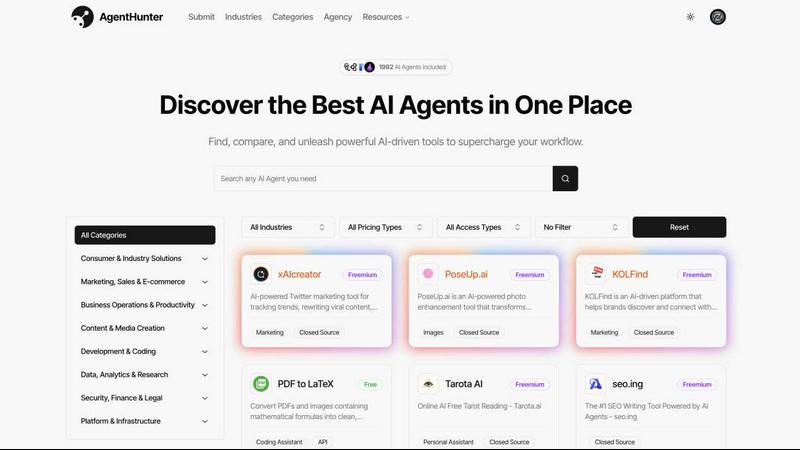
About AgentHunter
AgentHunter is the definitive technical directory and discovery platform for AI agents, designed to bridge the gap between powerful agentic tools and the developers, engineers, and tech-savvy professionals who need to integrate them. It functions as a centralized, searchable repository for over 2,400 AI agents, enabling users to efficiently find, compare, and evaluate agents based on their specific technical stack, compatibility requirements, and use case. The platform caters to a technical audience, from DevOps engineers seeking infrastructure automation agents to data scientists looking for advanced analytics bots and developers needing coding co-pilots. Its core value proposition lies in its structured, filter-driven approach that goes beyond simple listings, allowing for deep comparison of APIs, SDK availability, integration protocols, and supported platforms. By providing this granular, tech-stack oriented data, AgentHunter empowers users to make informed architectural decisions and seamlessly identify agents that can be plugged into their existing workflows and systems, thereby accelerating development and optimizing operational pipelines.
Features of AgentHunter
Comprehensive Technical Filtering
AgentHunter offers an advanced filtering system that allows users to drill down into the technical specifics of AI agents. Filters extend beyond basic categories to include pricing models, access types (API, SDK, Web App), and detailed industry and functional categorizations like Development & Coding, Platform & Infrastructure, and Data, Analytics & Research. This enables precise matching based on integration requirements, budget constraints, and deployment environment compatibility, ensuring the selected agent fits seamlessly into the user's existing tech stack.
Structured Comparison Framework
The platform provides a standardized framework for comparing multiple AI agents side-by-side. This goes beyond feature lists to focus on comparative technical specifications, integration ease, and supported platforms. Users can evaluate critical factors such as available APIs, documentation quality, authentication methods, and community support, which are essential for assessing the long-term viability and maintainability of integrating a new agentic tool into a production environment.
Ecosystem Growth & Submission Portal
AgentHunter actively fosters the growth of the AI agent ecosystem by providing a dedicated portal for creators and developers to submit their own agents. This ensures the directory remains current with the latest tools and innovations. The submission process likely involves detailing technical specifications, integration pathways, and use cases, which enriches the platform's data quality and provides valuable exposure for new tools seeking adoption within developer and enterprise communities.
Curated Resource Hub
Beyond the directory, AgentHunter serves as an educational hub with resources like an AI Agent Glossary and guides on AI Agentic Work. These resources are tailored to a technical audience, explaining core concepts, architectural patterns, and best practices for implementing and orchestrating AI agents. This focus on education helps users better understand agent capabilities, interoperability challenges, and effective deployment strategies within complex software ecosystems.
Use Cases of AgentHunter
Integrating Specialized Agents into SaaS Platforms
A development team building a SaaS product can use AgentHunter to find and vet specialized AI agents for embedding functionality, such as a customer support chatbot, a code review assistant, or a data visualization agent. The platform's filters allow the team to identify agents with robust APIs, clear documentation, and compatibility with their backend stack (e.g., Node.js, Python), ensuring a smooth and secure integration that enhances their product's feature set without extensive in-house AI development.
Building Automated Workflow Orchestrations
DevOps and business automation engineers can leverage AgentHunter to discover agents that automate specific tasks within a larger workflow. For instance, they could source an agent for monitoring cloud infrastructure logs, another for automatically generating performance reports, and a third for handling security alerts. By comparing the agents' integration protocols and trigger/action support, they can architect a cohesive, multi-agent system that automates complex, cross-platform operational processes.
Sourcing AI Capabilities for R&D Projects
Data scientists and research teams embarking on new projects can utilize AgentHunter to quickly survey the landscape of available AI agents for specific tasks like literature review, dataset annotation, hypothesis simulation, or advanced statistical analysis. The ability to filter by domain (e.g., "Data, Analytics & Research") and compare the technical approach of different agents accelerates the prototyping phase and helps in selecting the most suitable, state-of-the-art tools for their experimental pipeline.
Technology Stack Modernization and Audit
CTOs and engineering leads can use AgentHunter as a strategic tool for auditing and modernizing their company's technology stack. They can explore categories like "Business Operations & Productivity" or "Content & Media Creation" to identify modern AI agent solutions that could replace legacy software or manual processes. The comparison features allow for a cost-benefit and technical feasibility analysis, supporting data-driven decisions on adopting new agentic tools to boost overall efficiency and innovation.
Frequently Asked Questions
What is an AI Agent, and how is it different from a standard AI tool?
An AI agent is an autonomous or semi-autonomous software program that can perceive its environment, make decisions, and take actions to achieve specific goals, often across multiple steps. Unlike standard single-purpose AI tools (e.g., a text generator), agents typically have planning, memory, and tool-use capabilities, allowing them to execute complex workflows, interact with APIs, and adapt to new information. AgentHunter focuses specifically on these advanced, actionable systems rather than simple input-output models.
How does AgentHunter ensure the quality and accuracy of listed AI agents?
While AgentHunter provides a comprehensive directory, the platform relies on a community and creator-driven submission model. It encourages detailed technical listings from developers themselves. Users are advised to conduct their own due diligence by reviewing the agent's official documentation, API specifications, and user reviews before integration. The platform's structured comparison framework is designed to highlight the technical data necessary for users to make these informed assessments.
Can I integrate an agent found on AgentHunter directly into my application?
Direct integration is not handled by AgentHunter itself. The platform is a discovery and comparison engine. Once you identify a suitable agent, you must follow its specific integration process, which typically involves accessing its API, SDK, or web interface as provided by the agent's developer. AgentHunter provides the critical discovery and filtering service to help you find agents with the integration methods (API, SDK) that match your technical requirements.
Is AgentHunter free to use for finding and comparing agents?
Yes, based on the provided context, the core directory functionality of AgentHunter appears to be free for users to browse, search, filter, and compare the listed AI agents. The platform may offer additional premium features or services for creators submitting agents, but the primary use case of discovering and evaluating agents is accessible without a stated cost, as indicated by the "All Pricing Types" filter which includes free options.