
Agenta vs Fallom
Side-by-side comparison to help you choose the right product.

Agenta is an open-source LLMOps platform for centralized prompt management and evaluation.
Last updated: March 1, 2026

Fallom
Fallom provides real-time observability and cost tracking for LLMs, ensuring transparency and compliance for your AI.
Last updated: February 28, 2026
Visual Comparison
Agenta
Fallom
Feature Comparison
Agenta
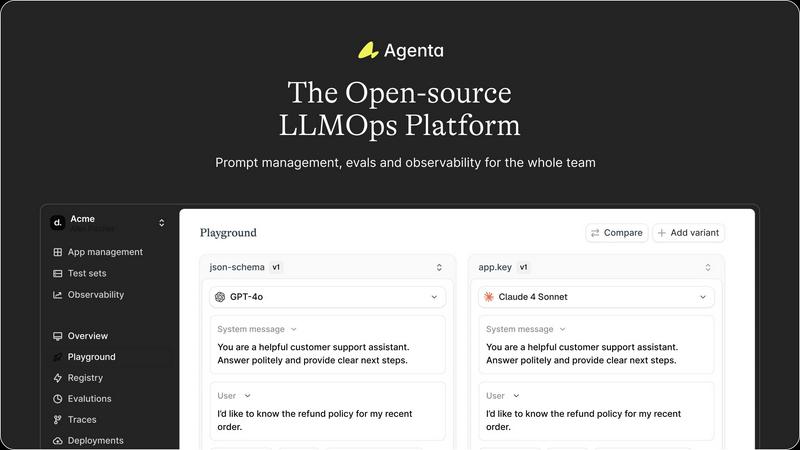
Unified Playground & Versioning
Agenta provides a centralized playground interface where developers and non-technical team members can experiment with different prompts, parameters, and foundation models from various providers side-by-side. Every iteration is automatically versioned, creating a complete audit trail of changes. This model-agnostic design prevents vendor lock-in and allows teams to compare OpenAI, Anthropic, open-source, and other models within the same experimentation environment, streamlining the prompt engineering process.
Automated & Integrated Evaluation Framework
This feature replaces guesswork with evidence-based development. Teams can create systematic evaluation workflows using LLM-as-a-judge, custom code evaluators, or built-in metrics. Crucially, Agenta allows for evaluation of full agentic traces, testing each intermediate reasoning step, not just the final output. This enables precise performance validation and comparison between different experiment versions, ensuring only improvements are promoted.
Production Observability & Debugging
Agenta offers comprehensive observability by tracing every LLM application request in production. Teams can monitor performance, detect regressions with live evaluations, and pinpoint the exact failure point in complex chains or agent workflows. Any problematic trace can be annotated collaboratively or instantly converted into a test case with one click, closing the feedback loop between production issues and development.
Collaborative Workflow for Cross-Functional Teams
Agenta breaks down silos by providing tools for every stakeholder. Domain experts get a safe UI to edit and test prompts without code. Product managers can run evaluations and compare experiments directly. Developers maintain full API control and parity with the UI. This brings PMs, experts, and engineers into a single integrated workflow for experimenting, versioning, and debugging with real data.
Fallom
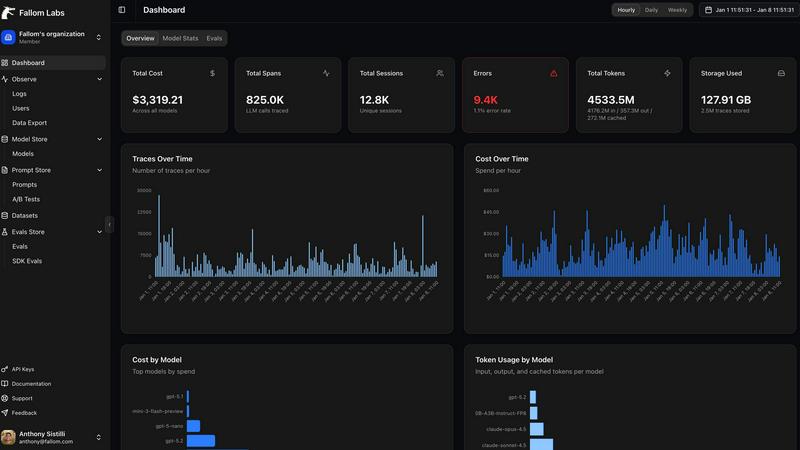
Real-Time Observability
Fallom provides comprehensive real-time observability for AI agents, allowing users to track tool calls and analyze timing. This feature enhances debugging processes, enabling teams to identify and resolve issues with confidence.
Cost Attribution
With Fallom, organizations can achieve full cost transparency by tracking expenses per model, user, and team. This feature is essential for budgeting and chargeback purposes, ensuring that teams can monitor and manage their AI operational costs effectively.
Compliance Ready
Fallom is designed to support various regulatory requirements, including the EU AI Act, SOC 2, and GDPR. This feature includes full audit trails, input/output logging, model versioning, and user consent tracking, helping organizations maintain compliance with ease.
Session Tracking
Fallom allows for grouping traces by session, user, or customer, providing complete context for every interaction. This feature is invaluable for understanding user behavior and optimizing AI performance across different workloads.
Use Cases
Agenta
Streamlining Complex Agent Development
Teams building multi-step AI agents with frameworks like LangChain can use Agenta to manage the entire lifecycle. The unified playground allows for iterative prompt tuning for each step, while the full-trace evaluation capability is critical for validating the agent's reasoning process. Observability tools then help debug intricate failures in production, turning errors into actionable test cases.
Centralizing Enterprise Prompt Management
In large organizations where prompts are managed across different departments and tools, Agenta acts as the single source of truth. It centralizes all prompt versions, experiments, and evaluation results, enabling governance and collaboration. Non-technical domain experts can directly contribute to prompt optimization through the UI, accelerating iteration cycles without developer bottlenecks.
Implementing Rigorous LLM Evaluation Pipelines
For teams requiring robust validation before deployment, Agenta provides the infrastructure to build automated evaluation pipelines. Integrating human evaluators and LLM judges, teams can create a systematic process to score experiments against key performance indicators. This ensures every prompt or model change is backed by quantitative and qualitative evidence, reducing risk.
Enhancing Production LLM Application Reliability
Post-deployment, engineering and product teams use Agenta's observability suite to monitor application health and user interactions. Live evaluations detect performance drifts, while detailed traces allow for rapid root-cause analysis of issues. This continuous monitoring and feedback loop is essential for maintaining and improving the reliability of customer-facing AI features.
Fallom
Debugging AI Workflows
Developers and data scientists can use Fallom to debug complex AI workflows by analyzing latency issues and timing waterfalls. This ensures that multi-step agent interactions are efficient and effective, leading to improved user experiences.
Cost Management in AI Operations
Organizations can leverage Fallom's cost attribution feature to monitor spending on LLMs per model and user. This is crucial for financial planning and ensuring that teams stay within budget while utilizing AI technologies.
Compliance and Audit Readiness
Fallom aids compliance officers by providing comprehensive audit trails and user consent tracking. This is particularly important for businesses operating in regulated industries that require rigorous documentation of AI interactions.
Performance Analytics
Fallom's real-time dashboard and customer analytics allow organizations to monitor usage patterns, identify power users, and assess the performance of various models. This data-driven approach helps teams make informed decisions about AI deployments.
Overview
About Agenta
Agenta is an open-source LLMOps platform engineered to provide the essential infrastructure for AI development teams building applications with large language models (LLMs). It is designed for engineering teams, product managers, and domain experts who need to collaborate effectively to ship reliable, production-grade AI products. The core value proposition of Agenta is its integrated, model-agnostic approach that consolidates the fragmented LLM development lifecycle into a single, collaborative workflow. It directly addresses the common pain points of prompts scattered across communication tools, siloed teams, and a lack of systematic evaluation and observability. By offering a unified playground for experimentation, a robust framework for automated and human-in-the-loop evaluation, and comprehensive observability tools, Agenta enables teams to iterate with evidence, debug with precision, and validate every change before deployment. Its seamless compatibility with popular frameworks like LangChain and LlamaIndex, and any model provider, ensures it fits into existing tech stacks without vendor lock-in, making it a central hub for implementing LLMOps best practices.
About Fallom
Fallom is a cutting-edge AI-native observability platform specifically designed for managing large language model (LLM) and agent workloads. By offering real-time monitoring and end-to-end tracing of every LLM call, Fallom empowers organizations to achieve comprehensive insights into their AI operations. The platform captures essential data such as prompts, outputs, tool calls, tokens, latency, and per-call costs. This information equips development teams, data scientists, and compliance officers with the necessary tools to debug issues quickly and efficiently. Fallom provides session-level context and detailed timing waterfalls, making it easier to understand complex multi-step agent workflows. Furthermore, it is built with enterprise readiness in mind, featuring robust audit trails, model versioning, and consent tracking to meet compliance requirements. Utilizing a single OpenTelemetry-native SDK, Fallom can be integrated into applications within minutes, significantly enhancing teams' ability to monitor usage in real-time and effectively attribute costs across various models, users, and teams.
Frequently Asked Questions
Agenta FAQ
Is Agenta compatible with my existing AI stack?
Yes, Agenta is designed for seamless integration. It is model-agnostic, working with OpenAI, Anthropic, Azure, open-source models, and more. It also integrates natively with popular LLM frameworks like LangChain and LlamaIndex, allowing you to incorporate its evaluation, versioning, and observability features without rewriting your application logic.
How does Agenta handle collaboration between technical and non-technical roles?
Agenta provides UI and API parity. Developers work via code and API, while product managers and domain experts can use the web interface to experiment with prompts, run evaluations, compare results, and annotate traces without writing a single line of code. This shared environment ensures everyone is aligned on the same data and experiments.
Can I evaluate complex multi-step AI agents, not just simple prompts?
Absolutely. A core strength of Agenta is its ability to evaluate full execution traces. For agents built with chains or sequential reasoning, you can evaluate and compare the output and logic at each intermediate step, not just the final answer. This provides deep insight into where an agent succeeds or fails during its reasoning process.
What does "open-source" mean for Agenta's deployment and pricing?
Agenta is a true open-source platform (Apache 2.0 license), meaning you can self-host the entire software on your own infrastructure for free, maintaining full control over your data and workflows. The company also offers a cloud-hosted enterprise version with additional features and support, providing flexibility based on your team's needs and scale.
Fallom FAQ
What kind of organizations can benefit from Fallom?
Fallom is ideal for organizations that utilize large language models and AI agents, particularly those in regulated industries such as finance, healthcare, and technology, where compliance and observability are crucial.
How quickly can Fallom be integrated into existing applications?
With its OpenTelemetry-native SDK, Fallom can be integrated into applications in under five minutes, making it a highly efficient solution for organizations looking to enhance their AI observability.
What compliance regulations does Fallom support?
Fallom is designed to meet various compliance requirements, including the EU AI Act, SOC 2, GDPR, and others, ensuring that organizations can maintain regulatory standards in their AI operations.
Can Fallom help with performance testing of AI models?
Yes, Fallom provides evaluation tools that allow teams to run tests on LLM outputs, enabling them to catch potential regressions before deployment and ensure high-quality AI performance.
Alternatives
Agenta Alternatives
Agenta is an open-source LLMOps platform designed to centralize prompt management, evaluation, and observability for AI development teams. It falls within the developer tools and MLOps categories, specifically targeting the workflow complexities of building reliable large language model applications. Users may explore alternatives for various reasons, including specific integration requirements with their existing tech stack, budget constraints that necessitate different pricing models, or the need for features that align with a different stage of their AI development lifecycle. Platform needs, such as deployment flexibility or team collaboration structures, also drive this evaluation. When selecting an alternative, key considerations should include the platform's compatibility with your current infrastructure and preferred LLM providers, the depth of its evaluation and observability tooling, and its approach to version control and collaboration. The ideal solution should seamlessly fit into your development pipeline, enhancing productivity without creating new silos.
Fallom Alternatives
Fallom is an AI-native observability platform specifically designed for managing large language model (LLM) and agent workloads. By offering real-time insights and comprehensive monitoring capabilities, it empowers organizations to optimize their AI operations effectively. Users commonly seek alternatives to Fallom for various reasons, including pricing concerns, specific feature requirements, or compatibility with existing platforms. As organizations evaluate their options, they should consider factors such as the level of observability provided, ease of integration with current tech stacks, and the ability to meet compliance requirements. When searching for an alternative, it's crucial to identify solutions that offer robust monitoring capabilities, real-time cost tracking, and enterprise-grade compliance features. Additionally, the ease of integration and support for tools like OpenTelemetry can significantly influence the effectiveness of the chosen platform. By focusing on these aspects, organizations can select an observability solution that best aligns with their operational needs and strategic goals.