
Afterly Plan vs AutoPhish
Side-by-side comparison to help you choose the right product.

Afterly Plan
Afterly Plan integrates expert guidance to streamline probate and estate settlement for executors.
Last updated: February 28, 2026

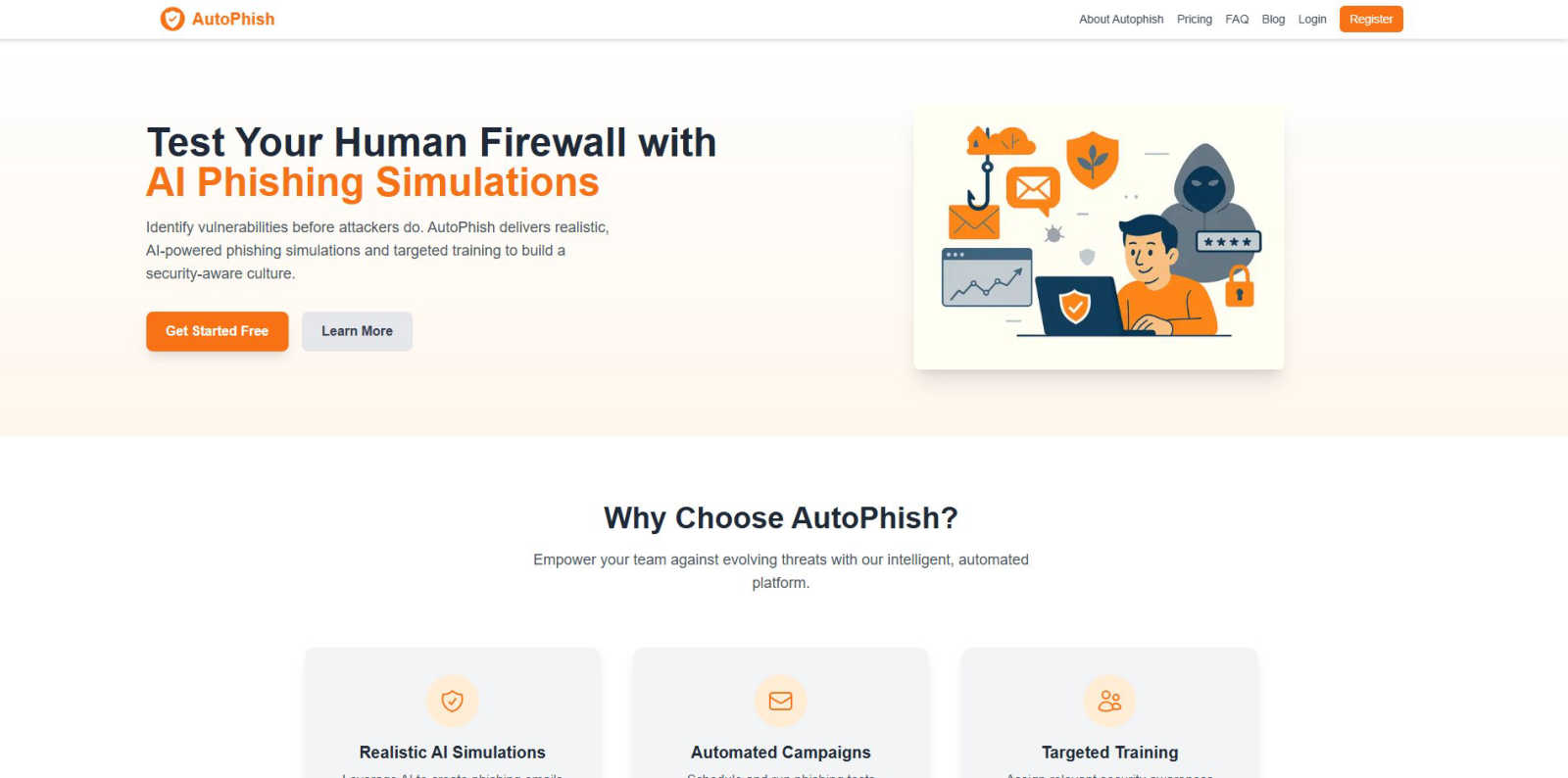
AutoPhish automates AI-driven phishing simulations and training to fortify your team's cybersecurity posture.
Last updated: March 1, 2026
Visual Comparison
Afterly Plan

AutoPhish
Feature Comparison
Afterly Plan
Phase-Based Action Plan
The platform structures the entire post-loss process into clear, sequential phases, such as Immediate Steps, Funeral & Memorial, and Financial Affairs. This architectural approach breaks down monumental tasks into a defined workflow, providing a visual timeline and prioritized checklist. Users progress through a curated roadmap, ensuring no critical step is overlooked while adapting the plan to their specific situation and jurisdiction.
Secure Digital Document Hub
Afterly Plan provides an encrypted, centralized vault for organizing and storing essential documents. This feature supports the upload and categorization of wills, deeds, account statements, death certificates, and other vital records. It mitigates the risk of lost paperwork and creates a single source of truth, facilitating easier sharing with attorneys, accountants, or family members as needed during the settlement process.
Integrated Expert Guidance Library
The platform embeds a comprehensive knowledge base curated by estate professionals. This library offers plain-language explanations of probate, executor responsibilities, legal terminology, and financial procedures. It acts as an always-available reference, reducing dependency on frantic internet searches and providing trustworthy, context-sensitive information directly within the relevant step of the action plan.
Interactive Checklists & Progress Tracking
Dynamic, customizable checklists form the core of the user interface, allowing individuals to track completed, pending, and upcoming tasks. The system offers conditional logic, showing or hiding tasks based on user input (e.g., "Was there a will?"). This interactive tracking provides a sense of control and accomplishment, visually mapping progress through an otherwise daunting journey.
AutoPhish
AI-Powered Phishing Simulation Engine
This core feature leverages a sophisticated AI model, likely built on transformer architectures similar to those used in large language models, to generate and adapt phishing email content. It analyzes real-world phishing campaigns to produce simulations with convincing pretexts, urgent language, and spoofed sender addresses that are highly tailored to your industry. The engine ensures technical realism, testing defenses against look-alike domains and sophisticated payload-less attacks that bypass traditional email gateways.
Automated Campaign Management & Scheduling
AutoPhish provides a fully automated workflow engine for end-to-end campaign management. Administrators can configure multi-stage phishing tests, define target user groups via integration with directories like Active Directory or Azure AD, and schedule campaigns to run at specific intervals. This automation ensures consistent, policy-driven security testing that operates on a continuous cycle, freeing security teams from manual execution and allowing for scalable, organization-wide coverage.
Role-Based Targeted Training Modules
Following simulation results, the platform dynamically assigns tailored security awareness training. It uses role-based access control (RBAC) logic and behavioral analytics from simulation clicks to serve relevant educational content. For instance, a finance department employee who fails a CEO fraud simulation would receive specific training on wire transfer protocols, while an HR staff member would get content focused on credential phishing. This targeted approach maximizes training efficacy and ROI.
Comprehensive Analytics & Reporting Dashboard
The platform features a centralized dashboard with advanced reporting capabilities. It provides granular metrics on click-through rates, vulnerability heat maps by department, and individual user risk scores. These analytics are exportable and can be integrated into SIEM or GRC platforms for a unified security posture view. The dashboard also tracks progress over time, measuring the improvement in employee resilience and the effectiveness of training interventions.
Use Cases
Afterly Plan
The Unprepared Executor
An individual named as executor in a will but with no prior experience in estate law or administration uses Afterly Plan. The platform provides them with a definitive, step-by-step protocol, explaining their fiduciary duties, court deadlines, and the order of operations for asset collection, debt payment, and distribution, transforming an overwhelming responsibility into a managed project.
The Grieving Immediate Family
A surviving spouse or adult child is emotionally overwhelmed and unable to focus on logistical details. They use the platform's compassionate, guided workflow starting with "Immediate Steps," which helps them notify relevant parties, plan a funeral using provided checklists, and locate critical documents without having to mentally organize the chaos themselves.
Managing Digital & Financial Assets
Families struggle to locate and manage a deceased loved one's online accounts, subscriptions, and financial assets. Afterly Plan's structured modules guide them through creating an inventory, providing templates for contacting financial institutions, and offering steps for handling passwords, recurring bills, and closing accounts systematically.
Coordinating with Professional Advisors
An executor or family representative uses Afterly Plan to organize all documents and task statuses in one secure hub. This organized digital estate file can then be efficiently shared with the family's attorney, CPA, or financial advisor, streamlining communication, reducing billable hours spent on organization, and ensuring all professionals are working from the same information.
AutoPhish
Proactive Security Posture Assessment for IT Teams
IT and security operations teams use AutoPhish to conduct regular, automated phishing simulations across the entire organization. This provides empirical data on the human risk surface, identifying which departments or individuals are most vulnerable. The resulting analytics inform where to allocate security resources and training budgets most effectively, transforming subjective concerns into quantifiable, actionable intelligence for risk management.
Compliance and Audit Readiness
Organizations in regulated industries (finance, healthcare, government) deploy AutoPhish to meet compliance mandates such as GDPR, HIPAA, PCI-DSS, and ISO 27001, which require regular security awareness training and testing. The platform's automated scheduling, detailed audit logs, and comprehensive reporting provide demonstrable proof of due diligence and ongoing employee education programs for auditors and regulators.
Onboarding and Continuous Employee Education
HR and People teams integrate AutoPhish into the employee onboarding lifecycle. New hires can be automatically enrolled in a baseline phishing simulation and training module. Subsequently, the platform supports a continuous education model with scheduled, recurring campaigns that keep security top-of-mind, helping to cultivate a persistent culture of security awareness rather than treating it as an annual checkbox exercise.
Simulating Advanced Persistent Threat (APT) Campaigns
For mature security teams, AutoPhish is used to model sophisticated, multi-vector attack campaigns that mimic Advanced Persistent Threats. Security architects can configure a series of interconnected simulations—starting with a phishing email, leading to a fake login page, and followed by a simulated malware download—to test the organization's detection and response protocols across different layers of defense, from email gateways to endpoint detection and response (EDR) systems.
Overview
About Afterly Plan
Afterly Plan is a specialized digital platform engineered to provide structured, step-by-step guidance through the complex administrative and logistical tasks following a death. It functions as an operational system for grief, translating the overwhelming process of estate settlement, probate, and executor duties into manageable, sequential actions. The platform is architected for individuals and families who are navigating loss, offering them clarity and organization when they need it most. Its core value proposition lies in filling the critical gap left by traditional estate plans, which are legal documents but not actionable day-by-day guides. Afterly Plan covers the immediate, practical necessities—from funeral planning and document location to managing financial accounts and understanding legal procedures—all within a secure, cloud-based environment. Built with direct input from estate professionals, it ensures reliable, expert-informed workflows. By integrating checklists, timelines, and secure document organization, Afterly Plan reduces cognitive load during a highly stressful time, allowing users to delegate mental energy from logistics to healing.
About AutoPhish
AutoPhish is an advanced, AI-driven cybersecurity platform engineered to proactively strengthen an organization's human firewall through realistic phishing simulations and targeted security awareness training. It is designed for IT security teams, compliance officers, and business leaders across all industries who need to quantify and mitigate human-centric security risks. The core value proposition lies in its seamless integration of generative AI to create hyper-realistic, context-aware phishing email templates that mimic current threat actor tactics, techniques, and procedures (TTPs). This technical approach ensures simulations are not generic but are tailored to specific industry verticals and job functions, providing accurate vulnerability assessments. The platform automates the entire lifecycle of security awareness campaigns, from domain verification and secure email dispatch using SPF, DKIM, and DMARC protocols to scheduling, execution, and detailed analytics. By automating resource-intensive tasks, AutoPhish enables continuous, consistent testing and training without straining IT budgets or personnel. Its API-first architecture and compatibility with existing security stacks allow for streamlined workflows, making it a critical tool for building a resilient, security-aware organizational culture against evolving social engineering attacks.
Frequently Asked Questions
Afterly Plan FAQ
How is Afterly Plan different from an estate plan?
An estate plan (will, trust) is a set of legal documents that instructs courts on your final wishes. Afterly Plan is the operational guide that helps your family execute those wishes. It addresses the immediate, practical logistics—finding documents, planning services, managing accounts—that legal documents do not cover, ensuring the plan is actionable.
Is my sensitive data secure on the platform?
Yes. Afterly Plan employs bank-level encryption for data both at rest and in transit. The company adheres to a strict privacy-first policy, meaning your personal information and uploaded documents are never sold or shared. The platform is designed as a secure vault for organizing this critical information during the settlement process.
Do I need to be tech-savvy to use Afterly Plan?
No. The platform is designed with a user-friendly, guided interface that requires no technical expertise. It uses simple language, clear step-by-step instructions, and intuitive checklists. The complexity of the estate process is handled by the platform's backend logic, presenting users with only the next actionable task in a simple format.
Can Afterly Plan provide legal or financial advice?
Afterly Plan is not a law firm or financial advisory service. It provides educational guidance, checklists, and organizational tools built with input from professionals. For specific legal, tax, or financial advice pertaining to your unique situation, the platform guides you on when and how to consult with licensed attorneys, CPAs, or other qualified experts.
AutoPhish FAQ
How does AutoPhish ensure the safe delivery of simulation emails?
AutoPhish prioritizes secure delivery through a technical integration with your email infrastructure. It requires domain verification, which involves configuring SPF (Sender Policy Framework) and DKIM (DomainKeys Identified Mail) records for your domain. This process authorizes AutoPhish's mail servers to send emails on your behalf legitimately, ensuring simulations are delivered to the inbox (not quarantined) while maintaining email authentication standards and preventing domain spoofing.
Can AutoPhish integrate with our existing IT and security stack?
Yes, AutoPhish is built with integration and compatibility in mind. It offers API access for programmatic campaign management and data extraction. It can integrate with Single Sign-On (SSO) providers like Okta or Azure AD for user authentication and synchronization. Furthermore, its reporting data can often be fed into Security Information and Event Management (SIEM) systems or other dashboards to correlate human risk with other security events.
What happens if an employee fails a phishing simulation?
The platform is designed for education, not punishment. When an employee clicks a simulated phishing link, they are typically redirected to an immediate, interactive training page that explains the red flags in the email they missed. Administrators are alerted through the dashboard, and the system can automatically assign follow-up, role-specific training modules to that user to reinforce learning, all managed through the automated workflow.
Is there a risk of data exposure or privacy violation with this tool?
AutoPhish is architected with data privacy and security as foundational principles. It operates on a least-privilege access model, syncing only necessary user data (like email and department) for campaign targeting. Simulation content is generated and managed within the platform, and no sensitive corporate data or real credentials are used in the simulations. The platform complies with major data protection regulations, and all data is encrypted in transit and at rest.
Alternatives
Afterly Plan Alternatives
Afterly Plan is a specialized productivity and management platform designed to guide individuals through the complex administrative and emotional tasks following a loss. It provides a structured, step-by-step framework for handling probate, estate duties, and memorial planning, integrating checklists and expert guidance into a single workflow. Users often explore alternatives to find a solution that better aligns with their specific technical ecosystem or budget. Common considerations include the need for deeper integration with existing legal or financial software stacks, a preference for a different pricing model, or requirements for more advanced collaborative features for dispersed family members. When evaluating an alternative, prioritize platforms with robust API support and compatibility with common cloud storage and document management systems. Assess the depth of the platform's feature set against your specific procedural needs, and ensure its security protocols and data handling policies meet the sensitive nature of estate management.
AutoPhish Alternatives
AutoPhish is a Business Intelligence and Productivity platform specializing in automated, AI-driven phishing simulation and security awareness training. It helps organizations proactively identify human vulnerabilities and reinforce their security culture through realistic, automated campaigns. Users often explore alternatives to AutoPhish to find solutions that better align with their specific tech stack, budget, or feature requirements. Common drivers include the need for deeper integration with existing SIEM, IAM, or HRIS platforms, a different pricing model, or more granular control over simulation scenarios and reporting analytics. When evaluating alternatives, prioritize platforms with robust API support for seamless workflow integration. Assess the depth of reporting, the flexibility of campaign automation, and the ability to deliver role-based, targeted training. Ensure the solution's deployment model and compatibility align with your organization's security architecture and compliance needs.