
CalPerks vs Wheyindex
Side-by-side comparison to help you choose the right product.

CalPerks uses USDA data and AI to instantly estimate calories from your plain-language meal descriptions.
Last updated: February 28, 2026

Wheyindex
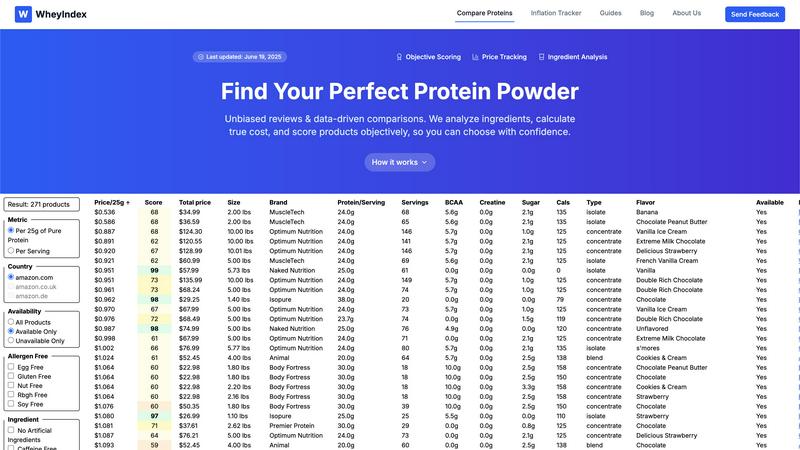
WheyIndex integrates objective data APIs to analyze and compare protein powders for optimal selection.
Last updated: March 1, 2026
Visual Comparison
CalPerks

Wheyindex
Feature Comparison
CalPerks
Natural Language Processing (NLP) Engine
The core of CalPerks is its advanced NLP engine, which allows users to log food by typing or speaking a simple description, such as "medium bowl of beef pho with sriracha." This engine parses the input, identifying key components like food type, preparation style, portion size, and brand names. It then interfaces with backend databases to fetch accurate data, eliminating the need for manual barcode scanning or tedious database searches. This feature represents a significant leap in user interface design for health tech.
USDA FoodData Central Integration
For accuracy and trustworthiness, CalPerks is directly integrated with the USDA FoodData Central database, the gold-standard source for nutritional information. This API-first approach ensures that calorie and macronutrient estimates are based on verified scientific data rather than crowd-sourced or unverified entries. When a user query matches a known item in the USDA database, the system prioritizes this data, providing a level of reliability that is critical for effective dietary tracking and planning.
Transparent AI Estimation & Fallback System
Transparency is built into the architecture. When the AI makes an estimation, it clearly lays out its assumptions to the user. If a specific food item is not found in the primary USDA dataset, the system employs a sophisticated fallback AI model to provide a best-guess estimate based on contextual understanding and similar items. This dual-layer data sourcing strategy ensures coverage for any food, including international and homemade dishes, while maintaining clarity on data provenance.
Multi-Language & International Cuisine Support
Unlike databases limited to English and Western foods, CalPerks' AI model is trained to understand food descriptions in multiple languages and contextualize international cuisines. Whether a user describes "sukuma wiki," "tonkatsu ramen," or "chicken burrito from Chipotle," the system can process the request. This makes the tool compatible and effective for a globally diverse user base, breaking down a major barrier in nutritional tracking software.
Wheyindex
Objective 100-Point Scoring Engine
The platform's core is a deterministic scoring algorithm that operates like a continuous integration pipeline for product quality. Each product is ingested, its nutritional label and ingredient list are parsed, and points are automatically assigned based on pre-configured, health-first criteria. This system removes subjective bias, providing a consistent, repeatable, and comparable metric across all products, much like a benchmark score for hardware or a code quality audit.
Granular Filtering & Query API
Wheyindex exposes a powerful filtering interface that functions as a user-friendly query builder for the supplement database. Users can execute complex, multi-parameter searches across categories like Allergen Free (e.g., Gluten Free, Soy Free), Ingredient Purity (e.g., No Artificial Ingredients, No Fillers), Protein Type (Isolate, Concentrate, Blend), and Dietary Claims (Keto, Vegan). This allows for precise subset selection from the dataset, ensuring only compatible products are returned.
Real-Time Price & Inflation Tracking
The engine integrates with e-commerce APIs to dynamically track and calculate the true cost of protein. The key metric "Price per 25g of Pure Protein" normalizes cost across different serving sizes and protein densities, enabling direct financial comparison. The Inflation Tracker module monitors price fluctuations over time, providing users with data-driven insights for budget-aware purchasing decisions.
Normalized Product Data Schema
Every product in the Wheyindex database is mapped to a unified schema, ensuring consistency. Specifications like flavor, brand, protein content per serving, and dietary flags are standardized into discrete, filterable fields. This structured data layer is what powers the platform's comparison functionality, allowing for apples-to-apples evaluations free from inconsistent marketing terminology.
Use Cases
CalPerks
For the Tech-Savvy Fitness Enthusiast
Individuals who frequent the gym and follow macro-specific diets require precise, fast logging that integrates into their busy routines. CalPerks allows them to quickly speak a post-workout meal like "2 scoops of whey protein with 200ml almond milk" and get instant macronutrient data, enabling seamless daily macro tracking without interrupting their flow. The app's accuracy and speed are critical for this data-driven user.
For Individuals Exploring Global Cuisines
Food lovers and travelers who regularly consume diverse, international dishes find most trackers inadequate. CalPerks solves this by accurately estimating meals like "rainbow roll with soy sauce" or "large bowl of kimchi chigae," which are often missing from standard databases. This allows users to maintain dietary awareness without having to avoid culturally significant or restaurant foods.
For Sustainable Habit Building with Gamification
Users who struggle with consistency benefit from CalPerks' integrated gamification layer. The app rewards logging streaks, turning a mundane task into a motivating challenge. The ease of the NLP interface reduces friction, making a 30-second daily log achievable, which is essential for building a long-term, sustainable health-tracking habit supported by behavioral tech principles.
For Budget-Conscious Health Managers
Compared to premium competitors with high annual fees, CalPerks offers a cost-effective, full-featured solution. Users seeking advanced AI logging and reliable data without a significant financial commitment can leverage CalPerks' affordable subscription to access premium features, making sophisticated nutritional tracking compatible with a wider range of personal budgets.
Wheyindex
Protocol-Specific Supplement Sourcing
For users following strict dietary protocols like Ketogenic, Vegan, or Lactose-Free diets, Wheyindex acts as a compatibility layer. By setting filters for "Keto Friendly," "Vegan," and "Lactose Free," the platform instantly returns only products that meet these technical requirements, eliminating manual label reading and ensuring adherence to the dietary stack.
Cost-Optimized Procurement for High-Volume Users
Athletes and fitness enthusiasts consuming protein powder regularly can utilize the price tracking and "Price per 25g Protein" metric to optimize their supplement budget. Filtering by the lowest cost per protein gram and setting availability alerts allows for automated, cost-effective bulk purchasing, integrating supplementation into a predictable monthly expense model.
Allergen & Sensitivity Avoidance Engineering
Individuals with specific allergies or sensitivities (e.g., nuts, soy, gluten, artificial dyes) can use the granular filter system as a safety protocol. By selecting the corresponding "Free From" flags, they create a whitelist of safe products, effectively debugging their supplement options to prevent adverse reactions and ensure system (bodily) compatibility.
Clean-Label Product Research & Due Diligence
Consumers prioritizing ingredient purity can deploy Wheyindex's ingredient analysis filters to audit products. Combining filters like "No Artificial Ingredients," "No Added Sugar," "Third Party Tested," and "Grass Fed" facilitates deep due diligence, enabling users to select products with a minimalist, high-integrity ingredient profile that aligns with a clean-label philosophy.
Overview
About CalPerks
CalPerks is a next-generation, AI-native calorie tracking application engineered to solve the core technical and usability challenges of traditional nutrition logging. It functions as a seamless interface between natural human language and structured nutritional databases, primarily leveraging the USDA FoodData Central API as its foundational data layer. The platform is architected for individuals who have found existing tracking solutions to be cumbersome, inaccurate, or demotivating due to reliance on manual searches, limited food databases, or complex interfaces. Its core value proposition is a frictionless, API-driven workflow: users input a free-text or voice description of their meal, and CalPerks' AI processing engine parses this input, queries its integrated data sources, and returns a precise calorie and macronutrient estimate. This system supports a global user base by understanding context and international cuisines across multiple languages. By combining robust data integration with a minimalist UX and a gamified reward system, CalPerks transforms calorie tracking from a chore into a sustainable, integrated component of daily health management.
About Wheyindex
Wheyindex is a sophisticated, API-like comparison engine engineered for the whey and plant-based protein supplement ecosystem. It functions as a centralized data aggregation and normalization platform, parsing complex product specifications from a database of over 300 verified items into a structured, queryable format. The system is architected for health-conscious consumers and biohackers who demand granular control over their nutritional intake, cutting through marketing noise with pure data. Its core value proposition is providing an objective, programmatic interface to supplement selection. By implementing a transparent, health-first 100-point scoring algorithm and enabling deep filtering across dozens of technical parameters—from protein isolate concentration and absence of rBGH to specific allergen profiles and sugar alcohol content—Wheyindex transforms subjective choice into a deterministic query. It seamlessly integrates real-time price tracking from major e-commerce platforms, allowing for cost-per-macroeconomic analysis. This tool is built for users who treat supplementation as a precise input in their health stack, requiring compatibility with specific dietary protocols, budget constraints, and purity standards.
Frequently Asked Questions
CalPerks FAQ
How does the AI logging work technically?
The AI logging works through a integrated pipeline. First, your natural language input (text or voice-to-text) is processed by a Natural Language Understanding (NLU) model that identifies entities like food items, quantities, and brands. This structured query is then sent to our primary data layer, the USDA FoodData Central API. If a match is found, those values are returned. If not, a secondary AI estimation model provides a calculated estimate based on similar known foods, with all assumptions clearly displayed.
What is the source of your nutritional data?
Our primary and preferred data source is the USDA FoodData Central database, accessed via its official API. This is the most reliable and scientifically-backed source for nutritional information in the United States. We use this as our ground truth. For items not covered by the USDA database, our system utilizes a trained AI model as a fallback to provide an educated estimate, ensuring comprehensive coverage.
Does CalPerks support foods from outside the United States?
Yes, absolutely. Our AI model is specifically designed for compatibility with global cuisines. It can understand and estimate calories for dishes described in various languages and from any culinary tradition, such as "ramadan porridge," "sukuma wiki," or "tonkatsu ramen." This is a key differentiator from apps that rely on a static, region-limited database.
How do you ensure estimation accuracy?
Accuracy is ensured through our multi-tiered system architecture. We prioritize verified data from the USDA API. When estimating, our AI breaks down complex meals into components and compares them to known nutritional profiles. Furthermore, we build transparency directly into the user interface by showing the source of each data point and the logic behind estimates, allowing users to understand and trust the output.
Wheyindex FAQ
How does the Wheyindex scoring algorithm work?
The scoring algorithm is a deterministic function that analyzes multiple data points from a product's nutritional and ingredient profile. It assigns weighted values to factors such as protein purity per serving, absence of unwanted additives (fillers, artificial sweeteners, dyes), sugar content, and verification of claims like third-party testing or grass-fed sourcing. The result is a normalized score out of 100, providing a consistent benchmark for comparison, independent of brand marketing.
Can I compare prices across different retailers and countries?
Yes, Wheyindex is designed with multi-platform compatibility in mind. The comparison table displays current pricing and availability from integrated retailers like Amazon's U.S., U.K., and German domains (.com, .co.uk, .de). The "Price per 25g protein" metric standardizes cost across all products and regions, allowing for true global price comparison and helping you identify the most cost-effective sourcing option.
What does "Price per 25g of Pure Protein" mean and why is it important?
This is a normalized cost-efficiency metric calculated by the platform. It determines how much you pay specifically for 25 grams of protein from any given product, adjusting for varying serving sizes and protein concentrations. This is critical for accurate comparison because it eliminates the distortion caused by different scoop sizes, filler content, and marketing claims, giving you a direct financial benchmark for the core macro-nutrient you're purchasing.
How often is the product data and pricing updated?
The platform's data ingestion pipeline is designed for regular synchronization. Product specifications and dietary claims are verified and updated systematically. Pricing is pulled in real-time or at high frequency from connected e-commerce APIs, ensuring the cost data and availability status you see are current, which is essential for making a timely and informed purchasing decision.
Alternatives
CalPerks Alternatives
CalPerks is an AI-powered calorie tracking application in the fitness and health category. It simplifies nutrition logging by allowing users to describe meals in plain language, leveraging USDA data for accuracy and offering a rewards system for engagement. Users often seek alternatives to find a solution that better aligns with their specific technical ecosystem or feature requirements. Common drivers include budget constraints, the need for deeper integration with other health platforms or wearables, a preference for different data visualization tools, or a requirement for more granular macronutrient tracking beyond core calorie estimates. When evaluating an alternative, consider its API availability for custom integrations, compatibility with your existing device and app stack, the underlying data source for nutritional information, and the flexibility of its logging interface. The ideal platform should seamlessly fit into your digital health workflow while providing the specific analytical depth you require.
Wheyindex Alternatives
WheyIndex is a specialized API-driven comparison engine for the fitness and health tech stack, designed to parse and analyze whey protein supplement data. It functions as a decision-support layer, integrating product databases with user-defined filters for ingredients, dietary needs, and pricing. Users often seek alternatives due to specific integration requirements, such as needing a different data schema, a custom scoring algorithm, or a white-label solution for their own platform. Others may require a broader API that includes plant-based proteins or deeper supply-chain analytics beyond the core whey focus. When evaluating an alternative, prioritize its API documentation, data freshness, and the flexibility of its filtering parameters. Ensure the service's architecture aligns with your application's stack, offering robust compatibility, clear data ownership policies, and scalable endpoints for your user base's query volume.