
HookMesh vs Hostim.dev
Side-by-side comparison to help you choose the right product.

Effortlessly implement reliable webhooks with automatic retries and a self-service portal for your SaaS product.
Last updated: February 27, 2026

Hostim.dev deploys Docker and Compose apps with built-in databases on EU bare-metal for predictable pricing.
Last updated: March 1, 2026
Visual Comparison
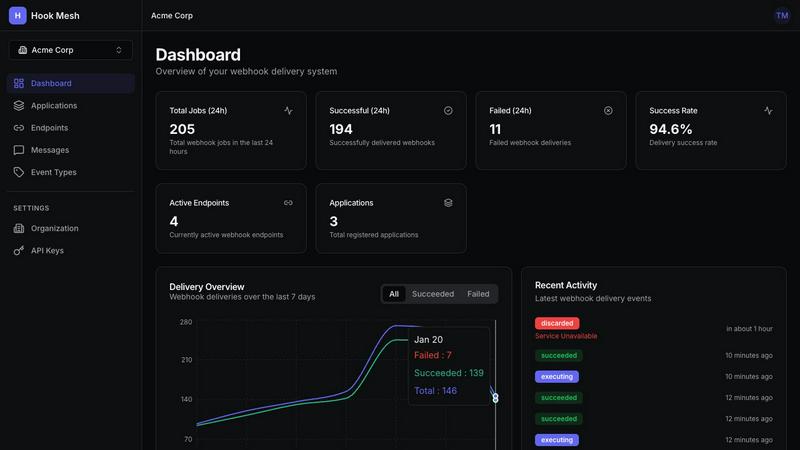
HookMesh
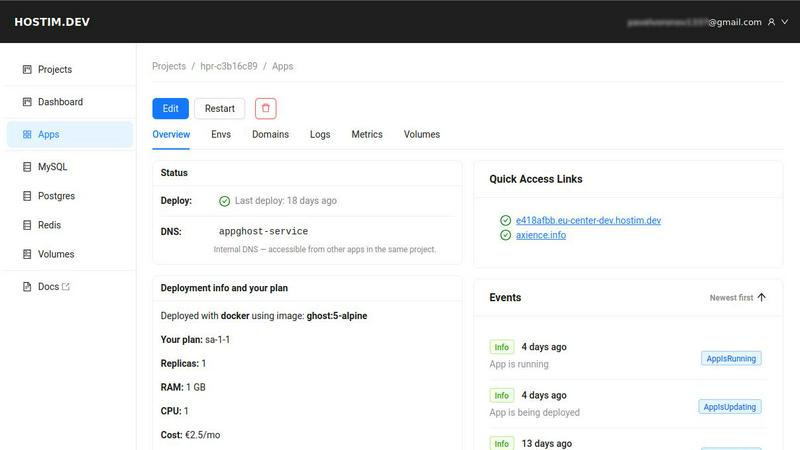
Hostim.dev
Feature Comparison
HookMesh
Reliable Delivery
HookMesh ensures that no webhook is ever lost by implementing automatic retries and exponential backoff strategies. With capabilities like circuit breakers, the platform can auto-disable failing endpoints and re-enable them upon recovery, providing a level of reliability critical for modern applications.
Customer Portal
The self-service customer portal is an embeddable UI that allows users to manage their webhook endpoints effortlessly. It provides essential features such as delivery logs, which offer full request and response visibility, enabling easier troubleshooting and monitoring of webhook events.
Developer Experience
Designed with developers in mind, HookMesh facilitates rapid deployment of webhooks. Through a comprehensive REST API and official SDKs for languages like JavaScript, Python, and Go, developers can integrate webhook functionality in just a few lines of code, significantly reducing development time.
One-Click Replay
One of the standout features of HookMesh is the one-click replay functionality for failed webhook deliveries. This allows users to instantly retry any failed events without needing to dig through logs or manually resend data, streamlining the error resolution process.
Hostim.dev
Multi-Source Deployment (Docker, Git, Compose)
Hostim.dev offers unparalleled deployment flexibility, supporting multiple entry points for your application. You can launch directly from a public or private Docker image, connect a Git repository for automatic deployments on push, or paste an entire docker-compose.yml file to spin up multi-service applications instantly. This native compatibility with industry-standard container tooling ensures zero vendor lock-in and a seamless migration path for existing projects.
Built-In Managed Databases & Storage
The platform integrates fully-managed database instances and persistent volumes as first-class citizens. With one-click provisioning for PostgreSQL, MySQL, and Redis, these services are automatically configured and securely linked to your application containers. Connection credentials are injected via environment variables, removing the need for complex setup and ensuring your backend framework (like Django, Rails, or Spring Boot) connects immediately.
EU Bare-Metal Hosting with GDPR Compliance
All applications are hosted on dedicated bare-metal servers within German data centers, ensuring high performance and low latency for EU users. This architecture, combined with per-project Kubernetes namespace isolation, provides a secure foundation that is GDPR compliant by default. It offers a critical advantage for businesses handling European customer data, eliminating the legal and logistical complexities of data transfer outside the EU.
Transparent Per-Project Cost Tracking
Hostim.dev employs a simple, flat pricing model with costs broken down per project. Each project's resource consumption (CPU, RAM, and attached services) is tracked with clear, hourly billing. This provides developers and agencies with precise cost control, enabling clean handovers to clients with predictable, quotable hosting fees and eliminating the surprise bills common with elastic cloud pricing.
Use Cases
HookMesh
E-Commerce Order Processing
In an e-commerce environment, businesses can leverage HookMesh to manage order completion notifications. When an order is completed, the webhook sends relevant information to inventory and shipping systems, ensuring seamless operations and timely updates for customers.
SaaS User Onboarding
SaaS companies can use HookMesh to facilitate user onboarding processes. By sending webhooks upon user registration, relevant systems can trigger welcome emails, set up user accounts, and initiate onboarding workflows, enhancing the overall user experience.
Payment Gateway Notifications
For businesses using payment gateways, HookMesh can manage webhook notifications related to payment confirmations and failures. This ensures that the finance team is alerted in real-time, allowing for immediate action to resolve payment issues.
API Integration Tracking
Organizations that provide APIs can utilize HookMesh to track and manage webhook notifications regarding API usage. By monitoring events such as rate limits and usage statistics, businesses can make informed decisions about scaling their services and managing resources.
Hostim.dev
Full-Stack Application Prototyping
Developers can rapidly prototype and iterate on full-stack applications by deploying a backend (e.g., FastAPI or Express.js) alongside a managed PostgreSQL database and Redis cache in a single action. The integrated stack and pre-wired connections allow teams to focus on building features rather than configuring infrastructure, dramatically accelerating the development cycle from idea to live demo.
Agency Client Project Hosting
Digital agencies can host each client's project in a completely isolated environment with dedicated resources and databases. The per-project billing model provides clear cost breakdowns for invoicing, while the simple deployment process and "clean handover" capability make it easy to transfer project ownership to the client post-launch, all on compliant EU infrastructure.
Microservices & Docker Compose Stacks
Teams running applications defined by Docker Compose can lift-and-shift their entire local development stack to production. Hostim.dev's native Docker Compose support means complex multi-service architectures, including web apps, workers, and internal tools, can be deployed without rewriting configurations for a proprietary platform, maintaining development/production parity.
Educational Projects & Portfolios
Students and developers building portfolio projects can deploy real, database-backed applications without cost complexity. The free trial and transparent pricing allow for hands-on learning with professional-grade tools (Docker, Git CI/CD, managed DBs), resulting in live projects that demonstrate practical DevOps and deployment skills to potential employers.
Overview
About HookMesh
HookMesh is a state-of-the-art solution tailored for businesses seeking to simplify and optimize webhook delivery in their SaaS products. Built to tackle the inherent complexities of developing webhooks in-house, HookMesh alleviates challenges such as implementing retry logic, managing circuit breakers, and diagnosing delivery issues. This platform is engineered specifically for developers and product teams who wish to maintain their focus on core functionalities rather than getting mired in the intricacies of webhook management. With its robust, battle-tested infrastructure, HookMesh guarantees reliable delivery of webhook events through mechanisms like automatic retries, exponential backoff, and idempotency keys. The self-service customer portal enhances user experience by allowing easy endpoint management, comprehensive visibility into delivery logs, and one-click replay for failed webhooks. Ultimately, HookMesh empowers organizations to streamline their webhook strategy, ensuring events are delivered consistently and reliably while providing peace of mind.
About Hostim.dev
Hostim.dev is a developer-centric, bare-metal Platform-as-a-Service (PaaS) engineered to streamline the deployment and management of containerized applications. It eliminates the traditional DevOps overhead by providing a direct path from code to production. Developers can deploy directly from a Docker image, a Git repository, or a full Docker Compose file, launching a complete application stack in minutes. The platform is built with a full-stack mentality, integrating essential managed services like PostgreSQL, MySQL, and Redis directly into the workflow, pre-wired with environment variables for instant compatibility. Every project is securely isolated within its own Kubernetes namespace, ensuring data separation and inherent compliance with strict regulations like the GDPR, facilitated by its exclusive hosting on EU bare-metal infrastructure in Germany. With a transparent, per-project hourly billing model and cost tracking, Hostim.dev delivers predictable pricing. It is the optimal solution for freelancers, agencies, startups, and SaaS builders who prioritize a fast, integrated, and compliant deployment pipeline without the complexity and unpredictable costs of major cloud providers.
Frequently Asked Questions
HookMesh FAQ
How does HookMesh ensure reliable webhook delivery?
HookMesh employs a series of strategies including automatic retries with exponential backoff, idempotency keys, and circuit breakers to guarantee that webhook events are delivered reliably, even in the face of transient failures.
Is there a limit to the number of webhooks I can send?
HookMesh offers a free tier that includes 5,000 webhooks per month. For higher volume needs, paid tiers are available, which allow for increased message capacity and additional features.
Can I integrate HookMesh with my existing applications?
Yes, HookMesh provides an easy integration process through its SDKs available for popular programming languages like JavaScript, Python, and Go. Developers can implement webhook functionality with minimal effort.
What support options are available for users?
HookMesh offers varying levels of support depending on the pricing tier chosen. Users on the free tier have access to community support, while higher tiers provide email support and priority assistance for critical issues.
Hostim.dev FAQ
Can I deploy with just a Docker Compose file?
Yes, absolutely. Hostim.dev provides native support for Docker Compose. You can directly paste your docker-compose.yml content into the platform's dashboard, and it will automatically provision and wire up all the services, networks, and volumes defined within it. This allows you to deploy complex, multi-container application stacks without any platform-specific configuration.
Where is my application hosted?
All applications on Hostim.dev are hosted exclusively on bare-metal servers in secure, enterprise-grade data centers located in Germany. This ensures your application and data reside within the European Union, providing inherent advantages for performance in the region and compliance with GDPR and other EU data protection regulations by default.
Do I need to know Kubernetes to use Hostim.dev?
No, you do not need any Kubernetes expertise. Hostim.dev abstracts away the underlying Kubernetes complexity through its simplified PaaS interface. You interact using familiar concepts like Docker images, Git repos, and Compose files. The platform manages all the Kubernetes orchestration, networking, and ingress control automatically behind the scenes.
Is this platform suitable for solo developers or only teams?
Hostim.dev is designed for both solo developers and teams. Its simplicity and fast deployment are perfect for individuals working on personal projects, startups, or freelance work. For teams and agencies, the per-project isolation, clear cost tracking, and easy handover features provide the structure needed to manage multiple client projects efficiently and securely.
Alternatives
HookMesh Alternatives
HookMesh is a state-of-the-art platform designed to streamline webhook delivery for software-as-a-service (SaaS) applications. It simplifies the complexities associated with webhook management, such as ensuring reliable delivery, handling retries, and providing a self-service customer portal for endpoint management. Users often seek alternatives to HookMesh due to various factors, including pricing structures, specific feature sets, or the need for integration with different platforms that may not align with HookMesh's offerings. When searching for an alternative to HookMesh, users should consider several key factors. First, assess the reliability of webhook delivery and whether the platform provides robust retry logic and error handling. Additionally, evaluate the user experience, particularly the availability of a customer portal for managing webhooks and gaining insights into delivery status. Finally, look for seamless integration capabilities with existing systems to ensure that the chosen solution meets your technical and business requirements.
Hostim.dev Alternatives
Hostim.dev is a bare-metal Platform-as-a-Service (PaaS) that simplifies deploying containerized applications from Docker, Git, or Compose files. It falls into the developer-centric PaaS and container hosting category, designed to reduce DevOps complexity with built-in databases and predictable EU-based hosting. Developers often evaluate alternatives for various reasons. These can include specific regional hosting requirements, different pricing models like free tiers or usage-based billing, the need for integrated CI/CD pipelines, or access to a broader marketplace of pre-configured services and add-ons. When assessing other platforms, key considerations are your core tech stack compatibility, such as Docker and Git integration, the simplicity of the deployment workflow, and the transparency of costs. Security posture, data residency compliance, and the availability of managed databases and automatic TLS are also critical for a production-ready environment.