
quickseo.ai vs SparkPix
Side-by-side comparison to help you choose the right product.

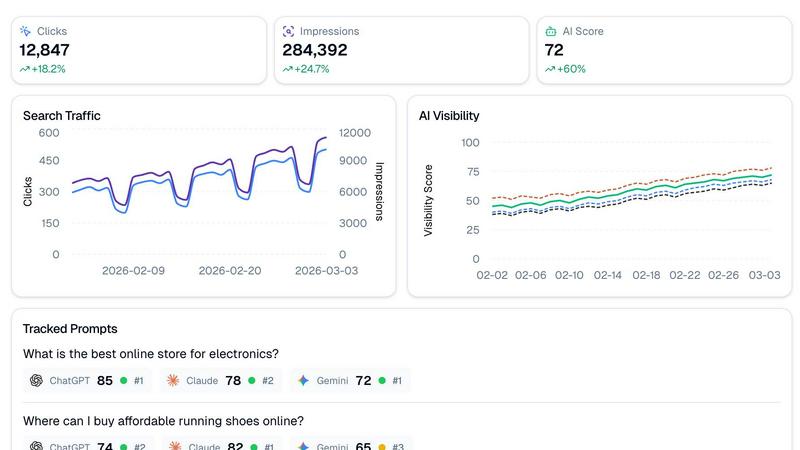
QuickSEO.ai integrates Google Search Console with AI visibility tracking across ChatGPT, Claude, and Gemini in a unified dashboard.
Last updated: March 11, 2026

SparkPix
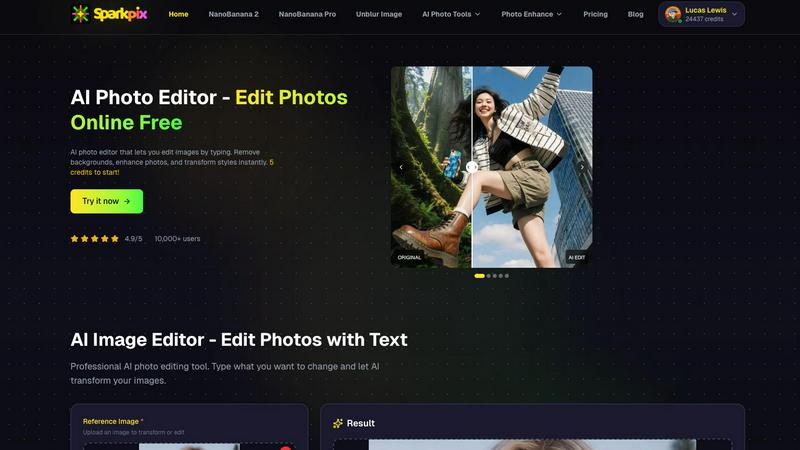
SparkPix is a developer-friendly AI photo editing API that integrates directly into your tech stack for programmatic image transformation.
Last updated: March 11, 2026
Visual Comparison
quickseo.ai
SparkPix
Feature Comparison
quickseo.ai
Unified Search & AI Dashboard
This core feature seamlessly integrates Google Search Console data with AI visibility tracking, presenting clicks, impressions, CTR, and ranking trends alongside AI performance metrics in a single interface. It eliminates the need to juggle multiple platforms, providing a holistic view of your organic performance across the entire search spectrum, from traditional queries to conversational AI prompts.
AI Visibility Scoring & Prompt Tracking
The platform automatically generates daily visibility scores for your brand across ChatGPT, Claude, and Gemini, tracking performance trends over time. Users can define and monitor specific prompts (e.g., "best online store for electronics") to see exactly where their brand ranks in AI-generated answers, providing actionable insights into conversational search visibility.
Sentiment Analysis & Cited Page Monitoring
QuickSEO.ai goes beyond mere mention tracking by analyzing the sentiment (positive, neutral, negative) of AI chatbot responses regarding your brand. Furthermore, it identifies which specific pages on your website are cited as sources by these AI models, allowing you to understand which content is authoritative and driving AI-driven referrals.
Page Group Organization & Competitor Tracking
Organize your website pages into logical groups (e.g., blog posts, product pages, documentation) to analyze which sections drive the most search and AI traffic. The tool also automatically extracts and lists competitor brands that appear alongside yours in AI responses, providing clear competitive intelligence within your niche.
SparkPix
AI-Powered Text-to-Edit Engine
This foundational feature integrates a sophisticated natural language interface with a suite of specialized AI models. Users input descriptive commands (e.g., "remove the tourist in the red shirt," "enhance colors and upscale to 4K"), and the system parses the intent to route the task to the appropriate backend model—such as a segmentation network for object removal or a super-resolution GAN for enhancement. This architecture allows for precise, context-aware edits in under 30 seconds, functioning as a unified API for multiple image processing tasks without manual tool selection.
Advanced Background Removal & Replacement
Built on a state-of-the-art semantic segmentation model, this tool delivers one-click, high-fidelity background extraction for even complex scenes with fine details like hair or transparent objects. It offers seamless integration for e-commerce workflows, automatically generating transparent PNGs or compositing subjects onto new backgrounds specified by text. The underlying model is optimized for batch processing, ensuring consistency for product catalogs and portrait photography, and serves as a direct, watermark-free alternative to standalone services like remove.bg.
Intelligent Photo Restoration & Deblurring
This feature employs a combination of denoising autoencoders and deblurring neural networks (like DeblurGAN variants) to algorithmically repair damaged visual data. It can restore old photos by inpainting scratches and tears, colorizing black-and-white images through historical color palette prediction, and reversing motion blur or lens defocus. The system is trained on diverse datasets of degraded imagery, making it compatible with scanning artifacts, JPEG compression issues, and physical photo damage, ideal for digitizing and preserving archival content.
Multi-Style AI Image Generation & Transfer
Leveraging diffusion models and neural style transfer (NST) algorithms, this capability serves a dual function. It can generate original, high-resolution (up to 4K) images from text prompts, acting as a built-in creative asset generator. Concurrently, it can apply over 15 distinct artistic styles (e.g., anime, oil painting, pencil sketch) to uploaded images. This is powered by a modular system where different style weights and generative adversarial networks (GANs) are deployed based on the selected aesthetic, providing extensive creative flexibility for branding and social media content.
Use Cases
quickseo.ai
SEO Agencies Managing Client Portfolios
Agencies can leverage quickseo.ai to provide enhanced reporting for clients, demonstrating value not just in Google rankings but also in emerging AI search visibility. The unified dashboard allows for efficient management of multiple accounts, tracking branded vs. non-branded performance and proving ROI in a shifting search landscape.
E-commerce Brands Optimizing for Commercial Queries
Online retailers can track rankings for key commercial prompts in AI chatbots, such as "where to buy affordable running shoes." By monitoring their position and sentiment, they can optimize product pages and content to capture high-intent AI-driven traffic, directly impacting sales opportunities.
SaaS Companies Building Brand Authority
Software companies can use the cited page monitoring and sentiment analysis to identify which help documentation, blog posts, or landing pages are referenced by AI. This informs content strategy to strengthen brand authority, ensure accurate AI representation, and drive qualified sign-ups from AI search results.
Content Teams Driving Organic Growth
Content marketing teams can analyze page group performance to see which blog sections or content hubs generate the most impressions and AI citations. This data-driven approach helps prioritize content creation, update existing pieces for better visibility, and align topics with what users are asking AI assistants.
SparkPix
E-Commerce Product Image Automation
Online retailers and Shopify store owners can integrate SparkPix into their product upload pipeline to automate time-consuming tasks. The platform can batch-process hundreds of product shots to remove backgrounds, create consistent white-background images for marketplaces like Amazon, generate lifestyle mockups by placing products into scenes via text prompts, and enhance overall image quality for better conversion rates, all without manual Photoshop work.
Professional Social Media & Marketing Content Creation
Marketing teams and social media managers utilize SparkPix to rapidly produce high-volume, engaging visual content. They can create branded graphics, apply consistent artistic filters to campaign photos, remove unwanted elements from event pictures, generate custom artwork for posts using AI, and optimize image resolution for different platform specs (Instagram feed, YouTube thumbnails, LinkedIn articles), streamlining the entire content creation workflow in a browser.
Archival Photo Digitization & Restoration
Genealogists, historians, and individuals preserving family history use SparkPix to restore and enhance old physical photographs. The tool can digitally repair tears, eliminate stains and scratches, colorize black-and-white portraits, and sharpen blurred details in scanned images. This provides a powerful, accessible alternative to specialized software or manual restoration services, enabling bulk processing of personal archives.
On-Demand Professional Portrait & Document Editing
Professionals and individuals can instantly create compliant passport and visa photos by generating headshots with specific attire and background colors. Freelancers can also use the object remover to clean up portrait backgrounds or the enhancer to perfect LinkedIn profile pictures. This use case highlights the platform's utility for formal, business, and personal documentation needs with immediate, watermark-free results.
Overview
About quickseo.ai
quickseo.ai is a comprehensive analytics platform engineered for the modern search landscape, unifying traditional SEO performance with critical AI visibility metrics. It integrates directly with Google Search Console to provide foundational search analytics, while simultaneously tracking a brand's presence and performance across leading AI chatbots like OpenAI's ChatGPT, Anthropic's Claude, and Google's Gemini. This dual-data approach addresses a fundamental gap for marketers and SEO professionals, as AI becomes a primary consumer search source. The platform is built for technical marketers, SEO agencies, and growth teams who need to move beyond guesswork and make data-driven decisions to capture traffic from both conventional and AI-powered search. Its core value proposition is delivering a single, unified dashboard where you can monitor clicks, impressions, and rankings from Google alongside daily AI visibility scores, prompt rankings, and sentiment analysis, ensuring no traffic opportunity is missed in the evolving digital ecosystem.
About SparkPix
SparkPix is a cutting-edge, web-based AI photo editing platform engineered to democratize professional-grade image manipulation. It functions as a comprehensive, cloud-native suite of tools that leverages advanced machine learning models to execute complex edits based on simple text prompts. The core value proposition is its seamless integration of natural language processing (NLP) with computer vision, eliminating the steep learning curve associated with traditional software like Adobe Photoshop. Designed for a broad tech stack, it serves developers, e-commerce managers, social media content creators, marketing professionals, and everyday users who require fast, efficient, and high-quality photo edits without installing software. Its API-friendly, browser-agnostic architecture ensures compatibility across desktop (Windows, macOS, Linux) and mobile (iOS, Android) environments, making it a versatile asset for embedding AI-powered imaging into existing workflows, from automating product photo backgrounds for Shopify stores to batch-restoring family archives. By offering a free tier with credits and scalable paid plans, SparkPix provides an accessible entry point into AI-driven visual content creation.
Frequently Asked Questions
quickseo.ai FAQ
How does quickseo.ai track rankings in AI chatbots?
Quickseo.ai uses proprietary technology to simulate queries and analyze responses from major AI platforms like ChatGPT, Claude, and Gemini. It processes these responses to identify brand mentions, determine ranking position for tracked prompts, assess sentiment, and extract cited source URLs, providing a structured data feed of your AI visibility.
What is the difference between branded and non-branded tracking?
Branded tracking focuses on keywords and prompts that include your company or product name (e.g., "quickseo.ai features"). Non-branded tracking monitors generic, industry-related queries (e.g., "best SEO analytics tool"). The platform allows you to filter data by these segments to understand how you attract new audiences versus retain existing ones.
Can I track my competitors with this tool?
Yes. The competitor tracking feature automatically identifies and lists other brands that are mentioned in the AI responses to your tracked prompts. This provides direct insight into who your main competitors are within AI search landscapes for specific topics, without requiring manual setup for each competitor.
How do I get started with connecting my Google Search Console data?
Getting started involves signing up for a quickseo.ai account and navigating to the integrations section. The platform uses Google's secure OAuth protocol to request read-only access to your Search Console data. This established API connection ensures your search performance data is imported safely and updated automatically.
SparkPix FAQ
What is the underlying technology stack for SparkPix?
SparkPix is built on a cloud-native microservices architecture, primarily utilizing Python with frameworks like FastAPI for backend services. It leverages multiple pre-trained and proprietary deep learning models, including Transformer-based models for prompt understanding, U-Net and Mask R-CNN architectures for segmentation tasks, GANs (Generative Adversarial Networks) for restoration and style transfer, and Diffusion models for image generation. The frontend is a responsive web application built with modern JavaScript frameworks, ensuring broad browser compatibility.
How does the credit system work and what is the cost per edit?
The platform operates on a credit-based system. Users start with 5 free credits upon sign-up, with no credit card required, and receive 1 additional credit daily. Each AI generation or major edit, such as applying a text prompt for transformation, background removal, or image generation, typically costs 5 credits. Simpler, one-click operations like basic background removal may cost less. Paid plans, starting at $9.99, offer larger credit packs (e.g., 350 credits) for high-volume users, providing a scalable cost structure.
Is there an API available for developers to integrate SparkPix?
Yes, SparkPix offers an API designed for developers to integrate its AI photo editing capabilities directly into their own applications, websites, or automated workflows. The API provides endpoints for all core features—background removal, photo enhancement, object removal, and text-based editing—allowing for server-to-server communication and batch processing. Documentation includes details on authentication (API keys), request/response formats, and rate limits, facilitating seamless integration into existing tech stacks.
Are the edited images free from watermarks and do I retain ownership?
Absolutely. All images processed through SparkPix, including those on the free tier, are delivered without any SparkPix watermark or branding. You retain full ownership of your original uploaded images and the AI-generated or edited results. The platform's terms of service grant you a license to use the output for personal or commercial purposes, making it suitable for professional work, client deliverables, and commercial product listings.
Alternatives
quickseo.ai Alternatives
quickseo.ai is a specialized analytics platform in the marketing technology category, designed to track and improve brand visibility across both Google and major AI platforms like ChatGPT, Claude, and Gemini. It merges traditional search analytics with AI-specific metrics, offering a unified view of performance in an evolving digital landscape. Users often explore alternatives for various reasons, including budget constraints, the need for different feature sets, or specific integration requirements with their existing tech stack. Some may require deeper analytics in one area, such as pure Google SEO, while others might seek broader platform compatibility or a different pricing model that aligns with their business scale. When evaluating an alternative, key considerations should include the depth of AI platform coverage, the robustness of data integration from sources like Google Search Console, and the tool's ability to provide actionable insights. It's crucial to assess how well a solution fits into your current marketing stack and whether it can scale with your brand's growth in both traditional and AI-driven search environments.
SparkPix Alternatives
SparkPix is a web-based AI photo editor that operates within the browser-based image editing and generation category. It allows users to apply complex edits like background removal, restoration, and style transfer through simple text prompts, eliminating the need for traditional software expertise. Users often seek alternatives for various technical and operational reasons. These can include budget constraints, the need for different pricing structures, or a requirement for specific advanced features not covered. Others may prioritize offline functionality, deeper integration with existing creative software stacks, or platforms with more extensive API access for workflow automation. When evaluating an alternative, consider the core technology stack, such as the underlying AI models and their output quality. Assess compatibility with your existing tools and workflows, including support for necessary file formats and export options. Finally, examine the platform's scalability, API availability for developers, and how its subscription model aligns with your projected usage volume and team size.