
ScopeGuard vs ScopeSnap
Side-by-side comparison to help you choose the right product.

ScopeGuard
ScopeGuard's AI instantly detects scope creep to ensure freelancers get paid for all work.
Last updated: February 28, 2026

ScopeSnap
ScopeSnap's AI instantly transforms discovery notes into structured project scopes and client-ready proposals.
Last updated: March 18, 2026
Visual Comparison
ScopeGuard

ScopeSnap
Feature Comparison
ScopeGuard
AI-Powered Scope Analysis Engine
At the heart of ScopeGuard is a sophisticated AI engine trained to understand contractual language and project deliverables. It automatically extracts scope items from imported documents and provides instant, accurate analysis of incoming client requests. The system categorizes each request and delivers a clear verdict with a supporting rationale, achieving a documented 95% accuracy rate. This provides freelancers with immediate, data-backed clarity to support billing discussions.
Universal Chrome Extension Integration
ScopeGuard's functionality is deeply embedded into the user's daily workflow via its Chrome Extension. This tool enables freelancers to highlight text on any webpage—be it an email in Gmail, a message in Slack, or a ticket in Jira—and right-click to "Check with ScopeGuard." This seamless integration eliminates context-switching and ensures scope verification happens in real-time, right at the point of request, without ever leaving the primary application.
Client Approval Portal & Invoice Generation
The platform includes a built-in, secure client approval portal to formalize the change request process. When out-of-scope work is identified, freelancers can generate and send a secure approval link directly from their dashboard. Clients can review the request and the associated scope rationale, then approve with a single click. Upon approval, the system can automatically generate and send professional invoices, streamlining the entire compensation workflow.
Centralized Scope & Revenue Dashboard
ScopeGuard provides a unified, real-time command center that aggregates data across all projects. The dashboard offers a comprehensive view of all logged out-of-scope requests, their status (pending, approved, billed), and their total monetary value. This gives freelancers immediate insight into unbilled work and recovered revenue, transforming scope management from a reactive task into a proactive, strategic financial activity.
ScopeSnap
AI-Powered Scope Generation
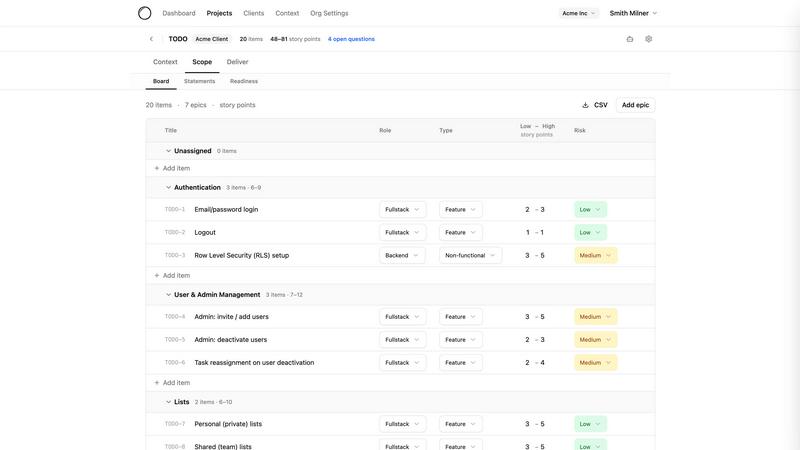
This core feature ingests raw, unstructured text from various sources like call transcripts, Slack exports, or handwritten notes. Using advanced language models, it automatically identifies key requirements, user actions, and system functionalities, structuring them into a preliminary project backlog complete with epics and detailed scope items. It intelligently flags assumptions and surfaces open questions for the team to review, providing a powerful head start on scope definition.
Interactive Scope Refinement Board
The generated scope is presented in a dynamic, kanban-style board interface where teams can collaboratively review, edit, and organize items. This feature allows for direct manipulation of the backlog: dragging items between stages, breaking down large epics, assigning development roles (e.g., Frontend, Backend, DevOps), and attaching custom time or complexity estimates to each task, ensuring every aspect of the project is quantified.
Automated Proposal & SOW Document Builder
Once the scope is finalized and estimated, this feature automates the creation of client-facing documentation. Users can select a template (Proposal or Statement of Work), and ScopeSnap populates it with the structured scope, estimates, assumptions, and defined deliverables. The output is a polished, professional PDF or shareable document, eliminating hours of manual copying, pasting, and formatting from disparate sources.
Integration-First Data Context
Understanding that discovery happens across tools, ScopeSnap is built with compatibility in mind. It supports direct paste-in from a wide array of sources and is designed for a workflow that sits alongside communication platforms like Zoom, Google Meet, email clients, and note-taking apps. This ensures all relevant project context can be easily aggregated into the scoping engine without disruptive context switching.
Use Cases
ScopeGuard
Web & Software Development Projects
Freelance developers and agencies use ScopeGuard to manage SOWs for website builds or feature development. When a client requests an additional form field, design revision, or integration not specified in the original contract, the Chrome Extension instantly flags it as out-of-scope. This provides concrete evidence to discuss change orders, preventing uncompensated work on iterative "small tweaks" that accumulate into significant unpaid hours.
Creative Design & Marketing Freelancing
Graphic designers, UX/UI designers, and marketing consultants integrate ScopeGuard to protect their project scope. For example, when a client asks for extra social media graphics beyond the agreed number or requests a new logo variation in an email, ScopeGuard analyzes the request against the imported proposal. This allows creatives to professionally justify additional fees for expanded deliverables, safeguarding their profit margins.
Consulting & Business Advisory Services
Management and strategy consultants utilize ScopeGuard to define and maintain engagement boundaries. The AI effectively parses complex consulting proposals to identify core deliverables. If a client asks for additional data analysis, workshop facilitation, or report sections outside the agreed framework, the consultant can use ScopeGuard's verdict to initiate a formal conversation about extending the engagement terms and fees.
Managing Retainer & Ongoing Service Agreements
Freelancers on monthly retainer agreements use ScopeGuard to delineate between covered support and new project work. By importing the retainer contract, they can quickly verify if a client's request falls under the "ongoing support" clause or constitutes a new, billable project. This clarity prevents scope creep within retainers and ensures additional work is properly scoped and invoiced separately.
ScopeSnap
Freelance Developer Client Onboarding
For solo developers, ScopeSnap streamlines the process of converting initial client discussions into a fixed-scope proposal. After a discovery call, the freelancer can paste their notes and meeting transcript into the tool to quickly generate a structured scope, identify edge cases, and produce a credible, detailed estimate and SOW to secure the project with clear boundaries and expectations.
Software Agency Pre-Sales Scoping
Agencies can use ScopeSnap to bring consistency and speed to their sales engineering phase. Sales teams can input notes from multiple stakeholder interviews, and the platform will synthesize a unified scope document. This allows for rapid iteration with internal technical leads to validate feasibility and cost before presenting a polished, accurate proposal to the prospective client.
Technical Consultant Requirement Analysis
Consultants tasked with defining project specifications for third-party teams can use ScopeSnap as an analysis tool. By processing all gathered business and technical requirements, the AI helps identify gaps, dependencies, and implicit assumptions, enabling the consultant to deliver a comprehensive, well-structured scope of work document to the development team for execution.
Iterative Project Scope Refinement
For projects following agile or iterative methodologies, ScopeSnap can be used at the start of each new phase or sprint. Teams can feed in notes from refinement sessions or user feedback to quickly generate and estimate the backlog for the upcoming cycle, maintaining a living document that accurately reflects the evolving project trajectory.
Overview
About ScopeGuard
ScopeGuard is an AI-native SaaS platform engineered to combat scope creep for freelancers and independent contractors. It integrates directly into a freelancer's existing tech stack, acting as a vigilant layer of protection over project agreements. The core value proposition is financial recovery and protection: by systematically identifying and managing out-of-scope requests, ScopeGuard empowers users to bill for every hour of work performed, directly addressing the industry-wide problem of an average $5,200 in annual lost revenue per freelancer. The platform is built for seamless compatibility, featuring a Chrome Extension that allows for right-click scope analysis from within critical web applications like Gmail, Slack, Asana, or Trello. Users can onboard in minutes by importing contracts or Statements of Work (SOW) via PDF, screenshot, or direct text paste. The proprietary AI engine then parses these documents to establish a baseline scope, providing instant, categorized verdicts (In-Scope, Out-of-Scope, Borderline) on any client request with detailed explanations. Beyond detection, ScopeGuard includes integrated workflow tools for client approval requests and invoice generation, creating a closed-loop system for scope management. It is specifically designed for the modern freelancer's workflow, offering enterprise-grade data security and real-time dashboards without the complexity of traditional project management suites.
About ScopeSnap
ScopeSnap is an AI-powered scoping and proposal platform engineered for freelance developers, technical consultants, and software development agencies. It directly addresses the critical, yet often chaotic, phase between client discovery and project kickoff. The core value proposition is transforming unstructured input—such as meeting transcripts, email threads, and scattered notes—into a structured, actionable, and estimatable project scope. By leveraging AI to parse context and generate a preliminary backlog of epics and user stories, ScopeSnap mitigates the risk of missed requirements and vague deliverables that plague custom software estimation. The platform provides a centralized workspace to iteratively refine this scope, assign roles, set time estimates, and resolve ambiguities. Finally, it seamlessly compiles the polished scope into client-ready professional documents like Proposals or Statements of Work (SOW). This end-to-end workflow is designed for integration into modern development practices, replacing manual, error-prone processes with a systematic, tech-stack compatible tool that ensures clarity from the first conversation to the signed contract.
Frequently Asked Questions
ScopeGuard FAQ
How does the AI scope checking work technically?
ScopeGuard's AI utilizes natural language processing (NLP) models specifically fine-tuned on contractual documents and project deliverables. When you import a contract, it parses the text to identify key nouns, verbs, and conditional statements that define the project's boundaries. When checking a request, it compares the semantic meaning of the client's ask against this parsed scope model, evaluating intent and context rather than just keyword matching to deliver a highly accurate verdict.
What file formats and integrations does ScopeGuard support?
The platform supports direct text paste, PDF upload, and image/screenshot imports for contract ingestion. Its primary integration is the Chrome Extension, which works on any website. This provides de facto integration with all web-based email clients (Gmail, Outlook), communication tools (Slack, Teams), and project management platforms (Asana, Trello, Jira). Future API developments aim for deeper native integrations.
How does the client approval process function?
Within the ScopeGuard dashboard, you can log an out-of-scope request and generate a secure, unique approval link. This link leads to a branded portal where your client sees the original request, the relevant section of the contract, and ScopeGuard's AI-powered explanation for the out-of-scope verdict. The client can then approve or decline with one click. All actions are logged in your dashboard for tracking and audit purposes.
Is my contract and client data secure with ScopeGuard?
Yes. ScopeGuard employs enterprise-grade security protocols. All data is encrypted in transit using TLS and at rest using AES-256 encryption. Your raw contract documents and client data are processed in a secure environment and are never used to train public AI models or shared with third parties. The platform is built with a privacy-by-design architecture, ensuring your sensitive business information remains protected.
ScopeSnap FAQ
What types of input does ScopeSnap accept for scope generation?
ScopeSnap is designed to process unstructured text from a wide variety of sources common in the discovery phase. You can directly paste in content from video call transcripts (e.g., Otter.ai, Rev), email correspondence, notes from apps like Notion or Google Docs, bullet-point lists, and even rough voice memo transcriptions. The AI is optimized to parse conversational language and extract actionable requirements.
How does ScopeSnap handle different tech stacks and project types?
The platform is technology-agnostic in its core scoping function. It focuses on identifying functional requirements, user stories, and features rather than prescribing implementations. During the refinement stage, you assign roles and estimates based on your team's specific expertise—whether it's a React frontend, a Node.js backend, mobile development, or cloud architecture. The output documents are templated to suit various project types, from web apps to SaaS platforms.
Can I collaborate with my team or client within ScopeSnap?
ScopeSnap provides a collaborative workspace for internal team refinement, allowing members to review, edit, and estimate the scope board. Client-facing sharing is typically handled through the generated Proposal or SOW documents, which are exported and sent via your existing communication channels. This maintains a clear separation between internal scoping work and the finalized client deliverable.
Is the AI-generated scope final, or does it require human review?
The AI-generated scope is a powerful starting point, but it is not final. It is explicitly designed for human-in-the-loop refinement. The platform surfaces open questions and flagged assumptions precisely to guide your review. Technical leads and project managers must critically review, adjust, break down, and estimate each item to ensure technical accuracy, completeness, and alignment with the client's true needs before generating a final proposal.
Alternatives
ScopeGuard Alternatives
ScopeGuard is an AI-powered project management tool designed to combat scope creep for freelancers and independent contractors. It integrates with common workflows to automatically analyze client requests against project contracts, ensuring all work is properly tracked and billed. Users often explore alternatives to find a solution that better fits their specific tech stack, budget, or feature requirements. Common considerations include integration depth with existing tools like CRMs or accounting software, the need for team collaboration features beyond individual freelancer use, and overall pricing structure relative to the value provided. When evaluating alternatives, prioritize tools that offer robust API access for custom integrations, compatibility with your core communication and project management platforms, and transparent data handling policies. The ideal solution should seamlessly embed into your existing workflow without creating additional administrative overhead.
ScopeSnap Alternatives
ScopeSnap is a project scoping and proposal generation tool in the productivity and management software category. It uses AI to help freelance developers and software agencies transform initial client discussions into structured, estimatable tasks and professional proposals. Users often explore alternatives to ScopeSnap for various reasons, such as specific budget constraints, the need for different feature sets, or deeper integration with their existing tech stack and project management ecosystem. The right tool must align with a team's operational workflow and technical environment. When evaluating alternatives, key considerations include the platform's ability to integrate with your current tools, its compatibility with your development methodology, and how it handles the iterative refinement of technical requirements. The focus should be on finding a solution that seamlessly fits into your existing software development lifecycle.