
quickseo.ai vs Startup Listing
Side-by-side comparison to help you choose the right product.

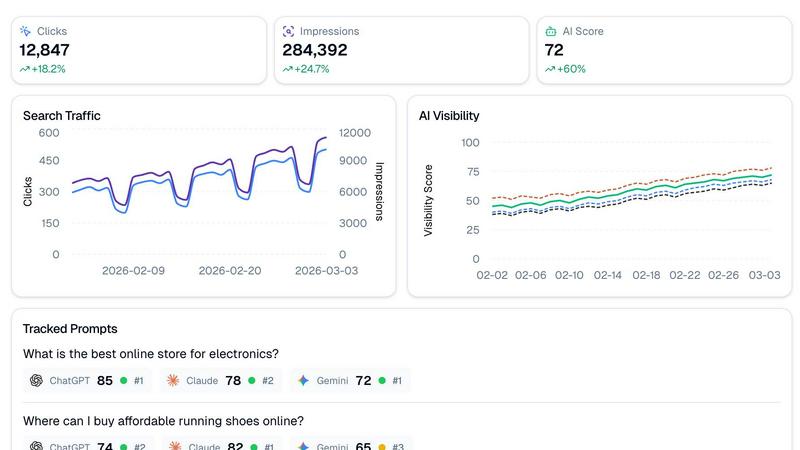
QuickSEO.ai integrates Google Search Console with AI visibility tracking across ChatGPT, Claude, and Gemini in a unified dashboard.
Last updated: March 11, 2026

Discover and integrate curated startups and SaaS tools with advanced search and leaderboard rankings.
Last updated: February 28, 2026
Visual Comparison
quickseo.ai
Startup Listing
Feature Comparison
quickseo.ai
Unified Search & AI Dashboard
This core feature seamlessly integrates Google Search Console data with AI visibility tracking, presenting clicks, impressions, CTR, and ranking trends alongside AI performance metrics in a single interface. It eliminates the need to juggle multiple platforms, providing a holistic view of your organic performance across the entire search spectrum, from traditional queries to conversational AI prompts.
AI Visibility Scoring & Prompt Tracking
The platform automatically generates daily visibility scores for your brand across ChatGPT, Claude, and Gemini, tracking performance trends over time. Users can define and monitor specific prompts (e.g., "best online store for electronics") to see exactly where their brand ranks in AI-generated answers, providing actionable insights into conversational search visibility.
Sentiment Analysis & Cited Page Monitoring
QuickSEO.ai goes beyond mere mention tracking by analyzing the sentiment (positive, neutral, negative) of AI chatbot responses regarding your brand. Furthermore, it identifies which specific pages on your website are cited as sources by these AI models, allowing you to understand which content is authoritative and driving AI-driven referrals.
Page Group Organization & Competitor Tracking
Organize your website pages into logical groups (e.g., blog posts, product pages, documentation) to analyze which sections drive the most search and AI traffic. The tool also automatically extracts and lists competitor brands that appear alongside yours in AI responses, providing clear competitive intelligence within your niche.
Startup Listing
Curated Product Discovery Engine
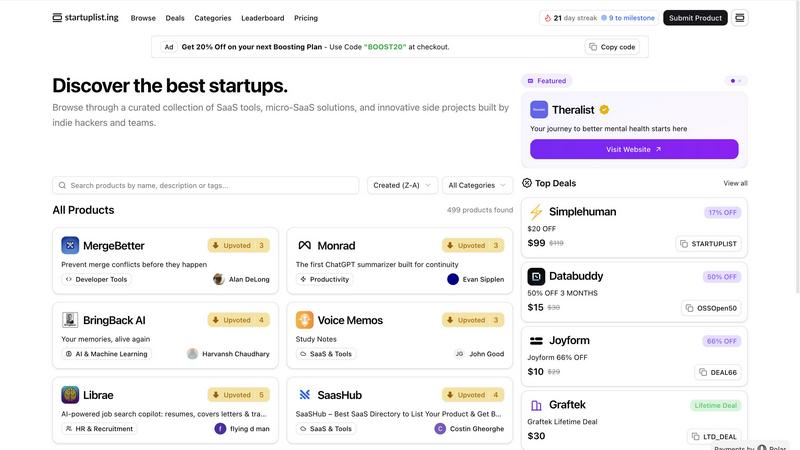
The platform features a powerful, command-palette inspired search (⌘K) that allows users to instantly query across thousands of products, categories, and active deals. This engine is built with a tech-stack aware categorization system, enabling precise filtering for specific niches like AI & ML or Developer Tools, ensuring developers and founders can find tools that integrate directly with their existing workflows and technical requirements without noise.
Integrated Deals & Promotions Hub
Startup Listing includes a dedicated Deals section featuring lifetime offers, limited-time discounts, and promotional pricing from listed startups. This system is designed for compatibility with a founder's budget cycle, providing direct access to cost-effective tooling and software deals that can be integrated into a company's operational stack, from marketing sales platforms to developer utilities, often at early-bird or lifetime access rates.
Community-Driven Leaderboard & Analytics
A dynamic Leaderboard ranks products based on community engagement and traction, providing built-in analytics on product popularity and user interest. This feature offers social proof and valuable market validation data, helping builders assess a tool's adoption rate and compatibility with current market trends before considering it for their own tech stack or investment portfolio.
Builder Directory & Networking API
Beyond product listings, the platform maintains a detailed Builders Directory, effectively serving as a programmable networking layer. This allows for direct discovery of the individuals and teams behind the tools, facilitating technical collaboration, partnership opportunities, and community support that is essential for integration projects and co-marketing within the SaaS ecosystem.
Use Cases
quickseo.ai
SEO Agencies Managing Client Portfolios
Agencies can leverage quickseo.ai to provide enhanced reporting for clients, demonstrating value not just in Google rankings but also in emerging AI search visibility. The unified dashboard allows for efficient management of multiple accounts, tracking branded vs. non-branded performance and proving ROI in a shifting search landscape.
E-commerce Brands Optimizing for Commercial Queries
Online retailers can track rankings for key commercial prompts in AI chatbots, such as "where to buy affordable running shoes." By monitoring their position and sentiment, they can optimize product pages and content to capture high-intent AI-driven traffic, directly impacting sales opportunities.
SaaS Companies Building Brand Authority
Software companies can use the cited page monitoring and sentiment analysis to identify which help documentation, blog posts, or landing pages are referenced by AI. This informs content strategy to strengthen brand authority, ensure accurate AI representation, and drive qualified sign-ups from AI search results.
Content Teams Driving Organic Growth
Content marketing teams can analyze page group performance to see which blog sections or content hubs generate the most impressions and AI citations. This data-driven approach helps prioritize content creation, update existing pieces for better visibility, and align topics with what users are asking AI assistants.
Startup Listing
Tech Stack Scouting & Integration Planning
Developers and CTOs use Startup Listing to scout for new, compatible tools to augment their existing tech stack. By filtering through categories like Developer Tools or AI & Machine Learning, they can efficiently evaluate and compare APIs, SDKs, and micro-SaaS solutions for seamless integration, reducing development time and vetting potential technical dependencies before commitment.
Competitive Analysis & Market Validation
Startup founders and product managers leverage the platform's curated collection to conduct thorough competitive analysis. They can monitor new launches in their category, analyze feature sets, and gauge market reception via the Leaderboard, using this data to validate their own product roadmap and ensure their offering remains technically competitive and uniquely positioned.
Launch Platform for MVP Traction
Indie hackers and solo founders utilize Startup Listing as a primary launchpad for their Minimum Viable Product (MVP). Submitting a product provides immediate exposure to a targeted audience of builders and early adopters, generates initial user sign-ups, and creates valuable SEO backlinks, all crucial for achieving the first wave of traction and user feedback.
Sourcing Investment & Partnership Opportunities
Investors and business development professionals browse the platform to source fresh investment opportunities and strategic partnership targets. The structured data on products, their teams, and community traction allows for efficient due diligence on emerging tools and startups that align with their investment thesis or partnership integration goals.
Overview
About quickseo.ai
quickseo.ai is a comprehensive analytics platform engineered for the modern search landscape, unifying traditional SEO performance with critical AI visibility metrics. It integrates directly with Google Search Console to provide foundational search analytics, while simultaneously tracking a brand's presence and performance across leading AI chatbots like OpenAI's ChatGPT, Anthropic's Claude, and Google's Gemini. This dual-data approach addresses a fundamental gap for marketers and SEO professionals, as AI becomes a primary consumer search source. The platform is built for technical marketers, SEO agencies, and growth teams who need to move beyond guesswork and make data-driven decisions to capture traffic from both conventional and AI-powered search. Its core value proposition is delivering a single, unified dashboard where you can monitor clicks, impressions, and rankings from Google alongside daily AI visibility scores, prompt rankings, and sentiment analysis, ensuring no traffic opportunity is missed in the evolving digital ecosystem.
About Startup Listing
Startup Listing is a comprehensive, API-first discovery and promotion platform engineered for the modern tech ecosystem. It functions as a centralized, searchable database and community hub specifically designed for indie hackers, startup teams, and SaaS builders to launch, validate, and scale their products. The platform's architecture is built to handle a high volume of listings across diverse categories like SaaS & Tools, AI & Machine Learning, Developer Tools, and Productivity, ensuring seamless integration into a user's workflow for discovery. Its core value proposition is a democratized visibility algorithm that ensures fair exposure for every listed product, from bootstrapped micro-SaaS solutions to funded startup ventures, preventing market saturation from overshadowing innovative niche tools. With a trusted community of over 2000 builders, the platform not only facilitates discovery but also fosters technical collaboration and resource sharing, making it an essential tool for anyone operating within the startup tech stack who needs to find compatible tools, analyze competitors, or gain initial traction through high-quality backlinks and featured placements.
Frequently Asked Questions
quickseo.ai FAQ
How does quickseo.ai track rankings in AI chatbots?
Quickseo.ai uses proprietary technology to simulate queries and analyze responses from major AI platforms like ChatGPT, Claude, and Gemini. It processes these responses to identify brand mentions, determine ranking position for tracked prompts, assess sentiment, and extract cited source URLs, providing a structured data feed of your AI visibility.
What is the difference between branded and non-branded tracking?
Branded tracking focuses on keywords and prompts that include your company or product name (e.g., "quickseo.ai features"). Non-branded tracking monitors generic, industry-related queries (e.g., "best SEO analytics tool"). The platform allows you to filter data by these segments to understand how you attract new audiences versus retain existing ones.
Can I track my competitors with this tool?
Yes. The competitor tracking feature automatically identifies and lists other brands that are mentioned in the AI responses to your tracked prompts. This provides direct insight into who your main competitors are within AI search landscapes for specific topics, without requiring manual setup for each competitor.
How do I get started with connecting my Google Search Console data?
Getting started involves signing up for a quickseo.ai account and navigating to the integrations section. The platform uses Google's secure OAuth protocol to request read-only access to your Search Console data. This established API connection ensures your search performance data is imported safely and updated automatically.
Startup Listing FAQ
How does Startup Listing ensure fair visibility for all products?
The platform employs a community-driven and time-based algorithmic feed alongside curated categories like "Featured" and "WeekHack." This prevents larger, established products from dominating visibility. Niche tools and new launches get prominent placement through these channels, and the integrated search functionality ensures every listed product is discoverable based on its technical merits and category fit.
What are the technical requirements for listing a product?
Products listed should be functional software, SaaS tools, or digital platforms, typically within the tech and startup ecosystem (e.g., SaaS, AI, Developer Tools). While there's no strict API requirement, products designed for integration and with a clear value proposition for builders, developers, or startups are the best fit. The submission process involves providing details like the product name, category, description, and website link.
Can I promote limited-time offers or deals on my product?
Yes, the platform has a dedicated Deals system for this purpose. Founders can list lifetime deals (LTD), seasonal discounts, or special promotional pricing. These deals are featured in a separate "Top Deals" section and can be tagged with labels like "Lifetime Deal" or "50% OFF," providing a direct channel to reach price-sensitive builders and accelerate user acquisition.
How does the Leaderboard ranking work?
The Leaderboard ranking is a function of community engagement and activity on the platform. It incorporates metrics such as profile visits, product page views, and likely community upvotes or interactions. This provides a transparent, data-driven indicator of a product's current popularity and resonance within the builder community, serving as a form of social proof and market validation.
Alternatives
quickseo.ai Alternatives
quickseo.ai is a specialized analytics platform in the marketing technology category, designed to track and improve brand visibility across both Google and major AI platforms like ChatGPT, Claude, and Gemini. It merges traditional search analytics with AI-specific metrics, offering a unified view of performance in an evolving digital landscape. Users often explore alternatives for various reasons, including budget constraints, the need for different feature sets, or specific integration requirements with their existing tech stack. Some may require deeper analytics in one area, such as pure Google SEO, while others might seek broader platform compatibility or a different pricing model that aligns with their business scale. When evaluating an alternative, key considerations should include the depth of AI platform coverage, the robustness of data integration from sources like Google Search Console, and the tool's ability to provide actionable insights. It's crucial to assess how well a solution fits into your current marketing stack and whether it can scale with your brand's growth in both traditional and AI-driven search environments.
Startup Listing Alternatives
Startup Listing is a curated discovery platform within the marketing and tech ecosystem, designed to surface innovative SaaS tools and side projects. It helps indie hackers, startups, and teams find and promote products, focusing on fair visibility and community building among its user base. Users often seek alternatives for various reasons, including specific integration requirements with their existing tech stack, different pricing models, or a need for platforms with alternative curation algorithms or community engagement features. The search for a different solution is typically driven by a need for better compatibility with a user's specific workflow or business tools. When evaluating an alternative, key considerations should include the platform's API availability for data syncing, the depth and structure of its product categorization, the transparency of its listing algorithms, and the overall health and activity level of its user community. The goal is to find a platform that seamlessly integrates into your operational stack while meeting your discovery or promotional objectives.