
Magic Hour vs WavespeedAI
Side-by-side comparison to help you choose the right product.

Magic Hour
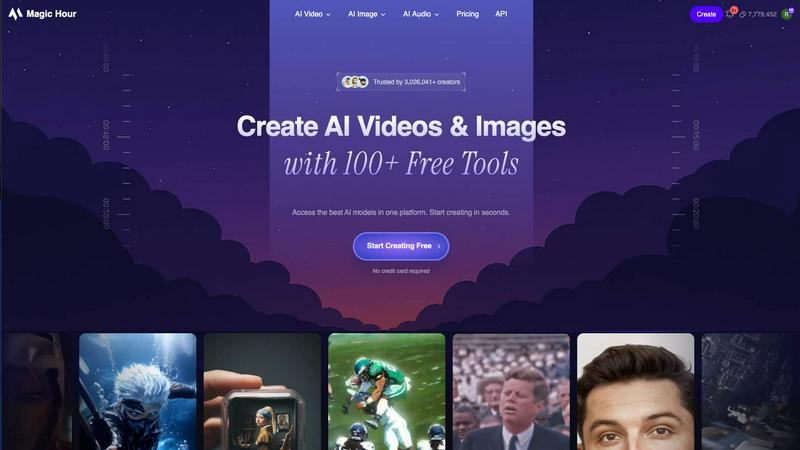
Magic Hour is a unified AI studio API for developers to integrate video, image, and audio generation into their tech.
Last updated: March 4, 2026

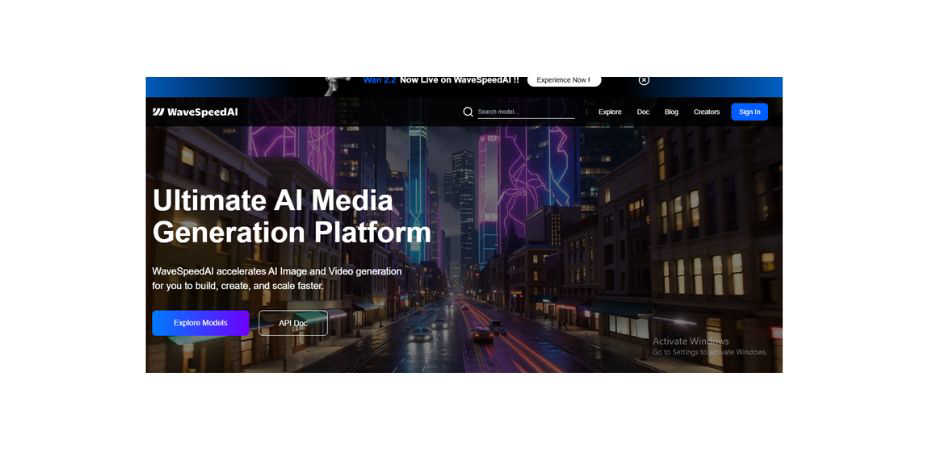
WavespeedAI is a unified API platform for seamless integration of cutting-edge AI image and video generation models.
Last updated: March 1, 2026
Visual Comparison
Magic Hour
WavespeedAI
Feature Comparison
Magic Hour
Unified AI Studio API
Magic Hour provides a single, cohesive API endpoint that grants access to its entire suite of over 100 AI tools. Developers can integrate advanced media generation capabilities like text-to-video, image-to-video, and face swapping into their own applications using drop-in SDKs for Node.js, Python, Go, and Rust. This unified API architecture simplifies the tech stack, allowing for installation, authentication, and first generation in under 60 seconds, with scalable, usage-based pricing that supports traffic from 10 to 10 million requests.
Text-to-Video & Video-to-Video Generation
The platform leverages state-of-the-art generative models to create cinematic 4K video scenes directly from text descriptions. Furthermore, its video-to-video feature allows users to apply new artistic styles and effects to existing footage. This enables rapid content variation and brand consistency, transforming source material into multiple engaging formats suitable for ads, social clips, and presentations without the need for reshoots or complex editing software.
AI-Powered Image & Audio Suite
Beyond video, Magic Hour includes a full spectrum of image and audio manipulation tools. This encompasses AI image generation and editing via text prompts, professional AI headshot generation, image upscaling, and background removal. For audio, it offers voice cloning, generation, and changing, as well as tools like lip sync to perfectly match new audio to video footage, creating a fully integrated media production environment.
Scalable Template & Asset System
Magic Hour offers a library of over 10,000 pre-designed templates that are perfectly sized for various social media channels and marketing formats. This system, combined with the AI UGC (User-Generated Content) generator and batch asset creation features, allows teams and agencies to personalize and scale content production efficiently. Users can drag, drop, and publish, enabling the rapid deployment of live campaigns and thousands of unique assets for paid media and experiential marketing.
WavespeedAI
Unified Multi-Model API Gateway
WavespeedAI provides a single, consistent RESTful API endpoint to access dozens of state-of-the-art AI models from various vendors. This eliminates the need for developers to manage multiple API keys, SDKs, and rate limits across different providers. The platform handles request routing, model versioning, and fallback strategies, ensuring high availability and optimal performance for critical generation tasks within your application's backend.
Advanced Model Orchestration & Optimization
The platform is not just an aggregator; it features proprietary optimizations for speed and quality. WavespeedAI fine-tunes and deploys models for enhanced inference performance, offering "Pro" and "Ultra" tiers for resource-intensive tasks. This technical orchestration layer allows users to select models based on specific needs—such as speed versus detail—and leverages the platform's infrastructure to deliver generation results faster than direct API calls to the source providers.
Integrated AI Toolchain for Pre & Post-Processing
Beyond core generation, WavespeedAI offers a suite of integrated AI tools essential for a complete media pipeline. This includes specialized models for object detection and segmentation (e.g., SAM3), content moderation (Molmo2), motion control, and video upscaling. This allows developers to build sophisticated, multi-stage media workflows—like generating a video, detecting objects within it, and then applying targeted edits—all within a single, compatible technical environment.
Developer-Centric Infrastructure & SDKs
Built for seamless integration, WavespeedAI offers comprehensive documentation, client SDKs, and developer tools. Features likely include detailed usage analytics, batch processing capabilities, and webhook support for asynchronous job completion. This infrastructure-centric approach ensures that engineering teams can embed powerful AI media generation into their products with minimal friction, focusing on their core application logic rather than AI infrastructure management.
Use Cases
Magic Hour
Scalable Marketing & Ad Campaigns
Marketing teams and agencies use Magic Hour to power live campaigns by generating personalized video ads and social media content at scale. The API facilitates virtual try-ons, face-swapped endorsements, and region-specific edits, driving higher engagement. The ability to quickly produce thousands of unique assets from a single template or prompt integrates directly into agile marketing tech stacks for rapid A/B testing and deployment.
Developer-Led Media Integration
Developers building content platforms, editing tools, or social apps integrate Magic Hour's API to ship advanced AI video and image features without building ML infrastructure. By calling endpoints for text-to-video or image upscaling, they can enhance their product's capabilities in minutes, offering users professional media generation powered by a reliable, scalable backend with a 99.9% uptime SLA.
Rapid Corporate & Training Content
Internal communications and L&D teams utilize Magic Hour to quickly produce consistent training videos, onboarding materials, and corporate announcements. The talking photo and lip sync tools can animate presentations, while the template system ensures brand compliance. This eliminates the cost and delay of traditional video production, allowing for easy updates and iterations directly from a web browser.
Personalized Social Media & UGC
Content creators and influencers leverage the platform's free tools to produce a high volume of engaging content. They can use face swap for humorous skits, apply video-to-video for trendy styles, generate AI headshots for professional profiles, and create animations from images. This democratizes high-production-value content creation, making it accessible without expensive software or equipment.
WavespeedAI
Scalable Content Generation for SaaS Platforms
SaaS companies in marketing, e-commerce, or social media can integrate WavespeedAI's API to offer automated visual content creation as a feature to their own users. For instance, an e-commerce platform can generate product demonstration videos or lifestyle imagery from text descriptions at scale, providing value-added services without building their own AI model training and serving infrastructure from scratch.
Rapid Prototyping and A/B Testing for Ad Agencies
Marketing and advertising teams can leverage the platform's diverse model library to rapidly produce multiple high-fidelity visual variants for campaign assets. By programmatically generating dozens of image or video ad concepts from text prompts, teams can efficiently conduct A/B testing, iterate on creative direction, and accelerate the time-to-market for digital advertising campaigns across various channels.
Enhanced Media Workflows for Game and App Developers
Game studios and mobile app developers can use WavespeedAI's toolchain for asset creation and dynamic content generation. This includes creating concept art, generating in-game character poses via motion control models, upscaling textures, or producing short narrative cutscenes. The API-driven model allows for integration into development pipelines for both pre-production and live-ops content updates.
Automated Content Moderation and Compliance
Platforms hosting user-generated content (UGC) can integrate WavespeedAI's content detection models (like Molmo2) to automatically scan and moderate uploaded images and videos. This AI-powered pre-filtering helps identify policy violations, sensitive material, or inappropriate content, assisting compliance teams and reducing the manual review burden while scaling with platform growth.
Overview
About Magic Hour
Magic Hour is a comprehensive, browser-based AI studio engineered to consolidate professional-grade media creation into a single, accessible platform. It serves as a unified tech stack for generating, editing, and enhancing videos, images, and audio, eliminating the dependency on disparate, complex software and hardware. The platform is architected for a broad user base, from solo creators and digital marketers to development teams and large-scale agencies, by providing scalable, API-driven tools. Its core value proposition lies in integrating over 100 specialized AI models—including Stable Video Diffusion, Flux, and others—into a cohesive workflow accessible via a web interface or a robust API. This allows users to initiate projects from text prompts, images, or video clips and transform them into polished, shareable content for social media, advertising, training, and more. Magic Hour is built for rapid iteration and compatibility, supporting seamless integration into existing production pipelines and enabling features like AI Face Swap, Lip Sync, and style transfer without requiring machine learning expertise.
About WavespeedAI
WavespeedAI is a comprehensive, API-first platform engineered for high-performance AI-powered media generation. It functions as a unified gateway, aggregating and optimizing a vast array of cutting-edge generative AI models from leading providers like Google, ByteDance (Seedance/Wan), Vidu, OpenAI, and Black Forest Labs (Flux). The platform is architected for developers, engineering teams, and tech-forward enterprises who require scalable, reliable, and fast integration of image and video generation capabilities into their applications and workflows. By abstracting the complexity of managing multiple model APIs, latency, and compatibility issues, WavespeedAI delivers a streamlined developer experience. Its core value proposition lies in providing a single, robust technical stack for on-demand visual content creation, significantly reducing development overhead and infrastructure costs while ensuring access to the latest model iterations and specialized tools for tasks like upscaling, editing, motion control, and content detection.
Frequently Asked Questions
Magic Hour FAQ
What is Magic Hour's primary tech stack compatibility?
Magic Hour is a cloud-native, browser-based platform with a backend built for broad compatibility. For direct integration, it offers official, well-documented SDKs for Node.js, Python, Go, and Rust. Its RESTful API can be consumed by any programming language capable of making HTTP requests, and its web studio requires only a modern browser, making it OS-agnostic for end-users.
Do I need machine learning expertise to use the API?
No, machine learning expertise is not required. Magic Hour's API is designed as a developer-friendly abstraction layer over complex AI models. You only need basic programming knowledge to install the SDK, authenticate with an API key, and make calls to endpoints like image-to-video or face-swap. The platform handles all model training, inference, and optimization on its infrastructure.
How does Magic Hour handle scalability and high traffic?
The platform is engineered for elastic scalability. It operates on a usage-based pricing model and an infrastructure designed to automatically scale with demand, supporting from 10 to over 10 million requests. Magic Hour guarantees consistent performance and offers a 99.9% uptime Service Level Agreement (SLA), making it suitable for both startups and enterprise-grade applications with fluctuating traffic loads.
Can I use Magic Hour for commercial projects?
Yes, Magic Hour is built for commercial use. Its tools and API are specifically designed to help businesses, creators, and agencies produce content for ads, social media, client work, and integrated applications. Users retain the rights to the content they generate, and the scalable plans and API pricing are structured to support commercial production at any volume.
WavespeedAI FAQ
What AI models are available on WavespeedAI?
WavespeedAI provides access to a curated and constantly updated selection of leading generative models. This includes image generation and editing models from Google (Nano Banana), Black Forest Labs (Flux), and Seedream; video generation models from ByteDance (Seedance Pro, Wan 2.6), Vidu (Q3), and Kling; as well as specialized models for upscaling, segmentation, and content moderation. The platform acts as a unified layer over these diverse technologies.
How does WavespeedAI ensure fast generation speeds?
The platform employs several technical strategies to optimize speed. This includes proprietary model optimizations, high-performance GPU infrastructure, and intelligent request routing to the most efficient endpoint. WavespeedAI also offers optimized model variants (e.g., "Turbo" or "Pro" tiers) that are fine-tuned for faster inference times compared to their base versions, which is critical for applications requiring low-latency responses.
Can I integrate WavespeedAI into my existing application backend?
Yes, integration is a core design principle. WavespeedAI offers a standard REST API with comprehensive documentation, making it compatible with any backend stack (Node.js, Python, Go, etc.). Developers can make HTTP requests directly or use available client SDKs to easily call generation, editing, and analysis functions, seamlessly weaving AI capabilities into their existing application logic and data flows.
Is WavespeedAI suitable for large-scale, enterprise-grade production use?
Absolutely. The platform is built with enterprise requirements in mind, offering features essential for production use: high availability, scalable infrastructure, consistent API performance, batch processing capabilities, and advanced tools for content safety and moderation. Its model aggregation also provides redundancy, preventing dependency on a single AI provider's uptime for business-critical creative workflows.
Alternatives
Magic Hour Alternatives
Magic Hour is a browser-based AI studio for creating professional videos and images. It consolidates a wide array of generative AI tools into a single platform, streamlining workflows for content creation, video production, and image generation. This all-in-one approach is designed for rapid iteration and accessibility directly from a web browser. Users often explore alternatives for several technical and operational reasons. These can include specific budget constraints, the need for different pricing models, or requirements for particular advanced features not covered in a consolidated suite. Platform compatibility is another key factor, as some teams may require dedicated desktop applications, specific API access for custom integrations, or tools that fit into an existing enterprise software stack. When evaluating other solutions, consider the core technology stack and its integration capabilities. Assess whether the tool offers the necessary AI model specialization, such as superior text-to-video or image upscaling engines. Also, examine its compatibility with your current workflow tools, its output format support for your distribution channels, and the scalability of its rendering and collaboration features for team environments.
WavespeedAI Alternatives
WavespeedAI is a high-speed AI image and video generation platform designed for professionals. It operates in the AI-powered creative tool category, focusing on rapid visual content creation for marketing, social media, and web use. Users leverage its generative models to streamline workflows and produce branded media efficiently. Teams often evaluate alternatives to find a solution that better aligns with their specific tech stack, budget, or feature requirements. Common drivers include integration needs with existing project management or CMS platforms, API availability for custom development, and granular control over output formats and resolutions for different deployment environments. When assessing other platforms, prioritize technical compatibility. Key considerations include the tool's API robustness for automation, support for common frameworks and export standards, and the ability to embed generated assets directly into your development pipeline. The ideal alternative should not only match core generative capabilities but also integrate seamlessly into your established workflow architecture.