
Analook
Analook delivers free competitor intelligence by analyzing any URL across SEO, traffic, social, and growth data in 60 seconds.
Visit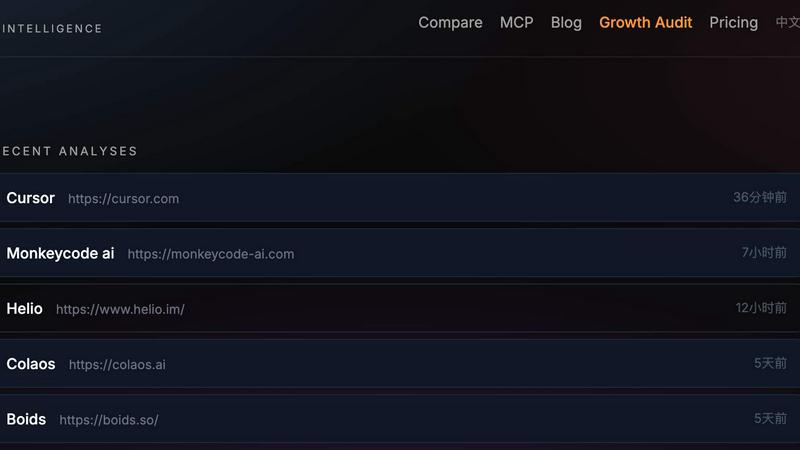
About Analook
Analook is a competitive intelligence tool designed for SaaS founders, growth consultants, and indie hackers who need rapid, data-driven insights into their competitors without the high cost of traditional enterprise platforms. The core functionality is straightforward: enter a competitor's URL, and within 60 seconds, Analook generates a comprehensive report by aggregating data from over 15 real-time sources. This eliminates the need for manual research across multiple platforms and the expense of tools like Ahrefs, which starts at $129 per month, or enterprise solutions like Crayon, which can cost $1,500 per month. The product's main value proposition is speed, affordability, and depth of analysis. It reads a competitor's entire web presence, pulling in SEO keywords and traffic estimates via DataForSEO, social media activity from Twitter, GitHub, Reddit, and YouTube, historical data from Product Hunt launches, Google Trends peaks, and the Wayback Machine for positioning evolution. It also analyzes pricing structures and delivers an AI-powered strategic verdict that identifies growth patterns. Built by Iris Wei, co-founder of AFFiNE (a project with over 60,000 GitHub stars and 30 Product Hunt #1 wins), Analook is part of the Gingiris suite of growth tools for founders. The product is available as a web application, a REST API, and a remote MCP server for integration with AI agents like Claude Desktop and Cursor, making it a versatile component in a modern tech stack.
Features of Analook
Multi-Source Data Aggregation
Analook does not rely on a single data point. Instead, it runs parallel queries across 15+ distinct data sources to build a holistic view of a competitor. This includes DataForSEO for organic search keywords and traffic estimates, the Wayback Machine for historical website positioning, social platforms like Twitter, GitHub, Reddit, and YouTube for community engagement, and the Product Hunt API for launch performance. Google Trends data is also integrated to identify search interest peaks. The result is a report where every number is sourced and verifiable, eliminating the hallucinations common in purely generative AI tools. This feature ensures that users get a fact-based, comprehensive picture of a competitor's digital footprint.
AI-Powered Strategic Verdict and Growth Patterns
Beyond raw data aggregation, Analook applies a proprietary AI engine to synthesize the collected information into actionable intelligence. The report includes a "Strategy Radar" score, a quantitative benchmark out of 100 that measures a competitor's overall strategic strength. The AI also delivers a written verdict that identifies specific growth patterns, such as reliance on organic SEO, community-driven adoption, or paid acquisition. This transforms a collection of metrics into a clear, strategic narrative, helping users understand not just what a competitor is doing, but why it is working and how they can counter or replicate that success.
Pricing Structure Analysis
Understanding a competitor's monetization strategy is critical for positioning. Analook automatically identifies and analyzes a competitor's pricing structure directly from their website. It surfaces the pricing model (e.g., freemium, usage-based, per-seat), the specific tiers offered, and the price points. This feature provides a direct comparison point for users to benchmark their own pricing, identify gaps in the market, or understand how a competitor is segmenting their customer base. It removes the manual effort of scouring pricing pages and comparing plans across different companies.
MCP Server and REST API Integration
Analook is built for the modern AI agent ecosystem. It is available as a remote MCP (Model Context Protocol) server, which allows it to be seamlessly integrated into AI-powered desktop environments like Claude Desktop and Cursor. Users can trigger a full competitive intelligence report with a single tool call. For developers and technical teams, a REST API is also available, enabling programmatic access. A simple curl command can return the entire report as structured JSON, making it easy to pipe competitive data into internal dashboards, CRM systems, or custom analysis workflows. This focus on integration and compatibility sets it apart as a tool that works with a user's existing tech stack.
Use Cases of Analook
Competitive Benchmarking for Product Strategy
A product manager at a Series A startup needs to understand how their direct competitor, Cursor, is positioned. Using Analook, they paste the cursor.com URL and receive a report showing an estimated 368,000 organic search visits per month, an "accidental SEO" strategy driven by the product name, and a usage-based pricing model. The AI verdict identifies a growth pattern heavily reliant on developer word-of-mouth. This allows the product manager to benchmark their own traffic and strategy, identify that the competitor has a strong brand moat, and decide to focus on a different acquisition channel, such as building a community on GitHub.
Growth Audit for Marketing Teams
A growth consultant is hired to audit a client's go-to-market strategy against a key competitor, Linear. The consultant uses Analook to analyze linear.app. The report reveals 52,000 estimated organic search visits per month, a product-led growth strategy with minimal SEO investment, and a brand moat built around the term "Linear" itself. The consultant can then advise the client to avoid competing on the same brand terms and instead target long-tail keywords related to project management workflows that Linear is not optimizing for. The report provides the concrete data needed to justify this strategic pivot.
Investment Due Diligence
An angel investor is evaluating a potential portfolio company that claims to be disrupting the scheduling space, competing with Cal.com. The investor uses Analook to run a report on cal.com. The report shows 41,000 GitHub stars, a Strategy Radar score of 50 out of 100, and a strong open-source community. The investor can use this data to verify the startup's claims about market traction and competitive positioning. The AI verdict helps the investor understand the competitive landscape, identifying Cal.com's reliance on its open-source community as a key strength and a potential moat that the startup will need to overcome.
Real-Time Competitive Monitoring for Indie Hackers
An indie hacker is building a new AI coding tool and wants to monitor their primary competitor, Cursor, on a regular basis. With Analook's Pro plan offering 30 reports per month, they can run a report on cursor.com weekly. They track changes in estimated traffic, social media sentiment on Twitter and Reddit, and any shifts in the pricing structure. If the AI verdict identifies a new growth pattern, such as a sudden increase in paid search ads, the indie hacker can quickly adapt their own marketing strategy. This continuous monitoring capability, available at a low monthly cost, was previously only accessible to teams with large budgets for enterprise CI tools.
Frequently Asked Questions
How does Analook compare to using Ahrefs or SimilarWeb for competitive analysis?
Analook is designed to be a faster, more affordable, and more focused alternative for competitive intelligence. While Ahrefs is a powerful all-in-one SEO toolset starting at $129/month, it requires significant expertise to use for competitive analysis and does not provide a synthesized strategic verdict. SimilarWeb offers traffic estimates but lacks deep integration with sources like GitHub, Product Hunt, and pricing pages. Analook combines data from over 15 sources, including these niche platforms, and uses AI to generate a single, actionable report in 60 seconds. It is purpose-built for founders and consultants who need a quick, comprehensive overview without the complexity or cost of enterprise tools.
What data sources does Analook use and is the data reliable?
Analook aggregates data from 15+ real-time sources to ensure accuracy and depth. These include DataForSEO for organic traffic and keyword estimates, the Wayback Machine for historical website analysis, social media APIs for Twitter, GitHub, Reddit, and YouTube, the Product Hunt API for launch history, and Google Trends for search interest. The product explicitly states that there are "no hallucinations" and that every number in the report is sourced. This means the AI-generated verdict is based on verified data points, not on a language model's unverified knowledge, making the reports reliable for strategic decision-making.
Can I integrate Analook with my existing tools like Claude Desktop or Cursor?
Yes. Analook is built with integration in mind and is available as a remote MCP (Model Context Protocol) server. This allows users of AI-powered desktop environments like Claude Desktop and Cursor to call Analook directly from their agent. A single MCP tool call will return the full competitive intelligence report as structured JSON. For developers, a standard REST API is also available, allowing the same functionality to be integrated into custom applications, dashboards, or automated workflows via a simple curl command.
Is there a free trial and what are the pricing plans?
Yes, Analook offers a free tier that provides 2 reports per month with no credit card required. This allows users to test the tool and see the depth of analysis before committing. For users who need more frequent insights, the Pro plan is priced at $29 per month and includes 30 reports. This pricing model is significantly more accessible than traditional competitive intelligence tools like Crayon (starting at $1,500/month) or all-in-one SEO platforms like Ahrefs ($129+/month), making it ideal for startups, indie hackers, and growth consultants with limited budgets.
Pricing of Analook
Analook offers a straightforward, usage-based pricing model with two main tiers. The Free tier provides 2 reports per month and requires no credit card, allowing users to evaluate the product's capabilities without any financial commitment. The Pro tier is priced at $29 per month and includes 30 reports, suitable for regular competitive monitoring. For developers and power users, the REST API and MCP server are available with the Pro plan, enabling integration into custom workflows and AI agents. This pricing is a fraction of the cost of traditional enterprise competitive intelligence tools like Crayon ($1,500/month) or all-in-one SEO platforms like Ahrefs ($129+/month).
Similar to Analook

AI SEO platform for keyword research, content briefs, writing, grading, optimization and publishing.

Research keywords, competitors, backlinks and AI visibility inside Claude or Codex, with findings saved to your SEO dashboard.


Independent Kling AI video generator for Kling 3.0, Motion Control, Lip Sync, and API workflows.

A directory of launch platforms: who each accepts, what disqualifies you, and how to submit. Free to read, and your agent can do the submitting.


