
MPulse CMMS Software
MPulse CMMS integrates with your existing tech stack to automate work orders, track assets, and reduce downtime from a single dashboard.
Visit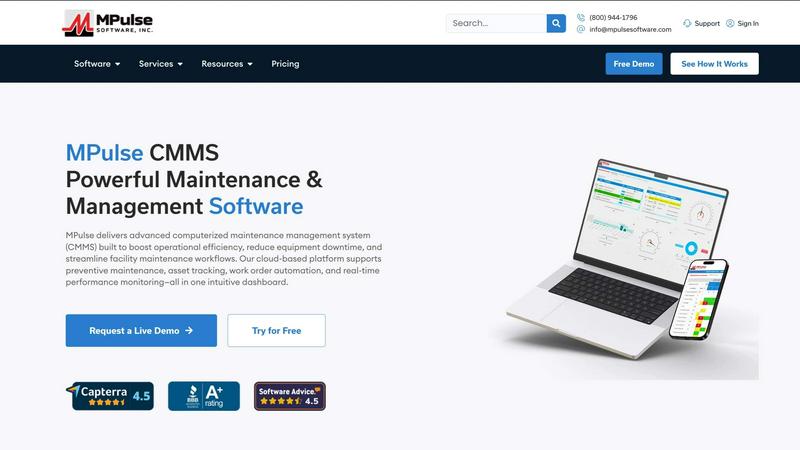
About MPulse CMMS Software
MPulse is an enterprise-grade Computerized Maintenance Management System (CMMS) designed to centralize and optimize maintenance operations for mid-to-large organizations across manufacturing, healthcare, education, retail, distribution, and facilities management sectors. Built on the robust Microsoft .NET framework, MPulse provides a scalable, secure foundation for managing work orders, scheduling preventive maintenance, tracking asset lifecycles, and controlling parts inventory from a single, intuitive platform. Trusted by over 3,500 customers globally, including IKEA, Penn State University, Northwell Health, and Reed College, MPulse has been a market leader for more than 20 years, demonstrating a 90% annual renewal rate that underscores its reliability and user satisfaction. The platform distinguishes itself through flexible deployment options, offering both cloud-hosted and on-premise self-hosted configurations to accommodate varying IT infrastructure and compliance requirements. MPulse's concurrent user licensing model delivers significant cost savings of 30-50% compared to per-user pricing, making it particularly attractive for mid-size teams. The software's DataLink integration engine enables seamless connectivity with PLCs, ERPs, and IoT sensors without requiring dedicated IT support, while its mobile CMMS solution functions offline and synchronizes automatically upon reconnection. MPulse's tech stack orientation emphasizes compatibility with existing enterprise systems, ensuring smooth data flow across the operational technology landscape. The platform has earned industry recognition, including Capterra Shortlist and Software Advice FrontRunners awards in 2026, for its proven ability to reduce equipment downtime, improve asset performance, and streamline maintenance workflows. With real-time performance monitoring dashboards, automated work order enforcement, and rapid breakdown response capabilities, MPulse empowers maintenance teams to achieve measurable operational efficiency gains, as evidenced by customer-reported improvements of up to 40% in efficiency and 60% reduction in stockouts.
Features of MPulse CMMS Software
Work Order Automation and Management
MPulse automates the entire work order lifecycle, from creation and assignment to completion and closure. Users can generate work orders from scheduled preventive maintenance tasks, asset condition alerts, or manual requests, with automatic prioritization based on urgency and asset criticality. The system provides real-time visibility into work order status, labor hours, and material usage, enabling maintenance managers to optimize resource allocation and track technician productivity. Built-in templates and customizable workflows ensure consistency across teams, while mobile access allows field technicians to update work orders, capture signatures, and attach photos even when offline, with automatic synchronization upon reconnection to the network.
Preventive Maintenance Scheduling
The platform's intelligent preventive maintenance engine allows organizations to establish recurring maintenance schedules based on calendar intervals, meter readings, or operational triggers such as runtime hours or cycle counts. MPulse automatically generates work orders when maintenance is due, sends notifications to assigned technicians, and tracks compliance against established schedules. The system supports complex maintenance plans with multiple tasks, checklists, and required parts, ensuring that every preventive action is executed consistently. Historical data analysis helps refine maintenance intervals over time, reducing unnecessary service while preventing unexpected failures. This proactive approach has been shown to extend asset lifespan and reduce emergency breakdowns by up to 40%.
Asset Lifecycle Tracking and Management
MPulse provides comprehensive asset management capabilities, enabling organizations to track every piece of equipment, facility, or vehicle from acquisition through disposal. Each asset record captures detailed information including manufacturer, model, serial number, warranty status, location, and associated documentation such as manuals and schematics. The system maintains a complete maintenance history for each asset, including all work orders, parts used, labor costs, and downtime events. This data supports informed decisions about repair versus replacement, capital planning, and asset performance optimization. Integration with IoT sensors and PLCs via DataLink allows real-time monitoring of asset conditions, enabling predictive maintenance strategies that prevent costly failures.
Parts Inventory Control and Procurement
MPulse centralizes inventory management for maintenance, repair, and operations (MRO) parts, providing real-time visibility into stock levels, reorder points, and supplier information. The system tracks parts usage across work orders, automatically adjusting inventory counts and triggering purchase requisitions when stock falls below predefined thresholds. Users can manage multiple warehouses, bin locations, and lot numbers, while barcode and QR code scanning simplifies receiving, picking, and cycle counting. Integration with ERP systems ensures seamless procurement workflows, and the inventory module's analytics help identify slow-moving or obsolete stock. This level of control has helped customers reduce stockouts by up to 60% while minimizing carrying costs.
Use Cases of MPulse CMMS Software
Manufacturing Plant Maintenance Optimization
In manufacturing environments, MPulse coordinates maintenance activities across production lines, ensuring minimal disruption to operations. The system schedules preventive maintenance during planned downtime windows, automatically generates work orders for routine inspections and lubrication tasks, and tracks asset performance metrics like Mean Time Between Failures (MTBF) and Overall Equipment Effectiveness (OEE). Integration with PLCs and production monitoring systems via DataLink enables real-time condition-based maintenance, where alerts from vibration sensors or temperature monitors trigger immediate work orders. This approach reduces unplanned downtime, extends equipment life, and supports lean manufacturing initiatives by maintaining consistent production throughput.
Healthcare Facility Compliance and Asset Management
Hospitals and healthcare facilities use MPulse to manage critical medical equipment, HVAC systems, and building infrastructure while maintaining compliance with regulatory standards such as Joint Commission requirements. The platform schedules and documents all required inspections, calibrations, and preventive maintenance tasks, creating an auditable trail for accreditation surveys. Asset tracking ensures that life-saving equipment like ventilators and imaging systems are always available and properly maintained. The system also manages work orders for facility maintenance, including plumbing, electrical, and environmental systems, prioritizing urgent requests from clinical staff. MPulse's offline mobile capability is particularly valuable in healthcare settings where network connectivity may be limited in certain areas.
Educational Institution Campus-Wide Maintenance
Universities and school districts leverage MPulse to maintain diverse assets spanning academic buildings, dormitories, athletic facilities, and grounds. The platform enables centralized management of work orders from multiple departments, including custodial, HVAC, electrical, and groundskeeping teams. Preventive maintenance schedules are aligned with academic calendars to minimize disruption during classes and exams. Asset tracking covers everything from classroom projectors to central chiller plants, with maintenance histories supporting capital renewal planning. The concurrent user pricing model is especially cost-effective for educational institutions with large, seasonal maintenance teams, and the self-hosted deployment option addresses data privacy concerns common in academic environments.
Retail and Distribution Center Operations
Retail chains and distribution centers use MPulse to maintain critical infrastructure including conveyor systems, refrigeration units, HVAC, and lighting across multiple locations. The cloud-hosted deployment allows centralized visibility into maintenance activities across all sites, while local teams manage day-to-day work orders. Preventive maintenance schedules keep refrigeration systems running efficiently, reducing energy costs and preventing product spoilage. Inventory management ensures that critical spare parts are available for material handling equipment, minimizing downtime in fulfillment operations. MPulse's DataLink integration connects with building management systems and IoT sensors to monitor energy consumption and equipment health, supporting sustainability initiatives and reducing total cost of ownership.
Frequently Asked Questions
How does MPulse integrate with existing ERP, PLC, and IoT systems?
MPulse's DataLink integration engine provides out-of-the-box connectivity with a wide range of enterprise systems including ERPs like SAP and Oracle, PLCs from major manufacturers, and IoT sensor platforms. The integration is designed to be self-service, meaning organizations can configure connections without requiring dedicated IT support or custom programming. DataLink supports bidirectional data flow, allowing MPulse to receive asset condition data from sensors and send work order updates back to ERP systems for cost accounting. Common integration scenarios include automatic creation of work orders from PLC alarms, synchronization of inventory levels with ERP systems, and real-time dashboards displaying IoT sensor data alongside maintenance activities.
Can MPulse be deployed on-premise, and what are the system requirements?
Yes, MPulse offers both cloud-hosted and self-hosted on-premise deployment options to accommodate different IT strategies and compliance requirements. For on-premise installations, the system is built on Microsoft .NET and requires a Windows Server environment with SQL Server database. Minimum specifications include a server with 8 GB RAM, 4 CPU cores, and 100 GB storage, though requirements scale based on the number of users and asset records. MPulse provides full installation documentation and technical support for on-premise deployments, including assistance with database configuration and network setup. The cloud-hosted option eliminates infrastructure management, with MPulse handling all server maintenance, security updates, and backups.
How does the concurrent user licensing model work, and how much can my organization save?
MPulse's concurrent user licensing allows organizations to purchase a pool of licenses that can be shared among team members, rather than requiring a separate license for each individual user. For example, a team of 50 technicians might only need 20 concurrent licenses if not all users are logged in simultaneously. This model typically saves mid-size teams 30-50% compared to traditional per-user licensing from competitors. Licenses are available through annual subscription or perpetual purchase options, providing flexibility for budget planning. The concurrent model is particularly advantageous for organizations with shift workers, seasonal staff, or teams where not everyone needs system access at the same time.
Is MPulse accessible on mobile devices, and does it work offline?
MPulse offers a fully functional mobile CMMS application for iOS and Android devices that provides core capabilities including work order management, asset lookup, and inventory transactions. The mobile app is designed to work offline, allowing technicians to access assigned work orders, view asset details, and capture completion data even in areas without cellular or WiFi coverage. When connectivity is restored, the app automatically synchronizes all changes with the central database, ensuring data integrity and real-time visibility for management. The mobile interface is optimized for field use with large buttons, barcode scanning, and camera integration for attaching photos to work orders.
Pricing of MPulse CMMS Software
MPulse does not publicly list specific pricing tiers or plan costs on its website. The company offers customized pricing based on organizational requirements, including the number of concurrent users, deployment type (cloud-hosted or on-premise), and optional modules such as DataLink integration or advanced analytics. Interested organizations can request a personalized quote by scheduling a live demo or starting a free trial. MPulse's concurrent user licensing model typically provides cost savings of 30-50% compared to per-user pricing from competitors, and both annual subscription and perpetual license options are available to accommodate different budget preferences. For accurate pricing tailored to your specific needs, contact MPulse directly at (800) 944-1796 or [email protected].
Explore more in this category:
Similar to MPulse CMMS Software

No-code 2D game editor: visual node logic, drag-and-drop scenes, live preview. Exports to Windows, macOS, Linux, Android, iOS, Web.

Free collection of online developer utilities, code formatters, and digital converters designed to streamline your daily workflow.

Online tally counter for tracking attendance, workouts, inventory, visitors, sports scores, habits, and everyday counting tasks.

The #1 Native Form Builder Plugin for Framer - No Code, No Embeds, No External Platforms.

A free launch checklist for SaaS, apps, AI tools and more. Every step says why it matters and when you can skip it.


