
Interactive Circle of Fifths vs PseudoRun
Side-by-side comparison to help you choose the right product.

Interactive Circle of Fifths
Integrate the Circle of Fifths into your DAW for real-time harmonic analysis and chord progression generation.
Last updated: March 1, 2026

PseudoRun
PseudoRun is the free, ad-free IGCSE pseudocode editor with real-time validation and debugging.
Last updated: March 1, 2026
Visual Comparison
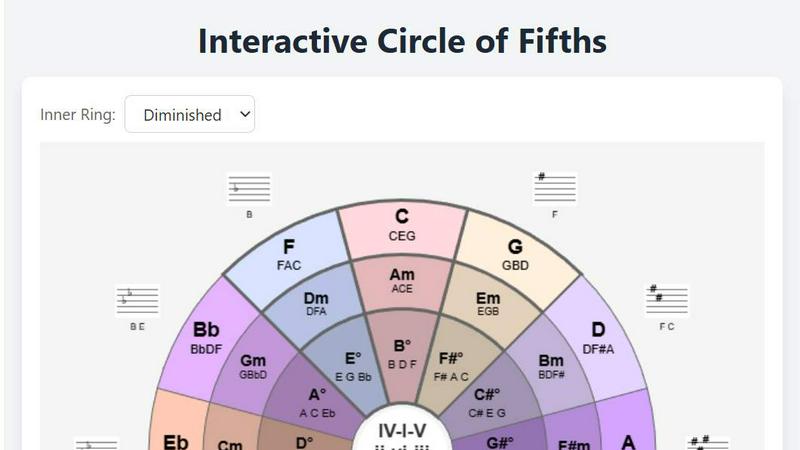
Interactive Circle of Fifths
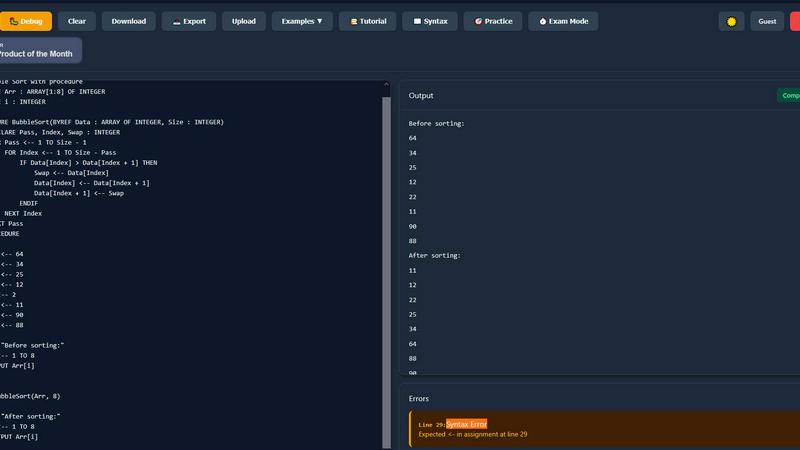
PseudoRun
Feature Comparison
Interactive Circle of Fifths
Dynamic Multi-Scale Visualization Engine
This feature powers the central interactive diagram, allowing users to dynamically switch between viewing the Circle of Fifths for different musical scales. With a simple interface toggle, musicians can visualize the structure and relationships for Pentatonic, Blues, Diatonic, and Diminished scales. The engine updates chord positions and relationships in real-time, providing a clear, color-coded map of harmonic function and scale degrees, which is essential for understanding modal interchange and advanced composition techniques.
Integrated Chord Sequencer & Harmonized Scale Panel
The tool includes a built-in chord sequencer linked directly to the harmonized scale panel. Users can select a root key (e.g., C) and instantly see the corresponding diatonic chords (C, Dm, Em, F, G, Am, B°) alongside their Roman numeral functions (I, ii, iii, IV, V, vi, vii°). This integration allows for the direct auditioning of chord progressions and an understanding of their functional resolution, effectively acting as a sandbox for testing songwriting ideas and understanding cadences.
Dual-Instrument Fretboard & Keyboard Integration
For maximum utility and compatibility, the platform features synchronized visual layouts for both piano keyboard and guitar fretboard. When a user selects a chord or scale, the tool displays the precise notes and fingerings on both instruments simultaneously. This cross-compatibility feature is invaluable for multi-instrumentalists, educators teaching diverse students, and for translating musical ideas between different instrumental contexts seamlessly.
Analytical Function & Resolution Mapping
Beyond basic visualization, this feature provides deep analytical insights. For any selected chord, it displays its "Scale Degree" and suggests what it "Resolves To" within the key's harmonic framework. This transforms the tool from a passive reference into an active theory guide, helping users understand tension and release, dominant-to-tonic movements, and the logical flow of chord progressions in real-time, which is critical for improvisation and analysis.
PseudoRun
IGCSE-Specification Compliant Editor
The editor is the cornerstone of PseudoRun, built to strictly adhere to the syntax and conventions of the Cambridge IGCSE pseudocode standard. It provides syntax highlighting, auto-indentation, and intelligent code completion tailored specifically for IGCSE constructs like DECLARE, CASE...OF, and REPEAT...UNTIL. This ensures that students practice and write code exactly as required in their examinations, preventing the formation of bad habits from using generic programming language syntax.
Real-Time Validation & Error Detection
Integrated directly into the editing environment, this feature performs continuous static analysis on the pseudocode. It instantly flags syntax errors, undefined variables, and logical inconsistencies specific to the IGCSE pseudocode specification. This immediate feedback loop allows for on-the-fly correction and learning, significantly reducing debugging time and helping students understand the precise rules of the pseudocode language before they run their programs.
Interactive Step-by-Step Debugger
This advanced tool allows users to execute their pseudocode line-by-line, providing deep visibility into the program's state. It features a call stack viewer, variable tracker that updates in real-time, and control flow visualization. This granular level of inspection is critical for understanding complex algorithms involving loops, conditionals, and procedures, enabling students to deconstruct and comprehend the exact sequence of operations and data changes.
Integrated IGCSE Practice Library & Exam Mode
PseudoRun includes a comprehensive, cloud-accessible repository of 50+ curated practice problems and examples that mirror IGCSE exam patterns. Coupled with an "Exam Mode" timer, this feature creates a simulated exam environment. Students can practice solving problems under timed conditions, building both speed and confidence, while all their work is automatically saved to their free cloud account for review across any compatible device.
Use Cases
Interactive Circle of Fifths
Music Theory Education & Classroom Integration
Educators can integrate this web-based tool directly into their curriculum, using it as a live demonstration platform during lessons. Its interactive nature allows for instant exploration of concepts like the relationship between relative majors and minors, chord construction, and scale modes, making abstract theory tangible and engaging for students in both in-person and remote learning environments.
Songwriting & Chord Progression Development
Songwriters and composers can use the Chord Sequencer and harmonized scale panel to break out of creative blocks. By experimenting with different diatonic and non-diatonic chords suggested by the Circle, users can quickly audition novel progressions, understand their functional harmony, and export these ideas to their preferred Digital Audio Workstation (DAW) for further development.
Instrument-Specific Practice & Transcription
Guitarists and pianists can utilize the dual-instrument display for targeted practice. A guitarist learning piano theory can see how the chords they know on the fretboard map onto the keyboard, and vice versa. This is also perfect for transcribing music, as identifying a song's key on the Circle immediately reveals the likely chords used, accelerating the learning process.
Improvisation & Solo Construction
Improvisers can select a backing track's key and then use the tool to visualize all available scales (e.g., major, pentatonic, blues) that fit over the harmony. The clear overlay of scale notes on the fretboard/keyboard, combined with the "Resolves To" function for chords, provides a roadmap for crafting melodically and harmonically coherent solos in real-time.
PseudoRun
Independent IGCSE Exam Preparation
Students can use PseudoRun as a primary study tool to independently practice past paper algorithms and textbook exercises. The platform's spec-aligned editor and instant feedback allow for self-directed learning, enabling students to identify weaknesses, practice efficiently, and track their progress through saved programs in their personal cloud storage, all tailored to the IGCSE syllabus.
Classroom Teaching & Live Demonstration
Educators can integrate PseudoRun into their lessons for live coding demonstrations. The step-by-step debugger is perfect for visually deconstructing algorithms on a projector, showing variable states and flow control in real-time. Teachers can also create and share problem sets with students, leveraging the platform to provide a standardized, accessible practice environment for the entire class.
Algorithm Design & Prototyping
Beyond rote practice, students and learners can use PseudoRun as a sandbox for designing and testing their own algorithms. The ability to quickly write, run, and debug pseudocode without setup overhead makes it an ideal tool for prototyping logic before potentially translating it into an actual programming language for coursework or projects.
Revision & Conceptual Reinforcement
In the lead-up to exams, students can utilize the platform for focused revision. They can re-run their saved programs, use the debugger to step through tricky algorithms they previously wrote, and tackle new problems from the practice library under timed "Exam Mode" conditions to reinforce concepts and improve time management skills.
Overview
About Interactive Circle of Fifths
The Interactive Circle of Fifths is a sophisticated, web-based educational platform engineered for musicians, producers, and educators. It functions as a dynamic, real-time music theory visualization and auditory tool, designed to demystify the complex relationships between keys, chords, and scales. Built for seamless integration into modern digital music workflows, it caters to users across the proficiency spectrum—from beginners grasping foundational concepts to advanced composers exploring sophisticated harmonic progressions. Its core value proposition lies in translating abstract music theory into an interactive, multi-sensory experience. By providing immediate visual feedback and corresponding audio playback, the tool bridges the gap between theoretical knowledge and practical application. The platform's architecture supports dual-instrument visualization for piano and guitar, ensuring broad compatibility with common learning and performance setups. It serves as a centralized hub for exploring major, minor, and diminished chords, alongside a comprehensive library of scales including pentatonic, blues, diatonic, and harmonized scales, making it an indispensable, always-accessible resource for serious musical study and creativity.
About PseudoRun
PseudoRun is a purpose-built, browser-based platform engineered to provide a seamless and integrated environment for mastering IGCSE Computer Science pseudocode. It functions as a comprehensive editor, simulator, and debugger, specifically architected to align with the Cambridge IGCSE pseudocode specification. The platform's core value proposition lies in its ability to bridge the gap between theoretical algorithm design and practical execution, eliminating the dependency on traditional, complex programming language setups. Its tech stack is designed for universal compatibility, running entirely in modern web browsers, which ensures immediate accessibility from any device without installation. The primary user base comprises IGCSE students, educators, and self-learners seeking a focused tool for exam preparation. By offering real-time code validation, step-by-step execution, and a vast library of IGCSE-aligned practice problems, PseudoRun provides a structured and distraction-free ecosystem that directly translates algorithmic thinking into exam-ready skills. Its commitment to a zero-ad, fully-featured free model further ensures an uninterrupted learning experience, making it an indispensable tool in the IGCSE Computer Science tech stack.
Frequently Asked Questions
Interactive Circle of Fifths FAQ
What instruments is the Interactive Circle of Fifths compatible with?
The tool is primarily designed as a visual and theoretical aid compatible with all instruments. However, it provides specific, integrated fingering diagrams for two of the most common instruments: piano (keyboard) and guitar (fretboard). This allows users of these instruments to directly apply the theoretical concepts to their physical playing, making the learning process highly practical and immediately applicable.
Can I use this tool to help me write music in non-standard keys?
Absolutely. The core functionality of the Interactive Circle of Fifths is not limited to common keys. You can select any root note as your tonal center. The engine will dynamically recalculate and display all corresponding chords, scale degrees, and harmonized scales for that key, whether it's C major, F# minor, or any other, providing full flexibility for composition in any key signature.
How does the "Resolves To" function work?
The "Resolves To" function is an analytical feature based on Western music theory conventions. It indicates the typical harmonic tendency of a chord within a given key. For example, the dominant chord (V) strongly "resolves to" the tonic (I). This feature helps users understand cadences and the natural directional flow of harmony, which is fundamental for creating satisfying progressions and for analytical study.
Is there an audio output feature to hear the chords and scales?
Yes, a core component of the tool is its integrated audio engine. When you click on any chord or scale within the interface, it generates a clear, synthesized audio playback of that musical element. This auditory feedback is crucial for connecting visual theory with sound, reinforcing learning, and enabling users to train their ears alongside their theoretical understanding.
PseudoRun FAQ
Is PseudoRun really free with no hidden costs?
Yes, absolutely. PseudoRun operates on a promise of being completely free, with zero advertisements and no premium paywalls. All features, including the IGCSE editor, debugger, cloud storage, and practice library, are available at no cost. The platform is sustained by community support, not user fees.
How does PseudoRun ensure compatibility with the IGCSE exam?
The platform's core parsing engine and syntax definitions are built exclusively around the official Cambridge IGCSE Computer Science pseudocode specification. The editor, error checks, and example problems are all designed to mirror the language and patterns used in past papers and syllabus materials, ensuring direct exam relevance.
Do I need to install any software or create an account?
No installation is required. PseudoRun is a web-based application that runs directly in your browser. While you can use many features immediately without an account, creating a free account is recommended to unlock cloud storage, allowing you to save and access your programs from any device seamlessly.
Can I use PseudoRun on a tablet or smartphone?
Yes, PseudoRun is built with a responsive design, making it compatible with tablets and larger smartphones. The interface adapts to different screen sizes, allowing you to write, edit, and run pseudocode on the go, although a physical keyboard is generally recommended for extensive coding sessions.
Alternatives
Interactive Circle of Fifths Alternatives
The Interactive Circle of Fifths is a web-based music theory application in the Education & Learning category. It functions as a dynamic, interactive tool that helps musicians visualize chord relationships, explore scales, and sequence progressions through an integrated audio-visual interface. Users often seek alternatives for several technical and practical reasons. These can include specific platform compatibility needs, such as a native desktop or mobile app versus a web app, or integration requirements with existing Digital Audio Workstation (DAW) environments. Other considerations are feature depth in niche areas like microtonal theory, preferred subscription or one-time pricing models, and the desire for open-source or self-hosted solutions to ensure long-term access and data control. When evaluating an alternative, prioritize its tech stack and API availability for potential custom workflows. Assess its cross-platform support, including browser compatibility, mobile responsiveness, and offline functionality. Finally, examine the depth of its educational content delivery system and how well its feature set—like visualizers, sequencers, and scale libraries—integrates into your personal or professional creative pipeline.
PseudoRun Alternatives
PseudoRun is a specialized online IDE and learning platform within the educational technology category, designed explicitly for mastering IGCSE Computer Science pseudocode. It provides a focused environment with real-time validation and debugging tailored to the Cambridge syllabus. Users often explore alternatives for various reasons, including specific feature requirements, the need for offline functionality, or integration with a broader tech stack like local IDEs or learning management systems. Some may seek platforms that support additional programming languages beyond the strict IGCSE pseudocode specification. When evaluating an alternative, key considerations include its compatibility with the official IGCSE pseudocode syntax, the robustness of its debugging and execution engine, and data portability. The ideal platform should offer seamless integration into a student's or educator's existing workflow, providing reliable performance without vendor lock-in for saved projects.