
Rankai vs SERPView
Side-by-side comparison to help you choose the right product.
Rankai
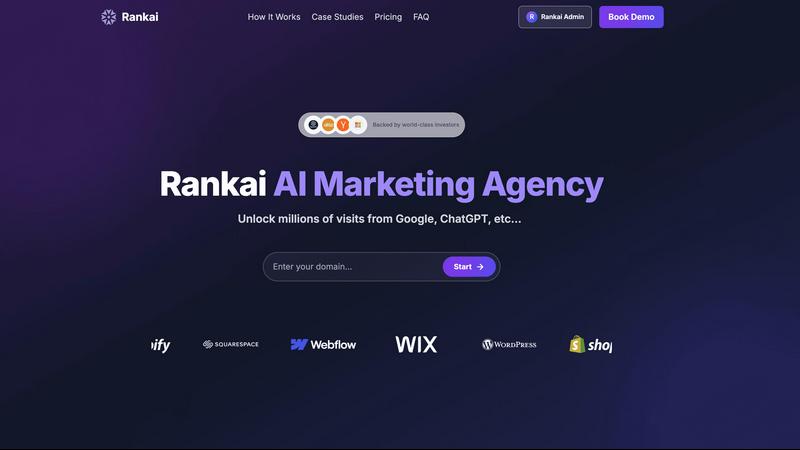
Rankai integrates AI with expert SEO to autonomously drive organic traffic from Google and AI search.
Last updated: February 28, 2026

SERPView
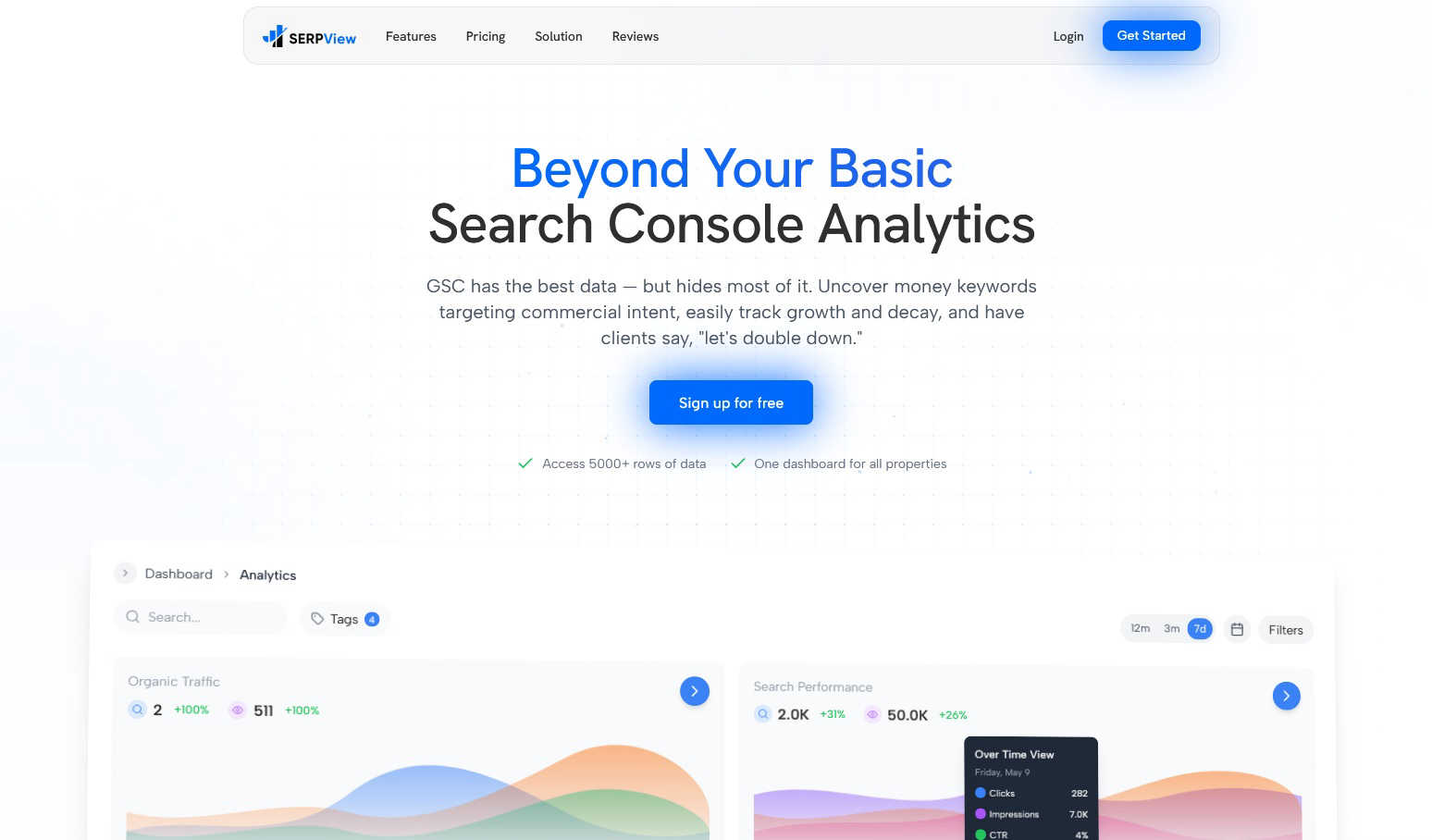
SERPView integrates with Google Search Console to unlock hidden SEO data and advanced analytics.
Last updated: March 1, 2026
Visual Comparison
Rankai
SERPView
Feature Comparison
Rankai
AI-Powered Keyword & Competitor Research
Rankai's engine conducts deep, data-backed research by analyzing a database of billions of keywords to identify high-impact, revenue-driving search terms. It goes beyond vanity metrics to uncover opportunities your competitors overlook. The system evaluates search trends monthly, ensuring your targeting strategy adapts to market shifts. This feature integrates directly with your analytics stack, providing a continuously updated foundation for content strategy that is vetted by human experts for maximum competitive edge.
High-Volume, Optimized Content Generation
The platform automates the creation of a high volume of SEO and GEO-optimized content pages. Each piece is research-backed and structured with proper schema markup, metadata, internal linking, and CTAs for both traditional search crawlers and large language models (LLMs). This tech-stack approach enables the rapid deployment of quality content at scale, accelerating visibility and compounding organic traffic growth directly to your connected CMS or e-commerce platform.
Generative Engine Optimization (GEO)
Rankai uniquely optimizes content for AI-powered search platforms like ChatGPT, Gemini, and Perplexity. It implements AI-optimized schema and clear citation structures, making your content more easily retrieved and cited by LLMs. The platform includes AI visibility tracking, allowing you to monitor brand mentions within AI engines. Its architecture is designed for continuous adaptation, automatically updating content strategies as LLM algorithms and outputs evolve.
Performance-Driven Automatic Rewriting
The system employs a closed-loop optimization process where every published page is monitored for ranking and traffic performance. Pages that underperform after a set period are automatically flagged for a complete rewrite. Rankai doesn't just tweak copy; it triggers fresh research and rebuilds content from new angles. This ensures that the content stack continuously improves, driving proven outcomes and maximizing the ROI of every asset in your marketing tech stack.
SERPView
Expanded Data Access & Performance Tracking
SERPView bypasses Google Search Console's most significant constraint by providing access to over 50,000 rows of search performance data, compared to the standard 1,000-row limit. This feature ensures comprehensive tracking of clicks, impressions, CTR, and average position over time without data sampling or truncation. It allows for complete historical analysis and trend identification, offering a full-funnel view of SEO performance that is critical for accurate reporting and strategic planning.
Advanced Keyword & Page Analysis
This feature enables granular investigation into keyword and page-level performance. Users can uncover high-intent, commercial keywords, track precise ranking movements over time, and identify new opportunities. Concurrently, page analysis highlights top-performing content and pinpoints underperforming pages that require optimization. The system correlates keyword data with specific URLs, providing a clear roadmap for content enhancement and targeted SEO efforts.
Cross-Device & International SEO Insights
SERPView provides segmented analytics to compare search performance across device types (mobile vs. desktop) and geographical locations. This allows SEOs to identify device-specific optimization opportunities and tailor strategies for different user behaviors. For global businesses, the international insights feature tracks performance by country and language, enabling data-backed decisions for region-specific SEO and content localization strategies.
Topic Cluster Tracking & Query Counting
Moving beyond single-page analysis, this feature aggregates performance data around thematic topic clusters, giving a holistic view of content strategy effectiveness across entire subject areas. The complementary Query Counting tool analyzes how many unique search queries generate impressions, broken down by ranking position ranges (e.g., 1-3, 4-10). This reveals visibility breadth and helps prioritize ranking improvement efforts for queries on the cusp of higher positions.
Use Cases
Rankai
Scaling SaaS Organic User Acquisition
SaaS companies can integrate Rankai to autonomously build a vast library of targeted blog posts, landing pages, and knowledge base articles. This content machine attracts high-intent traffic from Google for top-of-funnel keywords while simultaneously capturing citations and leads from AI search tools used by developers and decision-makers, creating a predictable pipeline for user sign-ups without scaling the content team.
Agency SEO Service Delivery & Scaling
Marketing agencies can white-label or leverage Rankai's platform to deliver consistent, high-volume SEO results for multiple clients simultaneously. The system's compatibility with major CMS platforms allows for seamless client onboarding and management. Agencies can offer a premium, data-driven SEO/GEO service with predictable outcomes, significantly increasing service capacity and profitability without proportional increases in overhead.
E-commerce Category & Product Page Dominance
E-commerce brands can use Rankai to generate and optimize thousands of category descriptions, product comparison pages, and informational blog content. This targets commercial keywords and question-based queries, driving qualified traffic from Google. Simultaneously, GEO optimization ensures product details and brand authority are cited by AI shopping assistants, capturing demand across the entire modern search landscape.
Local Business Visibility & Lead Generation
Ambitious local service businesses (e.g., contractors, clinics, law firms) can deploy Rankai to create locally-optimized service pages and authority content. The platform targets geo-specific keywords and structures information for clear citation by local AI search tools. This builds dominant local visibility, generates inbound phone calls and form fills, and establishes digital authority that competitors without an AI-stack cannot match.
SERPView
Agency SEO Reporting and Client Management
SEO agencies managing multiple client accounts utilize SERPView to unify all GSC properties into a single dashboard. This eliminates the need to switch between dozens of GSC accounts, streamlining monthly reporting, performance reviews, and opportunity identification. The expanded data access ensures agencies can deliver deep, insightful analysis to clients, justifying strategy and demonstrating clear ROI from SEO activities.
In-House Technical SEO Deep Dive
Technical SEO specialists and webmasters use SERPView to conduct thorough diagnostic analyses. The ability to access 50,000+ rows of data is crucial for identifying crawl budget issues, pinpointing pages with thin content, and understanding the full scope of keyword rankings after a site migration or major technical update. The detailed positional data and query analysis inform precise technical optimizations.
Content Strategy Development and Optimization
Content managers and strategists leverage the Topic Cluster and Page Analysis features to audit existing content performance at scale. They can identify which topics drive the most valuable traffic, spot content gaps within clusters, and prioritize updating underperforming pages that have ranking potential. This data-driven approach ensures content development aligns directly with search demand and commercial intent.
E-commerce and Global SEO Strategy
E-commerce sites and businesses with international audiences use SERPView's device and country analysis to optimize user experience and market-specific strategies. They can determine if mobile usability issues are hurting conversions in key markets or identify which countries have untapped search demand for their product categories, guiding both on-site SEO and broader digital marketing investments.
Overview
About Rankai
Rankai is an AI-first, full-stack marketing platform engineered to automate and scale high-impact organic traffic acquisition across the entire search ecosystem. It functions as an autonomous SEO and GEO (Generative Engine Optimization) agent, integrating proprietary AI content generation with human strategic oversight. The platform is specifically built for SaaS companies, marketing agencies, e-commerce brands, and ambitious local businesses that require predictable, scalable organic growth without the operational overhead of a large in-house team. Its core value proposition lies in its hybrid, tech-stack oriented architecture: it leverages advanced AI for unprecedented speed and volume—producing 20+ fully-optimized content pages monthly—while relying on human SEO experts to vet strategy and ensure alignment with business ROI. This system is designed for direct integration with major platforms like WordPress, Shopify, and Webflow, ensuring seamless workflow compatibility. Rankai's self-improving algorithm ensures continuous optimization, with automatic content rewrites based on real-time performance data, making it a dynamic system built for long-term ranking stability and visibility on both traditional search engines (Google) and modern AI-powered platforms like ChatGPT, Gemini, and Perplexity.
About SERPView
SERPView is a sophisticated, API-driven analytics platform engineered to overcome the inherent limitations of Google Search Console (GSC). Designed for SEO professionals, digital marketers, and technical SEOs, it serves as a powerful augmentation layer for GSC data. The platform directly integrates with the Google Search Console API to ingest raw search performance data, but then processes, enriches, and visualizes it far beyond GSC's native interface. Its core value proposition lies in unlocking the full depth of your search data, providing access to over 50,000 rows of data compared to GSC's restrictive 1,000-row limit. This allows for deep-dive analysis into keyword trends, page performance, and topic clusters that are otherwise inaccessible. SERPView consolidates multiple GSC properties and accounts into a single, unified dashboard, streamlining workflow and enabling holistic strategy management. Built for the modern tech stack, it empowers users to move from basic reporting to actionable intelligence, identifying commercial keyword opportunities, tracking performance across devices and countries, and correlating ranking changes with Google's algorithm updates. For teams serious about data-driven SEO, SERPView transforms fragmented GSC data into a centralized, insightful command center.
Frequently Asked Questions
Rankai FAQ
How does Rankai integrate with my existing website tech stack?
Rankai offers direct, native integration with leading content management and e-commerce platforms including WordPress, Shopify, Squarespace, Webflow, Wix, and HubSpot. The platform connects via API or plugin, allowing for automated content publishing and performance tracking directly within your existing workflow. This tech-stack oriented design eliminates manual uploads and ensures seamless data flow between systems.
What is GEO (Generative Engine Optimization) and how is it different from SEO?
GEO, or Generative Engine Optimization, is the practice of optimizing digital content to be retrieved, understood, and cited by large language models (LLMs) like ChatGPT, Gemini, and Perplexity. While traditional SEO focuses on ranking in search engine results pages (SERPs), GEO focuses on structuring content with clear facts, sources, and schema so AI engines use it as a trusted reference. Rankai executes both SEO and GEO in parallel.
How does the automatic content rewriting process work?
Rankai's system continuously monitors the performance of every published page against key metrics like ranking position and organic traffic. Using predefined performance thresholds, pages that fail to gain traction within a set timeframe (e.g., 3 weeks) are automatically flagged. The system then initiates a full rewrite cycle, which includes fresh competitive research and content generation from a new strategic angle, ensuring no underperforming asset is left stagnant.
Is the content created by Rankai purely AI-generated, and is it effective?
The content is generated using advanced proprietary AI, but it is strategically guided by data-driven research and can be vetted by human SEO experts. The effectiveness is proven by the system's performance-driven rewrite mechanism—content that doesn't work is automatically replaced. This hybrid AI-human approach, focused on outcomes rather than just output, ensures the content stack is continuously optimized for real-world traffic and conversion results.
SERPView FAQ
How does SERPView connect to my Google Search Console data?
SERPView connects securely via the official Google Search Console API using OAuth 2.0 authentication. This is the same secure protocol used by many third-party SEO tools. You grant SERPView read-only access to your GSC data, allowing the platform to fetch, process, and display your search analytics without ever storing your Google account credentials.
What is the difference between the 1,000-row limit in GSC and SERPView's 50,000+ rows?
Google Search Console's interface limits data exports and table views to a maximum of 1,000 rows, which can obscure long-tail keywords and detailed historical trends. SERPView uses the API to request and compile much larger datasets, allowing it to present up to 50,000 rows of performance data in its reports. This provides a more complete and accurate picture of your search presence.
Can I track multiple websites and properties in one dashboard?
Yes, a core functionality of SERPView is the consolidation of multiple Google Search Console properties. You can connect numerous websites (both domain and URL-prefix properties) from different Google accounts into a single SERPView dashboard. This creates a unified reporting and analytics environment, ideal for agencies or businesses with multiple brands or regional sites.
Does SERPView store my historical GSC data?
Yes, once you connect your GSC property, SERPView begins storing historical data from that point forward. This allows for long-term trend analysis, performance comparisons over different periods, and the ability to track the impact of Google algorithm updates or your own site changes over time, which is limited in the standard GSC interface.
Alternatives
Rankai Alternatives
Rankai is an AI-first SEO and GEO platform engineered to automate and scale organic traffic acquisition from both traditional search engines and modern AI-powered platforms like ChatGPT. It belongs to the marketing technology category, functioning as a full-stack agent that integrates proprietary AI content generation with human strategic oversight. Users often explore alternatives to find a solution with a better compatibility layer for their specific tech stack, budget, or feature requirements. Common drivers include the need for different pricing models, a specific integration focus, or a platform that aligns with a particular team's workflow and existing marketing architecture. When evaluating alternatives, prioritize platforms that offer a robust integration framework with your current systems. Look for a clear value proposition around automation scale, the presence of human strategic vetting for ROI alignment, and a proven architecture for long-term ranking stability across the evolving search ecosystem.
SERPView Alternatives
SERPView is a specialized analytics platform designed to unlock and enhance data from Google Search Console for SEO professionals. It operates within the SEO analytics and data visualization category, focusing on providing deeper insights than the native GSC interface allows. Users often explore alternatives to SERPView for various reasons. These can include budget constraints, specific feature requirements not covered, or the need for integration with a different tech stack, such as a particular CRM, project management tool, or broader marketing suite. Platform compatibility and the desire for a more comprehensive all-in-one SEO tool are also common drivers. When evaluating an alternative, key considerations should include its API connectivity and ability to integrate with your existing martech ecosystem. Assess the depth of GSC data access, the flexibility of reporting, and the tool's scalability to handle multiple properties. Security protocols for data handling are equally critical for any platform managing sensitive search performance data.