
Opal
Opal is a visual workspace that integrates your entire tech stack to organize projects and notes for instant retrieval.
Visit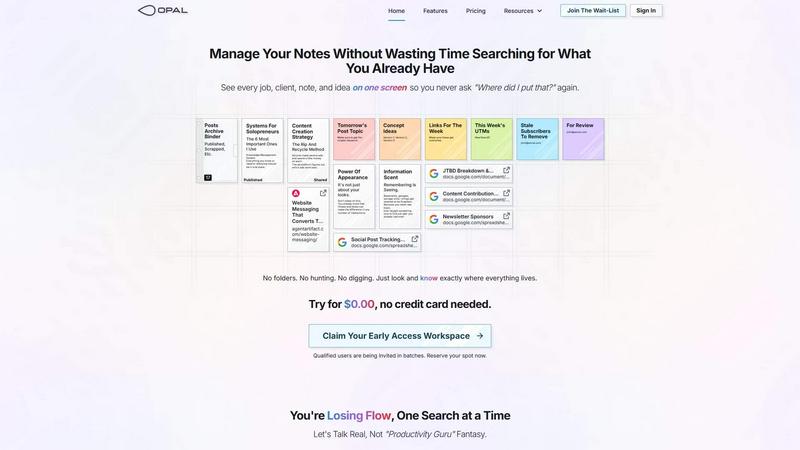
About Opal
Opal is a next-generation visual knowledge and project management workspace engineered for professionals whose cognitive workflows are inherently spatial. It directly addresses the critical inefficiency of information retrieval in traditional, hierarchical tools like Google Docs or Notion, where valuable data becomes buried in nested folders and dashboards, leading to lost time and broken focus. Opal provides an infinite, zoomable digital canvas that functions like a physical desk, allowing users to visually place, group, and organize notes, documents, files, and links. This leverages spatial memory—the brain's innate ability to remember where information is located—transforming retrieval from a search-based hunt into an instant, glanceable process. Built for solopreneurs, consultants, agency owners, writers, and creators, Opal integrates seamlessly into a modern tech stack to keep all active projects, client details, strategic notes, and creative ideas persistently visible. By eliminating the need to context-switch and search, Opal ensures your core business assets remain top-of-mind, enabling you to maintain deep workflow states and execute your best work without friction or data loss.
Features of Opal
Infinite Visual Canvas
Opal's core is an unbounded, zoomable workspace that rejects traditional folder hierarchies. This digital whiteboard allows you to spatially arrange every element of your work—client notes, project briefs, reference links, and multimedia files—just as you would physically lay out documents on a desk. This visual organization creates a cognitive map, making information retrieval intuitive and instantaneous, as you remember locations rather than filenames.
Drag-and-Drop Spatial Organization
The platform's entire interface is built around intuitive drag-and-drop functionality. You can freely move, group, stack, and connect notes and documents to create a workspace layout that mirrors your mental model. This flexibility supports various organizational styles, from kanban-like project lanes to thematic clusters, ensuring the tool adapts to your brain, not the other way around.
Multi-Element Side-by-Side Viewing
Opal enables true parallel processing by allowing you to open and view multiple notes, documents, and links simultaneously within the same canvas view, limited only by your screen real estate. This is critical for tasks like referencing a client brief while writing content, comparing strategy documents, or synthesizing information from several sources without tab-switching fatigue.
Direct Integration with Cloud Docs & Links
Opal acts as a unified visual layer atop your existing tech stack. You can embed live previews and create direct links to files from Google Docs, Sheets, presentations, and other web-based resources. This turns Opal into a central command center, aggregating scattered assets into a single, coherent visual landscape without needing to migrate data.
Use Cases of Opal
Client and Project Management for Agencies
Consultants and agency owners can dedicate canvas zones to each client, visually grouping all related communication, contracts, creative briefs, asset links, and meeting notes. This spatial setup ensures every client's entire context is one glance away, drastically reducing prep time for meetings and preventing critical details from slipping through the cracks between projects.
Content Planning and Production Workflow
Writers and content creators can map out entire editorial calendars on the canvas. You can spatially cluster topic ideas, draft documents, keyword research, published links, and promotion schedules. This visual pipeline makes it easy to track content stages, repurpose ideas, and maintain a clear overview of your publishing strategy without toggling between multiple apps.
Solopreneur Business Operating System
For solo founders, Opal serves as a complete external brain. You can consolidate business systems—like SOPs, financial tracking sheets, pitch decks, subscriber lists, and task backlogs—onto one persistent canvas. This visibility ensures operational knowledge is always accessible, turning the workspace into a resilient business continuity system that survives beyond memory.
Strategic Research and Knowledge Synthesis
Researchers and strategists can use the canvas to collect articles, data sources, interview transcripts, and visual inspiration. By spatially arranging these elements, you can identify patterns, draw connections, and synthesize insights visually. This method fosters deeper understanding and ideation compared to linear documents stored in closed folders.
Frequently Asked Questions
How is Opal different from note-taking apps like Notion or Evernote?
While traditional apps are built on databases and nested pages, forcing information into a hierarchical, out-of-sight structure, Opal is built on a spatial, infinite canvas. The difference is between filing information (which you forget) and placing it (which you remember visually). Opal prioritizes persistent visibility and location-based memory, reducing search time to zero.
Can I collaborate with my team in an Opal workspace?
Opal is primarily architected as a powerful personal knowledge and project management environment, focusing on deep individual workflow integration. Its strength lies in being your visual command center. Team collaboration is best handled by linking to and from dedicated collaborative documents (like Google Workspace) that are placed and managed within your personal Opal canvas.
What kind of files and content can I bring into Opal?
Opal is designed to be the connective layer for your digital work. You can create text notes directly and, more powerfully, embed and link to a wide array of external content. This includes live links to Google Docs, Sheets, Slides, PDFs, websites, image files, and video links. It aggregates and visually organizes your existing cloud-based tech stack.
Is there a risk of the canvas becoming visually cluttered?
The infinite canvas is designed for intentional organization. You have complete control to zoom out for a high-level map of your projects or zoom in to focus on a specific cluster. The spatial layout allows you to create clear zones and groupings that make sense to you, preventing clutter in a way that a single, linear list or a buried folder cannot.
Similar to Opal

A notepad calculator that reads plain text and gives instant answers as you type, free on Mac, iOS, Windows, Linux, Android and Web.

AI Email Filter sorts incoming mail into folders using plain-language prompts you write. Works with any IMAP mailbox; bring your own LLM if you want.

No-code 2D game editor: visual node logic, drag-and-drop scenes, live preview. Exports to Windows, macOS, Linux, Android, iOS, Web.

Free collection of online developer utilities, code formatters, and digital converters designed to streamline your daily workflow.

Online tally counter for tracking attendance, workouts, inventory, visitors, sports scores, habits, and everyday counting tasks.

The #1 Native Form Builder Plugin for Framer - No Code, No Embeds, No External Platforms.

A free launch checklist for SaaS, apps, AI tools and more. Every step says why it matters and when you can skip it.
